A Tail and a Tale: Bob Can Talk His Way Out of Anything

There’s a lot of wildlife we don’t see. The Rio Grande is low right now, making it easy to cross from the empty desert land on the other side. Tracks in the mud from recent rain showed small hooves trotting around on the mesa near Healing Waters Trail where I was running. I’ve never seen a javelina up there, but those were their little pointy feet. No surprise. We expect them around here. A friend sometimes has them in her yard.

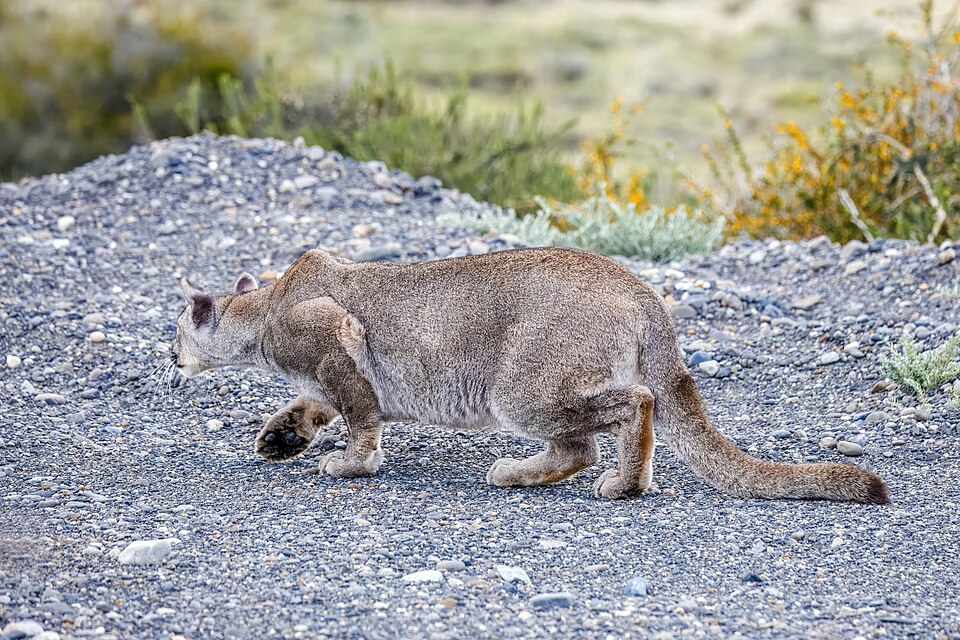
But I never expected to encounter a mountain lion. Its tail was toward me and it was sniffing the ground on the far end of the trail where it gets narrow and steep near the Veterans’ Home—my destination—so I didn’t get a good look at its head. I didn’t need to. Nothing else is that big, that color, and has a tail like that.

About a year ago, my friend Bob told me he’d looked out his window at night and seen a mountain lion. His bedroom window faces the mesa, not the rest of the Veterans’ Home campus. I detoured away from the animal and took an alternate route to go visit Bob. I told him about the sighting. Of course, he had a story.

He was much younger, hiking alone in upstate New York. He loved the woods and often spent hours exploring, but this was the only time he met a mountain lion. They met suddenly, practically face to face, and close enough that the cat could have reached him in a few bounds. Bob didn’t want to back away and look like prey, and he knew better than to approach. Feeling stuck, he improvised. He took his knife from his belt, held it up, and started talking.

“I know you probably want to eat me for lunch, and you could take me if you tried, but I’m warning you, you’re gonna get very scratched up in the process.”

The cat didn’t move, so Bob kept talking. It looked at him as if it was taking in every word. Finally, he took a step back, still holding the knife. Then another slow step. And they went their separate ways.


A New Mexico Mystery Review: Shutter by Ramona Emerson

Unique, breathtaking, intense—and somehow occasionally funny in the midst of tragedy and horror—Shutter is one of the most original books I’ve read in years. Forensic photographer Rita Todacheene is gifted with not only skill in her work but with a spirit world connection. The gift is a burden, provoking concern and conflict in her family and in her workplace and creating profound stress in her personal life, but the ghosts will not leave her alone.

The structure of the book, alternating between Rita’s earlier life on the Navajo  reservation and her work with the Albuquerque Police Department, gives depth and balance to the story. As a reader, I needed the reprieve from the APD. I cherished the time with Grandma, and got to know Rita through her roots, seeing the person she was before she became immersed in some of the ugliest murders in the city.

And those murders are horrific. Normally, I’d have struggled had get through the crime scenes, but Rita’s perspective made them compelling—seeing them through her eyes, through her lens, through her commitment to the dead. The reader can’t look away because Rita can’t. Neither her job nor the victims will let her.

I’ve only seen a ghost once. She chilled me to the bone. At least she went away and never came back. Rita’s ghosts linger, cling, persist, and return. Some are angry and desperate; some are benevolent. They can see her and communicate with her. Emerson makes them as real as the living characters.

I admire her writing skill. She doesn’t explain but allows readers to intuit through immersion. I never sensed Rita talking to an audience in the narration, though it’s first person. There’s a brush with the confrontation-and-confession trope, but it’s short and does no harm to the pace or to the plausibility of the moment. I felt that Rita wasn’t really a smoker, that this habit might have been an afterthought in some stage of revision in order to put her in the right place at the right time, but her flawed coping skills overall make her human and make her surges of strength all the more admirable.

If you appreciate a realistic crime story, a powerful ghost story, and an authentic New Mexico setting, this is your book.

Learn more about the author in this NPR archive interview.


Undefeated, the flowers came back.


Perhaps you remember my post about a man squirting weedkiller on unwanted plants. He explained that if they weren’t eradicated, they would take over. I’m happy to report they have done exactly that—only a few weeks after their apparent demise. Welcome back!

A New Mexico Mystery Review: Jemez Spring by Rudolfo Anaya

I wish I could say that Jemez Spring was as good as the rest of the series, but it’s not. I had to finish it because it wraps up the Sonny Baca series, but it doesn’t do the story cycle justice. Even Sonny himself is not as strong a character. He becomes something between a caricature and an archetype. I almost stopped reading early on, when Sonny—a private investigator—and a police detective are in the presence of the murder victim who died in a hot spring bath at Jemez Springs, and they derisively discuss the size of the dead man’s penis. At that point, I no longer liked Sonny. I thought, why is this episode here?

His girlfriend, Rita, was always simply an archetypal female ideal with no depth. None of the women in this book have any dimensionality except Naomi, the Jemez Pueblo potter. She has a personality. She’s original. I love it when she gets in Sonny’s truck and says, “You got spirits in this truck?” (One of the strongest characters is the ghost of Sonny’s late neighbor don Eliseo, riding in Sonny’s truck and giving him advice.) But like other women in the book, Naomi is an object of desire. The power players are all men, unless I slept through a scene that breaks that pattern

Between each important event, there are often three pages of digression on New Mexico politics, history, culture, and food, beautiful descriptions of the land, excessive backstory, discussions of whether or not dogs dream, and reflections on mythology. These side trips are masterful word craft and some could make good essays collected outside of a novel, but keeping track of the plot took patience.

The final confrontation between Sonny and Raven is in an intriguing setting and has some mystical moments, but it’s also full of philosophical discussion at a point when it deflates the tension instead of escalating it.

The outcome of the ongoing threat with the bomb made me feel as if the author had written himself into a corner and couldn’t get out of it, so he wrote it away into a trick. That’s almost as bad as “it was all a dream.”  I found flashes of delight in certain settings, good lines, and the few good characters, like the Green Indians, but I’m still disappointed in this work by an author whose books I normally love.


Disobeying Orders

The state park employee walked slowly with a small tank and a squirt nozzle he aimed onto each unwanted bit of vegetation on the playground. I hoped he was only getting rid of silver nightshade. It’s prickly and toxic, though it has pretty flowers. But there wasn’t much of it. There were many tiny, tough yellow flowers.

I asked the man with the tank how he chose which plants got to stay and which plants had to go.

“They all have to go,” he replied.

All of them? I like the little yellow flowers. I just watered one of them.” Encouraging its survival in the desert heat, I’d given it what was left in the water bottle I take on runs.

With an air of apology, he added, “We don’t do weed control except in the developed areas.”

Of course not, because a wildflower isn’t a weed in the wild. I didn’t say what I thought, but he kept explaining while he squirted. “If we let them go, they take over.”

“Yes. You’d have a meadow.” I smiled at the memory. One year, the flowers did take over. There were so many, I sometimes accidentally picked them with my five-fingers running shoes, snagging yellow blossoms between the toes when I crossed the playground to stretch on the equipment.

He kept squirting. I felt sad for the flowers, but finished stretching and went home. A few days later, I was back, and all the flowers were gone, sprayed to death and shriveled away. Except one. He saved the one I’d watered.


Book Ten Progress Report

I’ve been so busy writing the next book that I’ve neglected to write any blog posts. So, what have I accomplished?

I finished the first draft of Mae Martin Book 10 and have completed the first stage of revision—reading without making changes yet, taking notes as if I were critiquing for another writer. This is challenging. I see things I want to change right away, but why fix it if I might end up cutting it?

I grasped the importance of a theme I had doubts about I while I was writing, a theme relating to Mae, to Jamie, and non-ordinary spiritual experiences. It’s funny, but writing a paranormal mystery series, I sometimes pull back and ask myself, “Was that too paranormal?” But then I read through the work in progress and think, “That’s the best part.”

The book doesn’t have a title yet, but I’m leaning toward Wounded Healer. Here’s my first draft of the blurb:

Birdwatching, blackmail, and out-of-body travel.

A letter from Nashville gives Mae Martin hope that it’s safe to recover her psychic gift. The healing process is precarious and strange, but it’s also urgent. A friend’s two elderly dogs are lost, and another friend’s former lover has vanished. Spirit medium Azure Skye hasn’t seen her son’s father for twenty-one years. Then she hears his voice. Only the dead speak to her that way.

To learn his fate, Mae pushes her limits as a healer and seer, entering aspects of the spirit world she never knew existed—some beautiful, some dangerous. Will she find the missing man alive? What will his enemies do to stop her? And what will the effort cost?

*****

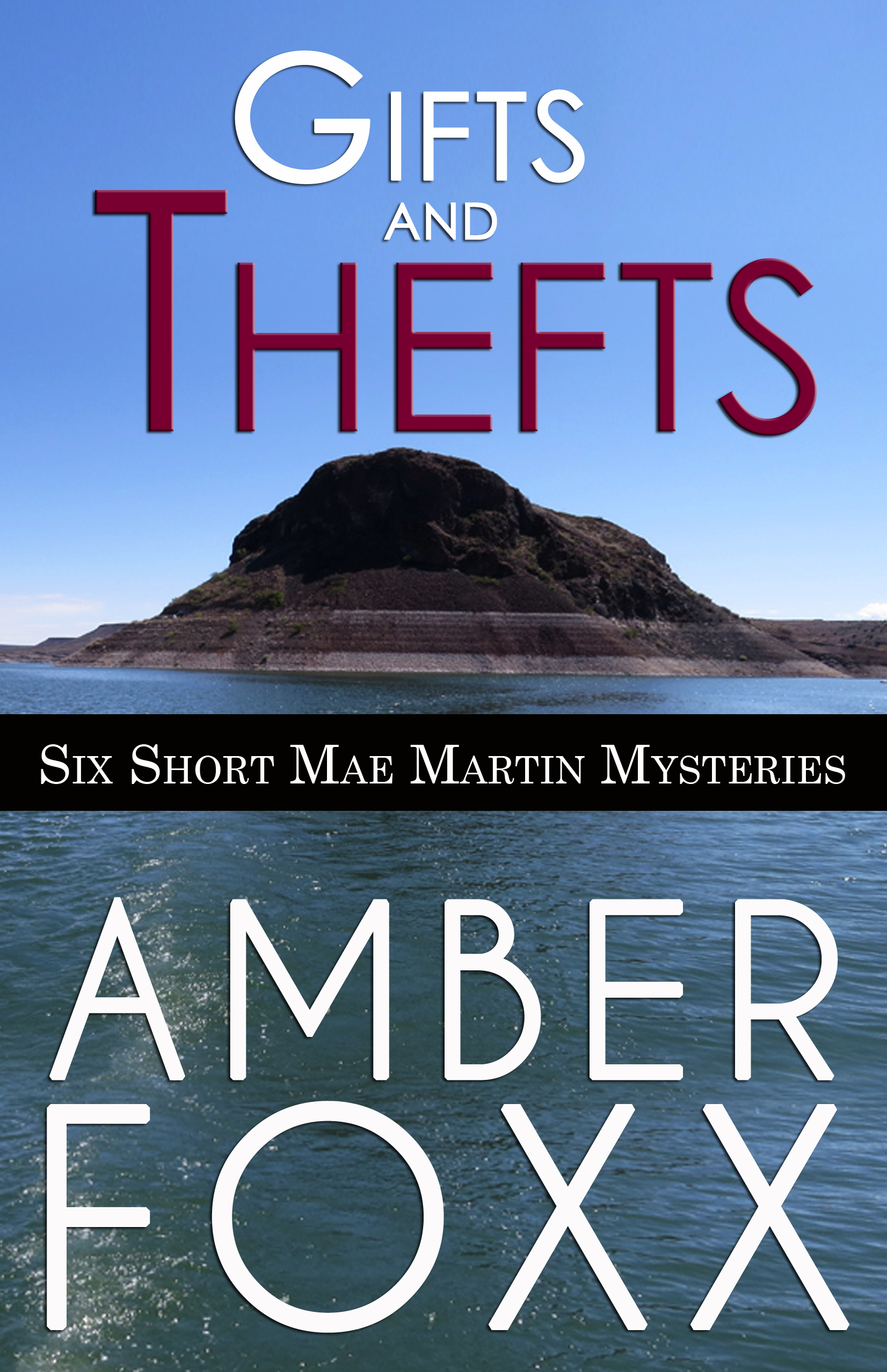
Prices on the whole series remain low on all e-book retailers. The Calling and Gifts and Thefts are $2.99 each, and the other books $3.99.

A New Mexico Movie Review: Eddington

“Are you on Team Joe or Team Ted?” asked the person at the swag table after the Truth or Consequences premier screening of the movie, Eddington on July 10, 2025. I picked a “Ted Garcia for Mayor” button. Given the choice, I’d have voted for him over Sheriff Joe Cross, but I was really on a third team.

If this movie were a mystery, the person solving it would have been the Pueblo cop who wasn’t minding his own business, who was encroaching on the sheriff’s territory because a crime took place on the border between Sevilla County and San Lupe Pueblo. (Both fictitious locations, FYI.)  He would have been the protagonist. I was rooting for him as the person figuring it out, observing who is acting suspiciously, and what circumstances suggest that people aren’t telling the truth, but the story is not told as a mystery. He’s actually part of the Western movie tradition of conflict with Native Americans. He’s trouble for the sheriff.

Eddington is a modern dystopian Western. Or maybe an anti-Western, turning the genre on its head. It’s primarily in the points of view of the sheriff and the mayor, political rivals who have different visions for the town and its future, and they disagree about how to cope with COVID. The mayor is enforcing the strict approach to COVID taken in New Mexico in the spring of 2020: mask mandates, no large gatherings, keeping your six-foot distance, and limiting the number of customers inside stores at one time. However, the sheriff has asthma and hates wearing a mask. The trouble begins in T or C’s real grocery store, Bullock’s. Sheriff Joe Cross defies the mask mandate on behalf of an elderly man who says he can’t breathe in a mask. Cross  goes into the store unmasked and buys groceries for the guy. The sheriff can get away with it. He hands him the groceries and doesn’t ask him to repay, making him both a law breaker and a compassionate guy.

When you think of the sheriff in a western he’s usually a tough guy. Sometimes corrupt, sometimes heroic, but tough. This sheriff is too, in some ways, but unlike the stereotypical version of the role, he wears glasses, needs to carry his inhaler around, and has problems in his marriage. Joaquin Phoenix is brilliant as Sheriff Joe Cross. (Perhaps getting out and about in T or C as much as he did helped him in his portrayal of the sheriff in a small New Mexico town.) Pedro Pascal’s portrayal of Mayor Ted Garcia is more restrained and equally powerful. Emma Stone plays the fragile and damaged Lou Cross, the sheriff’s wife, a new take on the Western trope of the woman with a past. Her conspiracy theorist mother is a 21st century addition to the genre cast of characters. The self-healing pseudo guru Lou and her mother follow is a new variation on the itinerant preacher and/or snake oil huckster of the old West.

Eddington also presents 21st century takes on the genre tropes of the bar fight, the stand-off, the big shootout, and the evil outsiders coming to town.

The conspiracy theory aspect of the pandemic is portrayed quite realistically, and the presence of phone and laptop screens gets appropriately oppressive. Toward the end, one of the secondary characters, a teenage boy, changes radically. His transformation is shown on a phone screen, as if the person he becomes exists only as seen through this medium.

One of the film’s themes is “you’re being manipulated.”  Notably, Joe Cross can’t spell it correctly; his campaign signs say “your being manipulated.”

Ari Aster, the director, was at the El Cortez theater to speak to the crew, who made up half the audience, about how wonderful they’d been to work with, and to tell the townspeople present how much he loved working in T or C. He seemed humble and not terribly comfortable speaking in public. I didn’t get a chance to talk with him after the movie, though some friends did. I would have liked to ask him how much the town influenced the final script. Did he see our water tower with Apaches on horseback painted on it and then decide that a scene on that hill would be perfect? I also wonder if Aster was inspired by our museum. When the sheriff crashes his way through it in extreme duress in the middle of the night, he’s scrambling through exhibits of the history of this area and coming out the actual exit, which is an old miner’s cabin. Rushing through the history of the West and coming out the other side.

Other strengths of the movie are the complexities of relationships, the absurdities of the political campaigns, the corruption, the deception, and the COVID realism. (I don’t know that this detail even shows in the movie, but they had signs on Bullock’s announcing toilet paper back in stock, with limit of a certain number per customer.)

Garcia’s bar, created for the movie in an old antique store long out of business, reopened for us after the screening, serving non-alcoholic drinks. There was a drone show out over the river, hundreds of drones lighting up with the logo of the production company A24, the name of the big bad tech company in the movie, and a 3D New Mexico Zia symbol accompanying the words Eddington, New Mexico. The town we will perhaps always be, at some level. Our Geronimo Springs Museum now has an Eddington Room, a permanent exhibit. I recommend the movie. It’s thought-provoking. Ambiguous. Ambitious. And it’s ours.

*****

For a look at the town when it was a film set, see my post from last year, None of These Places Are Real.


A New Mexico Mystery Review: The Pot Thief Who Studied Calvin

Like all Pot Thief mysteries, this one is unconventional, entertaining, and educational, with historical and philosophical explorations as well as a mysterious little pot and a sudden death, perhaps a murder. These ingredients are blended and seasoned with insight and humor. If you’re a series fan, you’ll enjoy a reunion with the usual characters as well as another trip to the village of La Reina. It was good to spend more time in Old Town Albuquerque and in Hubie’s shop. As usual, his personal life gets a good share of the story’s pages, as you’d want when catching up with an old friend. After all, he’s a person, not just the person solving a mystery. (Actually, he’s part of a team solving the mystery.)

The solution left me puzzled and questioning. Was this supposed to be like King Solomon and the case of the two women claiming the same baby? Was the reader meant to still be sorting it out, or was the reader supposed to get some hints? I am so bad at getting hints. Nonetheless, I loved the ending. It left me with a smile.

Bob Stories: A Cup of Coffee at the DMZ

Bob told me this story as he enjoyed a fresh cup of hot black coffee on the patio at the New Mexico State Veterans Home on a ninety-nine-degree day. In the shade. the weather wasn’t bad—dry heat really is quite tolerable—and his coffee stayed hot. Bob loves coffee, and it has to be strong, hot, and black. According to him “there’s no such thing as strong coffee, only weak people.” His favorite beverage led to the story of a welcome cup seventy years ago.

Bob remained in Korea after the armistice. He liked the country and preferred to be there rather than go back to a base in California. On a rainy night, he was one of the men on lookout duty at the edge of the DMZ, lying under some sort of waterproof shelter with his rifle at ready. Rain dripped from a tree nearby, but it just missed him. The ground was rough, “not a place where you would go out for a stroll.” They had to hold still and stay alert “in case hell broke loose.”

One of his fellow Marines was sent out with fresh, hot coffee, not a job the guy delivering it liked, since he had to get wet. Bob was so grateful, though. He found a place in his shelter where the coffee could sit on a rock right within reach, protected by another rock, so the rain wouldn’t get in to cool or dilute the coffee. And then the wind blew a dribbling tree branch directly onto it.

The man who’d been bringing the coffee around came back to check on Bob.

Bob indicated the branch. “Can you do something about this?”

“Better yet. I’ll bring you a fresh cup of coffee.”


A New Mexico History Review: The Villista Prisoners by James W. Hurst

The great strength of this book is its emphasis on the ordinary people involved in the international incident at Columbus, New Mexico in 1916. The book is not about Pancho Villa. It’s not about General Pershing. It’s about the men who were captured during Villa’s raid on the small town on the border of New Mexico and Old Mexico. One of the Villistas captured was a twelve-year-old boy. Their stories—how they came to be in Villa’s army, whether or not they knew they were in the United States, whether they wanted to be doing what they were doing—were matters of controversy at the time.

The author is an excellent historical detective, learning everything about these men that he could. Many of were illiterate conscripts who had been forced into Villa’s army; others had joined because they feared the army of his opponent, Mexican President Carranza. They didn’t want to be at war at all, though, and this issue came up in their trials, as did other questions Could the governor of New Mexico pardon them? Shouldn’t unwilling, illiterate conscripts be considered innocent? But there was a precedent set in both the United States and in Scotland that a soldier who follows an illegal order is still guilty of a crime.

I will not tell you how everything turned out them through the twists and turns of their of their trials. The book starts with the raid, not from the point of view of the leaders, but of the town’s people. And it ends with the fate of equally ordinary people entangled in international and national matters. I recommend this book if you have an interest in history and like to understand not only what happened and why, but who was involved and how they were affected.