
No murder, just mystery. Book two in the Mae Martin Psychic Mystery series is 99 cents in all eBook stores through the end of January. The book that brings Mae to New Mexico!
The Calling
The first Mae Martin psychic mystery
When an extraordinary ability intrudes on an ordinary life, ready or not, everything changes.
A down-to-earth North Carolina country girl, Mae Martin-Ridley Mae is a former high school athlete whose interests run to sports and fitness, not spirituality or mysticism. The last thing she ever expected to be was a psychic or a spiritual healer. Obeying her mother’s warning, Mae has been hiding her gift of “the sight” for years. When events compel her to use it again, the unforeseen consequences spread to affect every aspect of her life—work, marriage, and family. To qualify for a new job Mae takes a class in Norfolk, Virginia, where she meets people who not only accept her abilities but push her to explore them further. She struggles with the shadow side of her gift. Though she wants to use “the sight” to help people, it gives her access to secrets she could regret uncovering. Torn between those around her who encourage her and those who condemn or doubt, Mae has to find her own path.
No murder, just mystery.Book two in the Mae Martin Psychic Mystery series is 99 cents in all eBook stores through the end of January. The book that brings Mae to New Mexico!

I’m letting the ninth Mae Martin Mystery rest a while, though I’ll be back to work on it soon. I’m taking an intensive course on revision and self-editing. Even after ten years as a published author, I can learn and improve. Meanwhile, I’ve begun the first draft of the first book in a spin-off series featuring Azure Skye, the Santa Fe medium who plays an important role in Soul Loss and in Shadow Family. 
The creative challenges are exciting. The kind of mystery Azure will solve is different from the ones Mae is asked to handle as a psychic. Azure’s gift is communication with the dead. I’m disinclined to have her solve murders, but the question of how someone died has already come up. So far, it looks like Azure and Mae will need to collaborate to find the answer. Of course, I’m only on chapter two, and I don’t plot. I put the characters in a difficult situation and see how they react. Azure is in a situation only Mae can help her out of, and Mae has a problem she hopes Azure can solve.
The biggest challenge for me is that Azure wants to speak in the first person. I didn’t plan that she would, but that’s how she’s coming through.
Three of my novels use only Mae’s point of view, but I still had certain freedoms. I used prologues and epilogues in other points of view in two of those books. Mae’s visions as a psychic revealed events in in the restricted point of view of a silent witness. First person is the opposite of that. It gives me too much information to work with. I have to hold back some of what Azure knows, thinks, feels, and recalls about her past, her work, and the people close to her, in order to keep the story flowing. But I can share her inner life at the right moments more easily, since I never get outside her head.
Will I stick with first person or change to close third? I don’t know. For now, I’m getting to know Azure this way, like an actor exploring a role. Then I’ll have to set her story aside for about six weeks while I work on Mae’s most recent story in the revision class. Once that’s polished enough to send to my critique partners, I’ll plunge back into the spin-off.
*****
Book two in the Mae Martin series, Shaman’s Blues, is on sale for 99 cents in all eBook stores though the end of January.
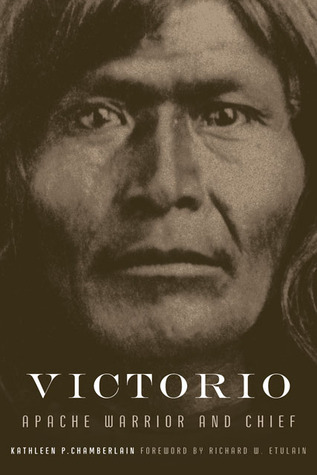
I once said—meaning to make a respectful acknowledgement to an Apache friend—that Truth or Consequences, the town where I live “used to be Apache land.” He replied, “It still is.”
Yes.
It still is.
*****
Living in New Mexico, a state with more tribal lands than most, I’m aware of the Indigenous cultures that thrive here. Reading this book made me far more aware of how the rest of us got here—the complexity of the fighting, negotiation, and politics. Geronimo is famous. A mural of his face greets you with a powerful glare as you drive into town. Victorio is less well known. His younger sister, the warrior and seer Lozen, may have more fame. But his story is worth reading. New Mexico’s story is incomplete without him.
The author did extraordinary historical detective work to reconstruct his life and the events that led to his death, his final battle. She explores Apache culture and pre-reservation life, and reveals the misunderstandings, failures, sincere efforts, and also the insensitive ignorance on the part of various agents of the U.S. and Mexican governments that drove Victorio’s band from their sacred land and its springs and drove them to keep fighting. Chamberlain’s analysis of the Apache wars is insightful.
This isn’t light reading, but it’s not dry or difficult, either. History can be a page-turner, even when you know how it ends.
I left this link out of the post about my holiday sale price on multiple paperbacks: https://amberfoxxmysteries.com/buy-paperbacks-direct/
The post has now been updated.
I don’t normally think about the holidays this early. I’m stunned to see that the neighbors two doors down have strings of red lights in their front window, and that the city has wrapped fake spruce branches around the light poles in the plaza as well as tiny white lights around the trunks of the palm trees. I hope this doesn’t herald the return of the inflatable snowmen. I confess I don’t understand the custom of pretending to be northern for winter holidays, when we have perfect winters here. Perfect meaning no snow.
I will be happy to head off to the post office on one of those sixty-degree sunny days with orders of books. I have to mention it this early because book rate is a tad slower than other options, and I include shipping in the price because book rate is inexpensive. Order one book at full price and get a dollar off other books in the same shipment. If you’re buying the whole Mae Martin Series, that would add up.
This offer goes through Dec. 8th.
I am now selling my paperbacks on my web site, where they’re priced the same as they were on Amazon, but my price includes tax and shipping. You don’t have to buy extra stuff to get free shipping (or pay to be in Prime). For $16.99 or $10.99, you get the book. Signed, if you like. The books are also available in some in small, independent shops.
Here’s why I took them off Amazon:
Amazon has been manipulating paperback prices in order to lower eBook royalties.
After I ran a hugely successful first-in-series free promotion of the eBook of The Calling, Amazon discounted the paperback of book two, Shamans’ Blues,  so steeply that they could discount the eBook. They pay full royalties on the paperback no matter how low the price, but if they “price match” the eBook to the paperback, they reduce the royalties on the eBook. That’s their rule. I did everything I could to fight it, but with no success. The eBook should have been $4.99 and the paperback $16.99, the same prices as the rest of the series, but Amazon dropped both to $3.49—below printing costs—and kept it that way for over a year. Like most indie authors, I sell primarily eBooks. Therefore, I lost significant royalties on sales of book two. I didn’t sell tons of cheap paperbacks. Readers saw both at the same price and still bought the eBook. Amazon’s price also made me feel obligated to keep the eBook at a lower price on other online stores, so customers there wouldn’t be unhappy about paying more. Book eight, Chloride Canyon came down to $4.88, and I had no ability to stop Amazon from lowering it even more and discounting the eBook as long as my paperbacks were on their site. Taking the paperbacks off Amazon was the only way I could get back control of eBook pricing. My one-woman strike for fair pay.
Amazon has been lowering paperback prices to make you buy more stuff in order to get free shipping while undercutting independent stores that can’t afford to discount a book below what they paid for it. I believe in supporting small businesses. They keep local downtowns and communities alive.
I expect I will publish paperbacks again through another print-on-demand printer in a year or so when the next book comes out or when my stock of books is depleted. However, because most of my books are long, the price of all that paper makes them more expensive to sell on any site that isn’t also the printer (like KDP print on Amazon). So, books from D2D Print or Ingram will cost more.
Or I may do a brief republication on KDP to make them less expensive, restock to sell direct, hope to dodge the price-match hassle, and unpublish again.
Of course, you can look for used copies of my work wherever you buy used books.
And a few new paperbacks may remain on Amazon, though not for long. After I thought I’d wrapped everything up and ended the chance of another $3.49 problem, they sent this message:
“Upon investigation, I see that your Paperback Book “The Calling”, currently has 1 copy still in Amazon’s inventory. I also see your Paperback Book “Shaman’s Blues” has 3 copies, the Paperback Book “Gifts and Thefts” has 1 copy and the Paperback Book “Small Awakenings” also has 1 copy left in Amazon’s inventory. If you’d like to clear out Amazon’s inventory, you could order those copies.”
Is that a good ending for this chapter?
I finished the second draft of the ninth Mae Martin Mystery. It took two drafts to find out who was the real “villain” was and why they acted as they did. Now I’m reading through the book and taking notes on what works, what needs to be changed, and what might be okay to cut. I find this stage of the revision process absorbing and challenging. I have to get creative within the existing framework and pay even closer attention to my characters’ inner workings. When a scene needs alteration, it’s often because I made someone do what they really wouldn’t do. I’m critiquing and analyzing my book in progress, but the characters are guiding me through it.

Shop for discounted e-books by author, by genre, or by price in the Smashwords Store.
My books are 25% off, which really adds up if you’re buying the whole series. Use this page to find Mae Martin Series the series in order, and click on the Smashwords links.
The sale runs through the end of July.

When I found pictures of the stairway descending from the mesa at Acoma, I recognized an image I used in Ghost Sickness,  the fifth Mae Martin mystery, and looked for the scene that featured it. In my search for the word “stair,” I assumed I would find the gallery scene with the paintings of the stairway.

I found it, but first, I discovered a connection I hadn’t consciously created. A major character in the book, Acoma Pueblo artist Florencia Mirabal, left her family—one of the last families to live on the high mesa—and eventually settled in Truth or Consequences. For Florencia’s house in T or C, I selected the one that is, like Acoma Pueblo, perched up high, with an extraordinary view … and a stairway. Writing the book, I was unaware of the parallels.
Mae pulled the truck into the weedy patch of dirt that qualified as a side yard, drawing near to the porch’s side steps. The front steps led to a long, winding set of stone stairs set into a steep cliff, giving the little house the feeling of a castle. On their way in, she and Niall paused on the porch, looking down at Main Street and the view of the Rio Grande and Turtleback Mountain beyond the town.
Mae said, “This is such a perfect place for an artist to live. It must have been hard for her to leave.”
Then, I found the scenes featuring Florencia’s stairway paintings.
Much of the mystery centers around Florencia’s art and her separation from her family. I knew I was writing that part. But I didn’t realize how her choice of a home reflected the one she left but never let go of in her paintings. And since I didn’t realize it, I think it was her choice, not mine.
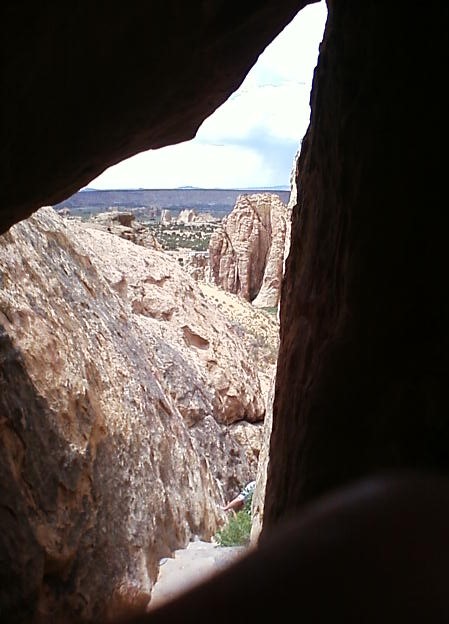
The view from the stairway

My sister called it a Barbie phone. It’s tiny and pink, circa 2009. I used it through 2019. I’d given no thought to the pictures on it for years, and had never downloaded them while it was my working phone, so I’m not sure why I finally did—but I’m glad I did. On it, I found pictures of Truth or Consequences and Santa Fe in the years during which my books are set. The work in progress, book nine, takes place in 2013.
When I took these photos, I was collecting material for my books. I chose the settings through Mae Martin’s eyes, her delight and awe in discovering New Mexico, and the feeling of deep change and emergence that her new home gives her.

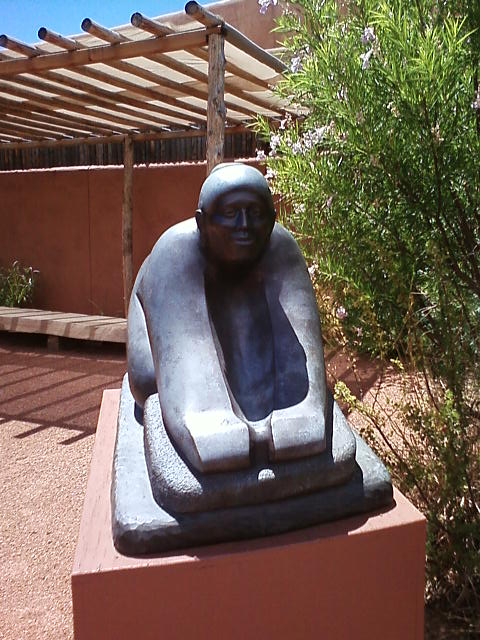
In Shaman’s Blues, Mae is often struck by the intensity of the light in Santa Fe. Encounters with outdoor art trigger key moments for her, for Jamie, and for the boy Jamie tried to help.

The nearly-dry Santa Fe River plays an important role, as does the image of the Lady of Guadalupe. I took a picture of this blue door in Santa Fe one year, and the next year the Lady had been painted on it.
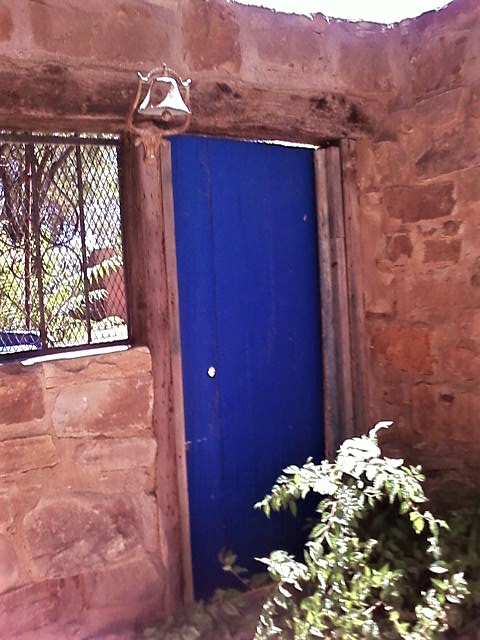
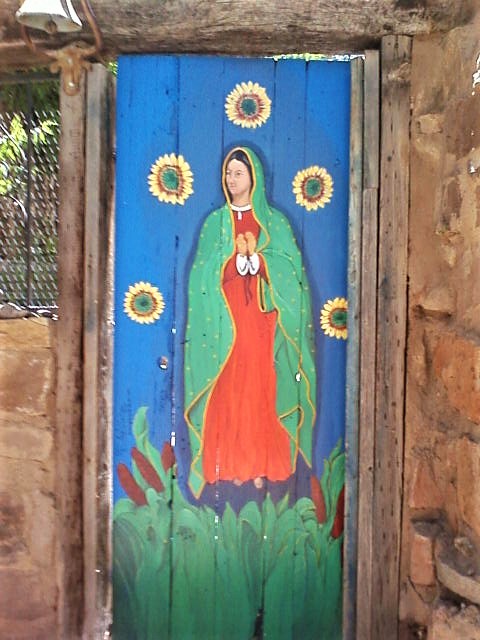
As I look at the colors in my old pictures, the book’s title echoes them. Blues.

I’ve also photographed settings that had meaning to other characters or played roles in later books, and will share some in future posts.
Shining a small, bright light in a wilderness of writing scams
scribbler
P H O T O G
Living and Writing in the great state of Maine
the Mae Martin psychic mystery series
An Iyengar Yoga blog
a journal
In a different light: my view of the world.
Merging into the divine sound form that is beyond time, space, and matter
visionary author
Expanding Human Consciousness
middle of the night musings
author & editor
A music blog written by Rich Brown
Explorations in contemplative writing
Nancy Adams' blog
 Amber Foxx Mysteries