
No murder, just mystery. Book two in the Mae Martin Psychic Mystery series is 99 cents in all eBook stores through the end of January. The book that brings Mae to New Mexico!
Reviews and Author Interviews
No murder, just mystery.Book two in the Mae Martin Psychic Mystery series is 99 cents in all eBook stores through the end of January. The book that brings Mae to New Mexico!

I’m letting the ninth Mae Martin Mystery rest a while, though I’ll be back to work on it soon. I’m taking an intensive course on revision and self-editing. Even after ten years as a published author, I can learn and improve. Meanwhile, I’ve begun the first draft of the first book in a spin-off series featuring Azure Skye, the Santa Fe medium who plays an important role in Soul Loss and in Shadow Family. 
The creative challenges are exciting. The kind of mystery Azure will solve is different from the ones Mae is asked to handle as a psychic. Azure’s gift is communication with the dead. I’m disinclined to have her solve murders, but the question of how someone died has already come up. So far, it looks like Azure and Mae will need to collaborate to find the answer. Of course, I’m only on chapter two, and I don’t plot. I put the characters in a difficult situation and see how they react. Azure is in a situation only Mae can help her out of, and Mae has a problem she hopes Azure can solve.
The biggest challenge for me is that Azure wants to speak in the first person. I didn’t plan that she would, but that’s how she’s coming through.
Three of my novels use only Mae’s point of view, but I still had certain freedoms. I used prologues and epilogues in other points of view in two of those books. Mae’s visions as a psychic revealed events in in the restricted point of view of a silent witness. First person is the opposite of that. It gives me too much information to work with. I have to hold back some of what Azure knows, thinks, feels, and recalls about her past, her work, and the people close to her, in order to keep the story flowing. But I can share her inner life at the right moments more easily, since I never get outside her head.
Will I stick with first person or change to close third? I don’t know. For now, I’m getting to know Azure this way, like an actor exploring a role. Then I’ll have to set her story aside for about six weeks while I work on Mae’s most recent story in the revision class. Once that’s polished enough to send to my critique partners, I’ll plunge back into the spin-off.
*****
Book two in the Mae Martin series, Shaman’s Blues, is on sale for 99 cents in all eBook stores though the end of January.
I finished the second draft of the ninth Mae Martin Mystery. It took two drafts to find out who was the real “villain” was and why they acted as they did. Now I’m reading through the book and taking notes on what works, what needs to be changed, and what might be okay to cut. I find this stage of the revision process absorbing and challenging. I have to get creative within the existing framework and pay even closer attention to my characters’ inner workings. When a scene needs alteration, it’s often because I made someone do what they really wouldn’t do. I’m critiquing and analyzing my book in progress, but the characters are guiding me through it.

When I found pictures of the stairway descending from the mesa at Acoma, I recognized an image I used in Ghost Sickness,  the fifth Mae Martin mystery, and looked for the scene that featured it. In my search for the word “stair,” I assumed I would find the gallery scene with the paintings of the stairway.

I found it, but first, I discovered a connection I hadn’t consciously created. A major character in the book, Acoma Pueblo artist Florencia Mirabal, left her family—one of the last families to live on the high mesa—and eventually settled in Truth or Consequences. For Florencia’s house in T or C, I selected the one that is, like Acoma Pueblo, perched up high, with an extraordinary view … and a stairway. Writing the book, I was unaware of the parallels.
Mae pulled the truck into the weedy patch of dirt that qualified as a side yard, drawing near to the porch’s side steps. The front steps led to a long, winding set of stone stairs set into a steep cliff, giving the little house the feeling of a castle. On their way in, she and Niall paused on the porch, looking down at Main Street and the view of the Rio Grande and Turtleback Mountain beyond the town.
Mae said, “This is such a perfect place for an artist to live. It must have been hard for her to leave.”
Then, I found the scenes featuring Florencia’s stairway paintings.
Much of the mystery centers around Florencia’s art and her separation from her family. I knew I was writing that part. But I didn’t realize how her choice of a home reflected the one she left but never let go of in her paintings. And since I didn’t realize it, I think it was her choice, not mine.
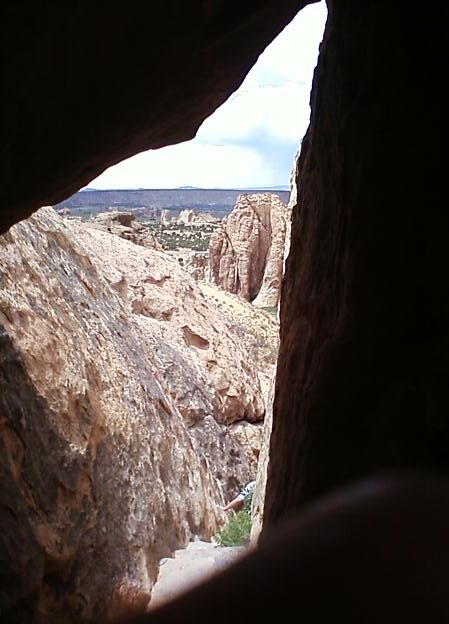
The view from the stairway

My sister called it a Barbie phone. It’s tiny and pink, circa 2009. I used it through 2019. I’d given no thought to the pictures on it for years, and had never downloaded them while it was my working phone, so I’m not sure why I finally did—but I’m glad I did. On it, I found pictures of Truth or Consequences and Santa Fe in the years during which my books are set. The work in progress, book nine, takes place in 2013.
When I took these photos, I was collecting material for my books. I chose the settings through Mae Martin’s eyes, her delight and awe in discovering New Mexico, and the feeling of deep change and emergence that her new home gives her.

In Shaman’s Blues, Mae is often struck by the intensity of the light in Santa Fe. Encounters with outdoor art trigger key moments for her, for Jamie, and for the boy Jamie tried to help.
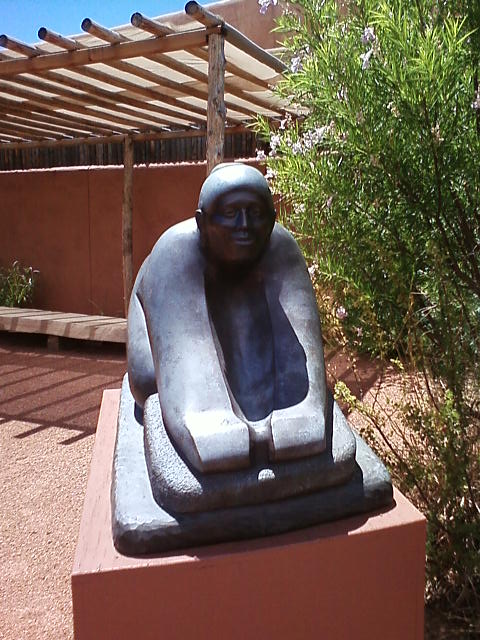

The nearly-dry Santa Fe River plays an important role, as does the image of the Lady of Guadalupe. I took a picture of this blue door in Santa Fe one year, and the next year the Lady had been painted on it.
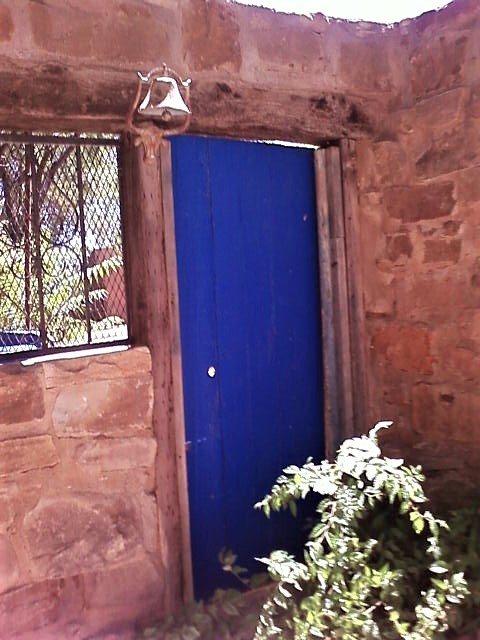
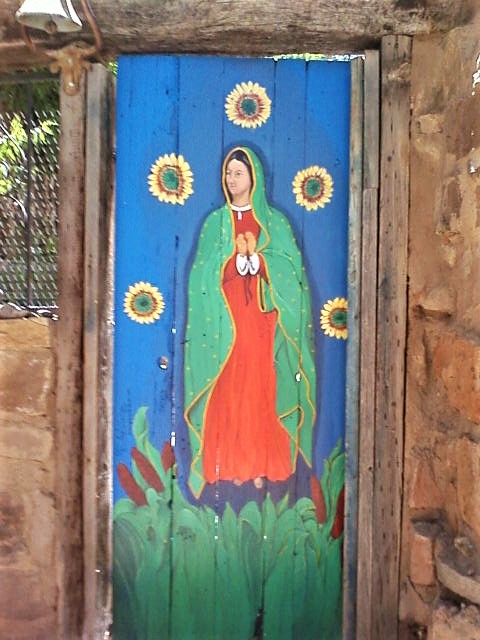
As I look at the colors in my old pictures, the book’s title echoes them. Blues.

I’ve also photographed settings that had meaning to other characters or played roles in later books, and will share some in future posts.
 The boxed set of the first three Mae Martin Psychic Mysteries is on sale for $2.99 through April 26th.
Is your book club reading either The Calling or Shaman’s Blues? These have become book club choices, I think, because of their genre-spanning qualities, with elements of women’s fiction, mystery, and the mystical/paranormal. After discovering how much my book club likes using the suggested questions for books, I’ve created a Book Club Discussion Question page on my web site. (I’ll eventually get around to adding the link to the end matter of the books. So far, I’ve added the task to my to-do list.)
Book nine in the Mae Martin series is in progress. I’m a slow writer, so it will probably take another year to bring it to its final form. Using the almost-finished first draft and an earlier, unfinished half draft as foundations, I’m creating anew while revising and recycling the earlier material. Always an adventure—following where the characters lead me.

My first completed manuscript was awful. I’ve saved it, but shared it with no one. It was an exercise is completing a plot and proving to myself I could do it. My second completed manuscript was awful, too, but I thought it was better, and I shared it with my first writing critique partners, fellow members of the Guppies (Great Unpublished) subgroup of Sisters in Crime.
I was so lucky. One person hated it and didn’t finish it, and her harsh critique was pretty accurate. The other found the strengths in the mess, the gems in the muck, and supported me. She loved my characters so much she took an incredible amount of time to graciously point out my beginner writing mistakes and to explain why they were mistakes. She was under no obligation to work that hard for no pay. Yet she did. She was more experienced, and she saw promise in this beginner.
My first book, The Calling, emerged from that manuscript a few years later. It has many of the same characters. It has the same theme. But not the same plot. My style and structure improved. I read books on writing, took classes on writing, and worked with additional critique partners. With all that the help over the years of revision and polishing, I crafted a solid, favorably-reviewed book.
This week, I finished a critique of a first-time novelist’s manuscript. I’ve read three versions of it, investing in this book the way my early critique partner invested in mine. The author is gifted. She made newbie errors, but I could see the gems beneath them, as could her other beta readers. She had an original idea, fascinating characters, and outstanding research. I’ve been a published author for going on ten years now. It felt good to “pay it forward.” I may be alone at my desk tonight, but not a single book I’ve published has truly been written alone.
All books in the Mae Martin Series are discounted through the end of January, on sale for $3.99 each . Book one, The Calling, is free. The prequel, The Outlaw Women, is 99 cents, and book 7.5, the short story suite Gifts and Thefts, is $2.99. No murder, just mystery. No inflation, either. Available through all major eBook stores.
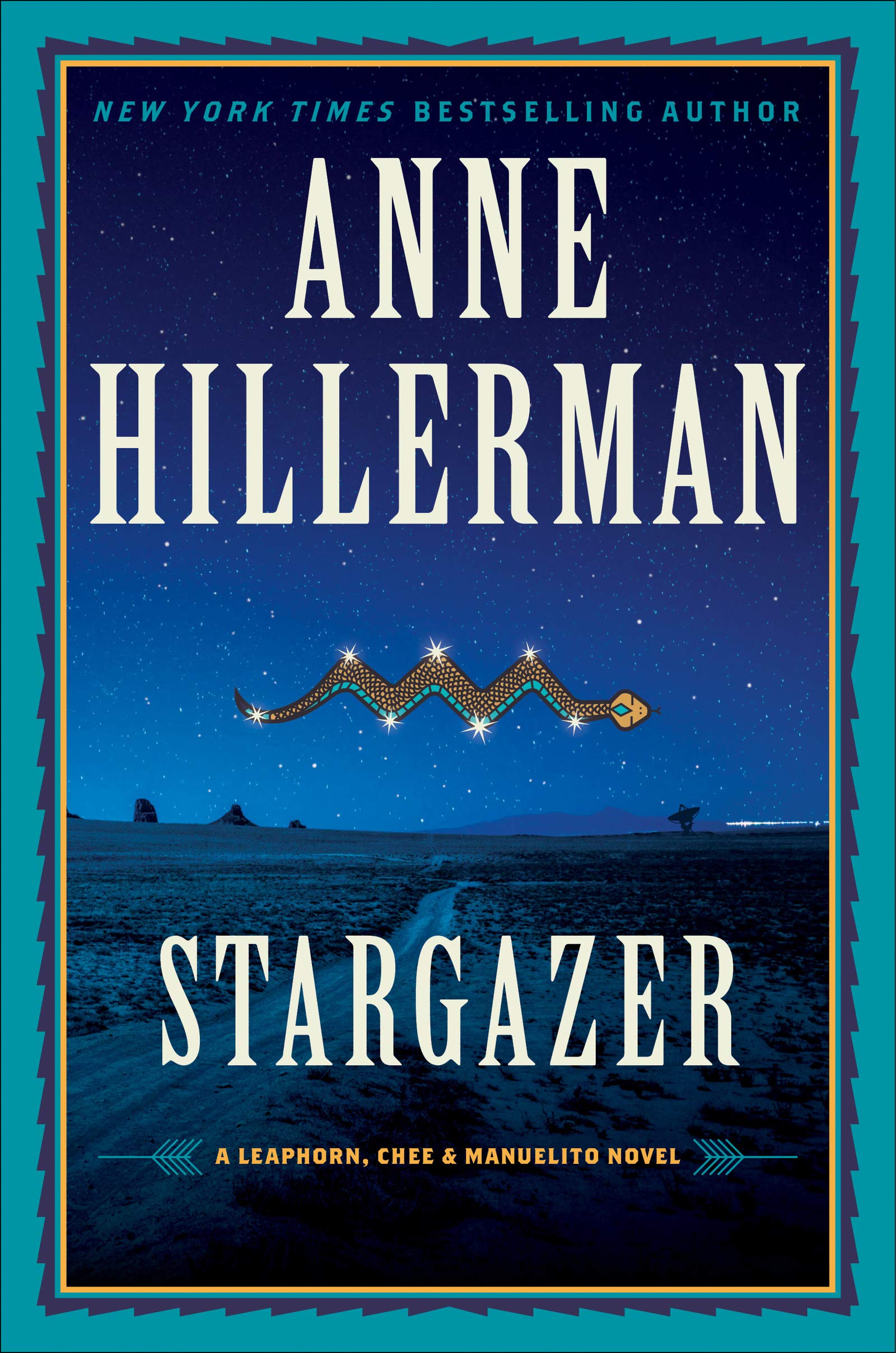
The protagonists have kept this series strong for years. Hillerman develops them further with each book. As an elder, Joe Leaphorn is still growing and learning. Bernie Manuelito and Jim Chee navigate the challenges of their police work and their marriage. And the new characters are memorable and deep. The multiple suspects in the crime were all plausible, and I was never sure who was responsible until near the end. The settings are intriguing. The Alamo Navajo Reservation near Socorro, New Mexico is a lesser known section of the Navajo Nation, yet still part of the nation and its culture. Also near Socorro is the Very Large Array, the site of high tech studies of the stars. The victim, a scientist who worked there—the star gazer of the title—is revealed in depth as a person.
Anne Hillerman has knack for creating colorful, utterly real, and very regional people as minor characters, also. Bernie’s attempt to serve a warrant on Melvin Shorty presents one of these gems. And how Shorty behaves in the end is true to the way he and Bernie met as human beings, not just as officer and law breaker.
Hillerman gives realistic complexity to the characters’ lives. Leaphorn, Chee and Manuelito are never dealing with just one case. There’s a primary mystery plot, but there are other demands on their professional time as well, including a painfully sad case Bernie stumbles across while attempting to deal with stray cattle. The leads’ private lives are not neglected by the author or the characters. I like having fully functional sleuths. They attend to their relationships and friendships, not just their work.
The author’s prior writing career in nonfiction serves her well. She integrates research fluidly as needed, resulting in a poetic balance between the science at the Very Large Array and Bernie’s Navajo view of the stars and constellations.
The ending is satisfying. Major issues are wrapped up, yet the reader is left thinking about the characters’ future plans.
No spoilers, but Joe Leaphorn’s encounter with a child who is traveling alone is wonderful. And if you read the author’s notes at the end, that scene gets even better. Hillerman’s notes are as good as the story, as she shares more about the Very Large Array, Navajo cosmology, and her writing process.
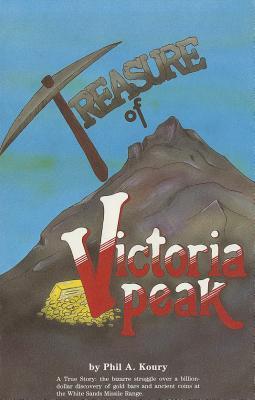
This true story would make a great movie, featuring a hidden treasure and a huge cast of characters trying to get hold of it despite the claim of the stubborn widow of the original finder, Doc Noss.
Doc, a Cheyenne foot doctor of no known medical credentials, had an office in what was then Hot Springs, now Truth or Consequences. He was reputed to be skilled in treating foot ailments, whether or not he was real doctor. Once he found treasure while out deer hunting, his life changed, and not for the better. He had a lot to worry about—more gold and ancient Spanish artifacts than he could remove from the cavern in Victorio Peak. (The mountain is named after Victorio, the Apache war chief. I’m not sure how or why Koury or perhaps his publisher renamed it Victoria.)
The book chronicles Doc Noss’s adventures, his sudden and dramatic death, court case after court case, subsequent treasure searches, and Ova Noss’s years of fighting to retain her right to the treasure and get permission to dig it up. Once the peak was made part of the White Sands Missile Range, Mrs. Noss had to go up against everyone from the U.S. military and F. Lee Bailey to the woman who claimed to be her late husband’s other widow.
Attorney for Mrs. Noss Phil H. Koury has a penchant for detail. As you might expect, he tells his story with an emphasis on the legal battles, but it’s never dull or confusing, and he has a humorous flair. He recounts the treasure hunt scenes he witnessed with apt observations of character and settings. The process of solving this mystery during a time when communication was slower increases the suspense. I rooted for Mrs. Noss all the way. Since this is a true story, the plot doesn’t necessarily turn the way a work of fiction would, but that makes it no less compelling.
Portal to Visionary Fiction - Transforming Human Consciousness
Shining a small, bright light in a wilderness of writing scams
Living and Writing in the great state of Maine
the Mae Martin psychic mystery series
In a different light: my view of the world.
visionary author
middle of the night musings
Nancy Adams' blog

