
 This history is detailed and yet never dull. Jim Eckles is a great storyteller, bringing the camp and the town to life through the unique experiences of individuals who trained there. The eventual demolition—the complete vanishing—of this camp in Deming is as interesting as how it came into being. When I told an old friend, a Korean War veteran, about this book, he said that his father—from upstate New York— had trained at Camp Cody when he volunteered for WWI. In numerous visits to Deming. I’d never heard of the camp, so I was intrigued when I found this volume at my local bookstore. As a New Mexico history buff, I thoroughly enjoyed every page. The characters make it worth reading, as well as insights I gained about our country’s entry into World War One through this particular aspect of it in a small New Mexico town. Since his father had been at Camp Cody, I passed the book along to Bob, and he said he was surprised how engaging it was. He couldn’t put it down.
Tag: Deming New Mexico
Untold Stories
Certain people print their images on my mind like photographs, unforgettable:
Three orange-robed Buddhist monks in Albuquerque painting the iron fence of their compound bright turquoise-blue. One was wearing a cowboy hat.
A green-haired teenaged girl in shredded black tights and dramatic make-up playing heavy metal electric guitar for tips outside an art gallery in Deming. Her tip jar was labeled “encouragement.”
A fiddler playing outside the movie theater in T or C as people lined up and went inside. After they vanished, he kept fiddling, practically dancing to his own music. He didn’t need encouragement.
A platinum blonde woman on the edge of the dance floor at Santa Fe Bandstand, wearing big sunglasses, tight denim capris, a white shirt, black spike heels, red lipstick and a red scarf, holding the leashes of a pair of fluffy little dogs in pink and blue harnesses. For reasons known only to her, she came to hear Native drum groups and then Levi Platero’s Hendrix-style blues in her 1950s Marilyn Monroe persona.
A white-haired, white-bearded man on a bicycle hauling a small wagon covered with orange reflective material and loaded with what appeared to be all his worldly goods, traveling slowly through Nutt, New Mexico. 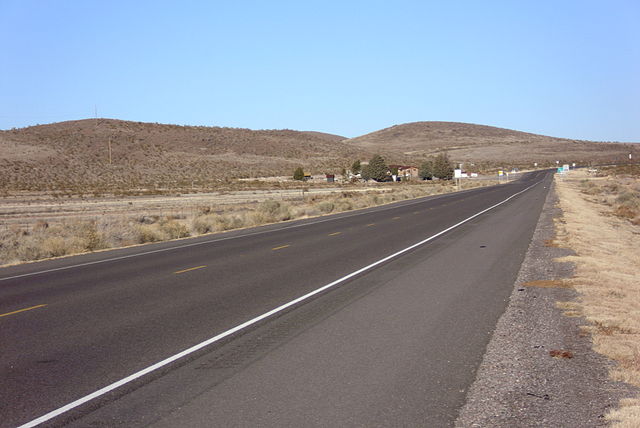 Nutt has a lot of wind turbines and solar panels, but a population of twelve.
  What was he doing there? I first saw him on the way to Deming with a friend. Hours later, on our way back to T or C, we passed him again, still in Nutt, only a tad further along. Two weeks later, we saw him yet again, this time on I-25 North about a third of the way to Albuquerque. Needless to say, we remembered him and wondered about his life.
Of all these memorable people, he’s the one I wish I’d stopped to talk with. The one whose story is the biggest mystery. I can guess that “Marilyn” had fun dressing up in her retro style. It’s not unusual at Bandstand for half the audience to be so colorful they’re as much a part of the show as the musicians. The monks, the heavy metal girl, and the fiddler also seemed happy, doing things that were meaningful to them. There’s a story behind each of them and how they chose to be where they were, but they didn’t raise as many questions in my mind as the bicyclist did. Is he mentally healthy or unwell? How far does he travel in a day? Where does he sleep? How does he get food? It’s possible he’s engaged by choice in an eccentric yet purposeful life, but more likely he’s pushing his way through, doing the best he can after a series of set-backs or a disaster.
Whether he’s on a spiritual journey, a lost, homeless trek, or another kind of trip I can’t even guess at, I hope he travels safely. Perhaps I’ll see him again and pull off to learn his story.
 Amber Foxx Mysteries