The Miracle of Reading

When I was recently visiting my friend Bob at the New Mexico Veterans’ Home, we found ourselves talking about reading. Not only about the book I’d brought him and why I thought he’d like it, but about reading itself, how amazing it was when we first learned to read as children. He’s eighty-nine and I’m seventy, but we both remember the experience. We marveled at how the transition took place from puzzling over words to reading so fluidly we instantly visualize the story, unaware of looking at little figures on a page and translating them into meaning something.

He recalled being very young, excited to read, and bothering all the adults and older siblings around him, running around with a book asking “What’s that word? What does that word mean?” And I remembered not being able to read yet, and my sister pretending she could read by turning the pages of one of our favorite books and reciting the story from memory. Because we wanted to read. To pass through the gateway to stories.

And yet so many people don’t read. According to a Washington Post article, 46% of Americans didn’t read even one book last year. What they’re missing! For those of us who do read, it’s a daily miracle. If I couldn’t read, I don’t know what I would do with myself. I rely on books for information, for escape, for experience, for insight. I think of a wonderful poem by Truth or Consequences poet Beverly Manley called Why I Read Fiction, written to explain to a friend who didn’t understand. If you can find or order her book, Seasons of the Soul, I recommend it, not only for that poem, but for all of them. The last two lines:
“I read to open my heart, my eyes, my mind
I read to feel connection with all mankind.”
What is Pleasant to Live Through …

… seldom makes a good story. I was reminded of this as I searched for something interesting to say in an e-mail to a friend. I wanted to stay in touch and to hear from him, but my sane, steady, enjoyable life provided little material. Hello. I’m happy. My students are great this semester. My yoga classes are going well. I’m reading good books and I’m writing. In conversation, a lot could flow from any of this, but in writing, not much.

A few years ago, I was talking with a new acquaintance at a faculty holiday party, and he mentioned that he was reading The Lord of The Rings for the first time. I had read it my freshman year in high school. Yet, when he mentioned the passage that stood out most strongly for him, it was one that I’d often thought of in the decades since reading it. Tolkien sums up the passage a long and pleasant time for the travelers in his story in one or two lines, then adds that things that are agreeable to live through are often dull to tell about, but things that are hard or even terrible to live through make marvelous tales. Authors tend to feel affection for their characters, and yet to make good stories, we have to put them through challenges. No life would remain pleasant if it didn’t require us to do something difficult. And that’s where the story is—growth through pain or danger.

At the last meeting of my book club, each us got the others caught up on her summer. One person was getting divorced, another had seen a friend through a major crisis, and another had taken her peace studies students to Hiroshima, a place that literally went through hell to become what it now is, a city dedicated to peace. And I … had been on vacation. Needless to say, the most compelling narrative wasn’t mine.

I had tons of fun, but my friends had more questions about a medical weirdness that took place shortly before I left for New Mexico. Because what makes a better story? “I went on vacation and it was great,” or “I had a posterior vitreal detachment?” They were fascinated by the phenomenon of having the gel in my eyeball partially detach and getting flashes of light and a giant floater in one eye. “How big is it? Like, the size of blueberry? Is it always there? Do you have to have surgery?” (Smaller than a blueberry, in case you care, and no, and no.) Ah, we humans. We love icky, scary stuff, and you can’t get much ickier than eyeballs.

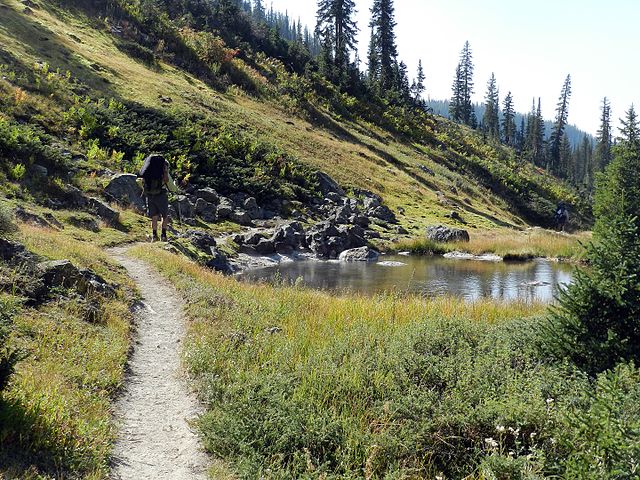
I thought the divorce story was amazing, a much better story. Not for the conflict but for the grace. The couple who are parting ways took a long-planned backpacking trip together even though they had decided they would end their marriage. I’ve talked to each of them about it and they’re glad they had this final adventure together. backpacking_bechler_canyon_18430518468It’s their story, so I won’t tell any more of it here, but I can see in it the qualities that make the best stories. In a way, it ties in with the peace studies story and the helping-a-friend-in-crisis story. It had value and purpose, and took strength and courage. It made them grow and change. And in its difficulty shines its beauty.

Waltzing to “New Mexico Rain”

In my years of being happily single I’ve never minded going places on my own—in fact, I love the freedom of going alone, and the openness to meeting new people that I have when I do this. Last summer, when Michael Hearne played at Santa Fe Bandstand, I struck up an acquaintance with a fellow Hearne fan. The music was a little late starting and we were early, so we sat together on the base of the monument in the Plaza for quite a while. The funny thing is that for as long as we talked, I couldn’t remember his name or what he did for work, only that he was from Albuquerque and loved music and dancing. We danced together for much of the evening. He switched partners occasionally, dancing with women he knew from Albuquerque, and then coming back to me. He had to catch the Rail Runner before the song, the one everyone wants to hear and dance to most of all, “New Mexico Rain.”* If this were fiction, the Cinderella-esque departure of the dancing partner whose name I’d forgotten would lead to something. It didn’t. I ended up dancing to that song with a stunningly attractive and much younger man who could lead a waltz with energy and grace.

This year, I arrived early again, and found a huge crowd waiting for Bill Hearne and Michael Hearne**. I sat on the base on the monument between two slim, fit, middle-aged women with brilliant (and definitely natural) red hair of the same length and with the same kind of rippling curls. The one on my left was local, and the one on my right was reading a tourist brochure in French, oblivious to her Santa Fe twin—who assured me they were not in any way connected. If this were fiction, the coincidence of their resemblance would go somewhere. It didn’t. I just happened to be between two oddly similar members of that particular one-percent.

I looked up and saw a tall, slender man with a youthful face and gray hair under a faded pink ball cap—the same man from Albuquerque in the same hat. He was saying to the woman with him, “I don’t see any of the regulars.” I spoke up, and he remembered me—though not my name. He introduced me to his friend, and I easily learned her name, and that she was a massage therapist visiting from North Carolina. I forgot his name and occupation again. But I did dance with him. He flowed back and forth between partners. I liked having breaks to watch the sea of dancers before being re-immersed in its waves.

When he left last August, I said, “see you next year.” He told me he’d wondered if “that lady” would be here again. All either of us could remember about each other was how we danced, with a connection that was perfectly of the moment. If this were fiction, there would be more to this story, but there isn’t. He is my Bandstand Michael Hearne concert dance partner. In its own way, that story is magical enough.

This year, we did get a chance to waltz to those lovely lines about waltzing in New Mexico rain. Maybe we’ll dance again next year. If we’re lucky, perhaps it will rain. (If this were fiction, it would.)

*“New Mexico Rain” https://www.youtube.com/watch?v=96UkbM6cII4

**New Mexico’s adopted sons—Americana with a touch of Western Swing

http://billhearne.com/wp/

http://www.michaelhearne.com/index.html