Pictures I Didn’t Take

I often get a powerful urge to stop and take a picture. Then I don’t do it, for many reasons, but primarily because it takes me out of the moment. Instead of experiencing where I am and what I’m seeing, feeling, hearing, and smelling, I’ll get wrapped up in composing a picture to post. Granted, I would love to share the experience, but this urge usually occurs when I’m by myself out in the desert on a long run. If I pull out my camera and try to find some shade where I can actually see my screen and then make adjustments, I’m missing part of part of the joy of running. If I were a photographer, this would be joy to stop and take a picture. I admire and deeply appreciate the work of gifted photographers.  But that’s not my creative form. Words are. So, here are the words.

A fox den that lasted two days. I think the fox realized it had dug in too close to a well-used trail. So much work for a couple of busy nights, and now there’s a cobweb draped over the entrance. It’s been there for a long time. Sometimes location is everything. The shade of that big juniper, alas, was a bad location.

The bats. At sunset, they come pouring out from behind the mural on a roofless building. I met a friend on the way there one evening. She also loves the bats. As we watched them emerge in an erratic cloud, a complex aerial ballet, she laughed in delight. They have that effect on me too, as if their sonar is vibrating something positive deep inside us that creates pure happiness.

Other things I haven’t taken pictures of are odd moments where something looks out of place on the street, and I think “I should take a picture of that. That’s strange.” Maybe nobody else would think it was odd or interesting. I don’t take the picture. I have my moment and keep going.

I often think of a friend who told me about being near the edge of a woodland with her father when a herd of deer exploded from the trees. Her father was scrambling in the car for his camera so he could get a picture of the deer while she watched them leaping past. By the time he got his camera out, the deer were gone. Pictures I haven’t taken are moments that I lived. I’ll share them some other way. Some will show up in my stories. I’ll remember them when I need them. A pyrrhuloxia, a desert Cardinal, perched atop of a half dead tree in the desert has a place in the book that I’ve just started. He’s going to show up near the end as a significant and meaningful sight, with his brown-gray body and his red crest and his three different songs pouring out. I saved him in my memory, but I didn’t take his picture. (Someone on Wikipedia did.)
Shape-Shifters: How Did You Think of That?

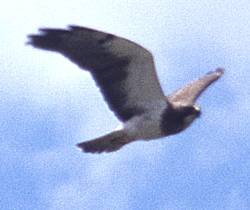
SwainsonHawk23One of the hardest questions for a fiction writer to answer is exactly where an idea came from. I was asked that question recently about some of the imagery in one of my books. The short answer is that I imagined it, but the long answer mixes research, experience, imagination and dreams.

In what is basically realistic fiction with paranormal elements, I create some characters who have unusual abilities—psychics, healers, mediums, and shamans. A few can take—or seem to take— animal forms, and my Apache characters speak about this with fear and caution as the sign of a witch. Bearing is a horror story (though gore-free), so in that genre I made the shifting real. In the Mae Martin Mysteries, characters who shape-shift are not physically becoming animals but psychically manipulating others’ perceptions to create the illusion of another creature, or so strongly identifying with an animal that a psychic could pick up the imagery. The power of our minds to share images and information is astounding, and that ability is at the root of the stories I tell.

When I was choosing search terms to help readers find Bearing, one of the ones I chose was shape-shifter, a concept that I associate with skin-walkers and similar witches. I was surprised to find that there are shape-shifter romances. The possibility that this power was romantic had never crossed my mind. To me it’s scary, so it’s an element I use in fiction to give readers goosebumps. What makes an animal image scary to one person and beautiful and powerful to another is often regional and cultural. One of my Apache friends told me some terrifying stories of owl-witches that chilled me to the bone. He scared himself by telling them and said he shouldn’t be talking about the subject. When I was in my teens, I had what turned out to be a premonition, a frightening image of someone prowling outside the house hooting like an owl. Around ten years later, my roommate and I were disturbed at night by owl calls first at the front and then at the back of our townhouse apartment. Her cat’s hair stood on end and he quivered and made pitiful sounds, his fear scaring us all the more. We’d never seen him act like that. My roommate looked outside and saw a man she worked with but didn’t know well, and she called the police. The man admitted to stalking her but couldn’t explain what had gotten into him with the owl calls. Somehow that was creepier than if he knew.

One of my good friends in high school had repeating nightmares about wolves looking through every window of her house, and the way she told it gave me the shivers. When I was a very small child, I had repeating nightmares about bears, including a strange one in which I was a fourteen-year-old boy camping on a hunting trip with an uncle, and it ended with being attacked—I think killed—by a bear. No one in my family hunted or camped, and I had never seen a bear or a gun or even a tent at the age at which I dreamed this.

A little girl I knew years ago liked to think she had hawk powers. We were swinging in swings and she told me the reason she could go so high was this special power she had. She stayed in my mind, too, as another way that people identify with animal spirits.

This can be a “treasure hunt” through the series now. (Obviously the bear story is the standalone Bearing.) Readers will find the wolf, the hawk and the owl in the Mae Martin series. No spoilers. I’ll let you look for them.