A New Mexico Mystery Review: Shutter by Ramona Emerson

Unique, breathtaking, intense—and somehow occasionally funny in the midst of tragedy and horror—Shutter is one of the most original books I’ve read in years. Forensic photographer Rita Todacheene is gifted with not only skill in her work but with a spirit world connection. The gift is a burden, provoking concern and conflict in her family and in her workplace and creating profound stress in her personal life, but the ghosts will not leave her alone.

The structure of the book, alternating between Rita’s earlier life on the Navajo  reservation and her work with the Albuquerque Police Department, gives depth and balance to the story. As a reader, I needed the reprieve from the APD. I cherished the time with Grandma, and got to know Rita through her roots, seeing the person she was before she became immersed in some of the ugliest murders in the city.

And those murders are horrific. Normally, I’d have struggled had get through the crime scenes, but Rita’s perspective made them compelling—seeing them through her eyes, through her lens, through her commitment to the dead. The reader can’t look away because Rita can’t. Neither her job nor the victims will let her.

I’ve only seen a ghost once. She chilled me to the bone. At least she went away and never came back. Rita’s ghosts linger, cling, persist, and return. Some are angry and desperate; some are benevolent. They can see her and communicate with her. Emerson makes them as real as the living characters.

I admire her writing skill. She doesn’t explain but allows readers to intuit through immersion. I never sensed Rita talking to an audience in the narration, though it’s first person. There’s a brush with the confrontation-and-confession trope, but it’s short and does no harm to the pace or to the plausibility of the moment. I felt that Rita wasn’t really a smoker, that this habit might have been an afterthought in some stage of revision in order to put her in the right place at the right time, but her flawed coping skills overall make her human and make her surges of strength all the more admirable.

If you appreciate a realistic crime story, a powerful ghost story, and an authentic New Mexico setting, this is your book.

Learn more about the author in this NPR archive interview.


A New Mexico Mystery Review: The Pot Thief Who Studied Calvin

Like all Pot Thief mysteries, this one is unconventional, entertaining, and educational, with historical and philosophical explorations as well as a mysterious little pot and a sudden death, perhaps a murder. These ingredients are blended and seasoned with insight and humor. If you’re a series fan, you’ll enjoy a reunion with the usual characters as well as another trip to the village of La Reina. It was good to spend more time in Old Town Albuquerque and in Hubie’s shop. As usual, his personal life gets a good share of the story’s pages, as you’d want when catching up with an old friend. After all, he’s a person, not just the person solving a mystery. (Actually, he’s part of a team solving the mystery.)

The solution left me puzzled and questioning. Was this supposed to be like King Solomon and the case of the two women claiming the same baby? Was the reader meant to still be sorting it out, or was the reader supposed to get some hints? I am so bad at getting hints. Nonetheless, I loved the ending. It left me with a smile.

Mae Martin Mysteries Sequence and Settings: A Quick Guide to the Series

When reading a long series, it’s helpful to have a list of the titles in order, and reminders of the years and places in which they’re set.

1. The Calling Winter 2009 – Spring 2010 Bertie County, NC and Norfolk and Virginia Beach, VA
2. Shaman’s Blues August 2010 Truth or Consequences and Santa Fe, NM
3. Snake Face December 2010 Las Cruces and Truth or Consequences, NM and a road trip
4. Soul Loss Spring 2011 Elephant Butte, Hatch, Truth or Consequences, and Santa Fe, NM
5. Ghost Sickness Summer 2011 Truth or Consequences and Mescalero, NM
6. Death Omen August – October 2011 Truth or Consequences and Santa Fe, NM and a road trip
7. Shadow Family December 2011 – January 2012 Truth or Consequences and Santa Fe, NM, Bertie County, NC, and a road trip
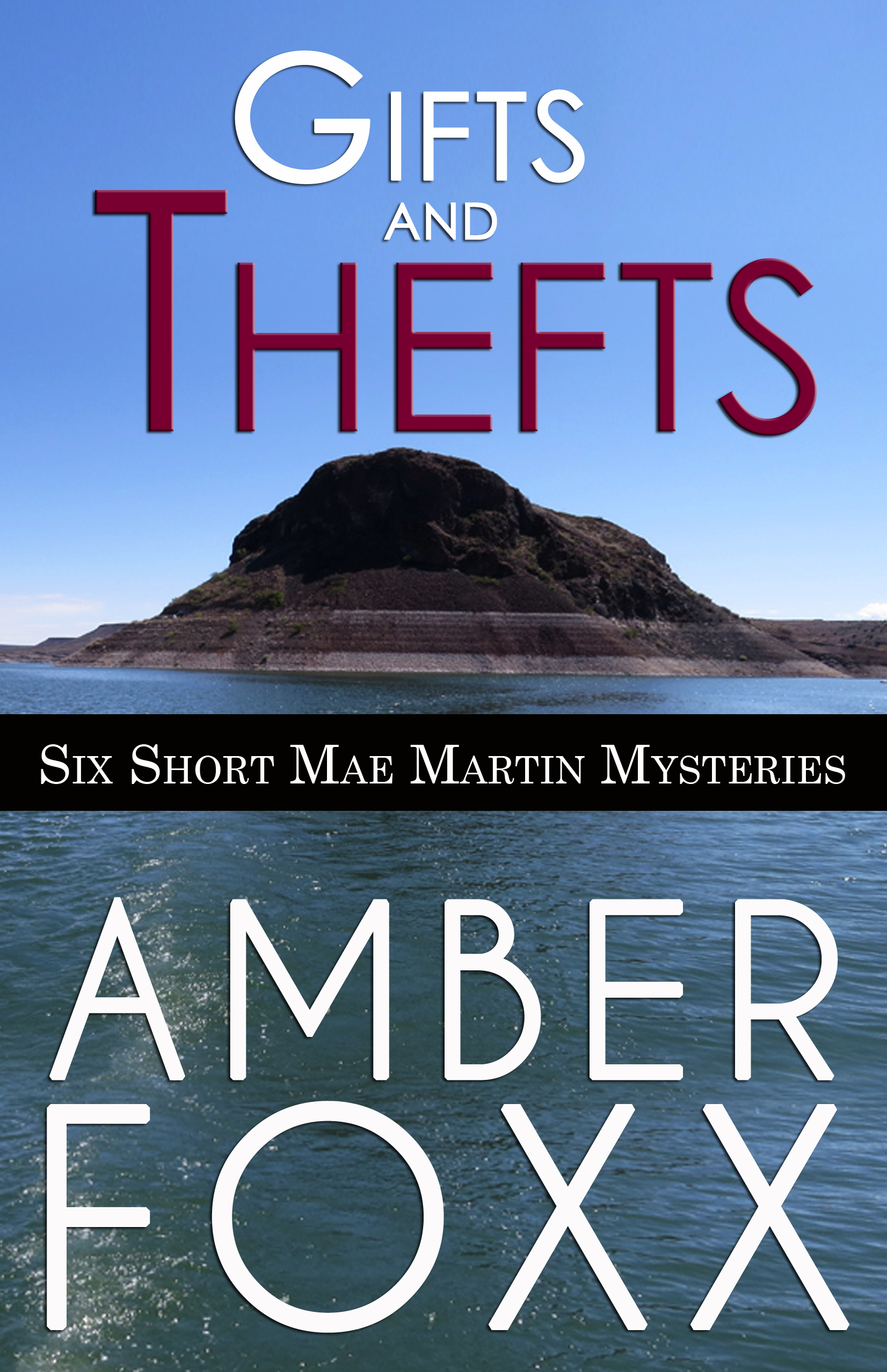
7.5 Gifts and Thefts Summer 2012 – Spring 2013 Santa Fe, Las Cruces, Truth or Consequences, Mescalero, and Elephant Butte, NM
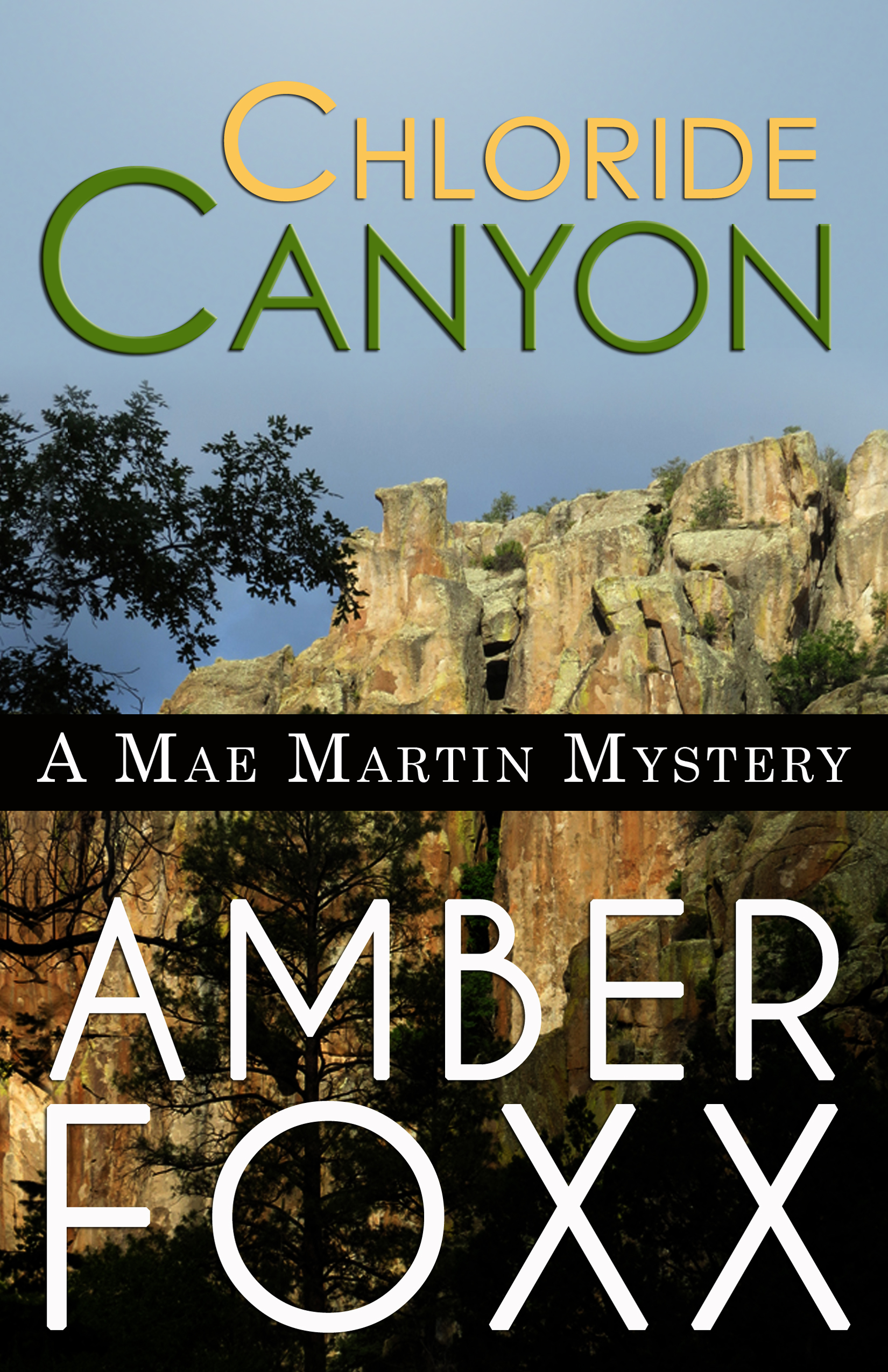
8. Chloride Canyon June 2013 Las Cruces, Truth or Consequences, and Chloride, NM
9. Smoking Mirror August 2013 Truth or Consequences and Santa Fe, NM and coastal Maine

A New Mexico Mystery Review: The Sacred Bridge by Anne Hillermann

This is Anne Hillerman’s best book yet, a crime novel but also a book about culture, land, and history, set in various parts of the Navajo Nation in both New Mexico and Arizona. As always, her research is thorough and woven naturally into the flow of the story. The character development is deep, and the plot revolves around the inner workings of people— the victims of the crimes, the perpetrators, and the people solving the crimes.

The beginning of the book is a masterpiece in building tension, suspense, setting, plot, and conflict, when there’s only one character present: Jim Chee hiking alone at Lake Powell, discovering a crime as he’s contemplating what to do with his career. Meanwhile, Chee’s wife, Bernie Manuelito, is investigating another crime that she had the misfortune to witness. This second crime is somewhat based on actual events on the Navajo Nation that I’d read about. I immediately recognized the farm that inspired this story, and its misuse of Chinese laborers. The discovery of the full character and life path of the victims of these two different crimes is a fascinating and integral part of the process of solving them.

Bernie’s career development and Chee’s professional decisions and spiritual explorations are inseparable from the plot. Bernie’s younger sister Darleen’s maturation and use of her talents fit perfectly into the mystery. There’s not a single loose thread. Every subplot is tightly woven into the main plots.

This book kept me awake. When Bernie is coming to the end of her undercover assignment, the pace is intense and full of surprises—surprises that fit.  I like when a mystery hits me this way: Oh wow! I never saw this coming! But yes, of course that’s what happens.

Everything’s wrapped up and yet the book also ends in a way that makes me want to read the next one. Starting immediately.

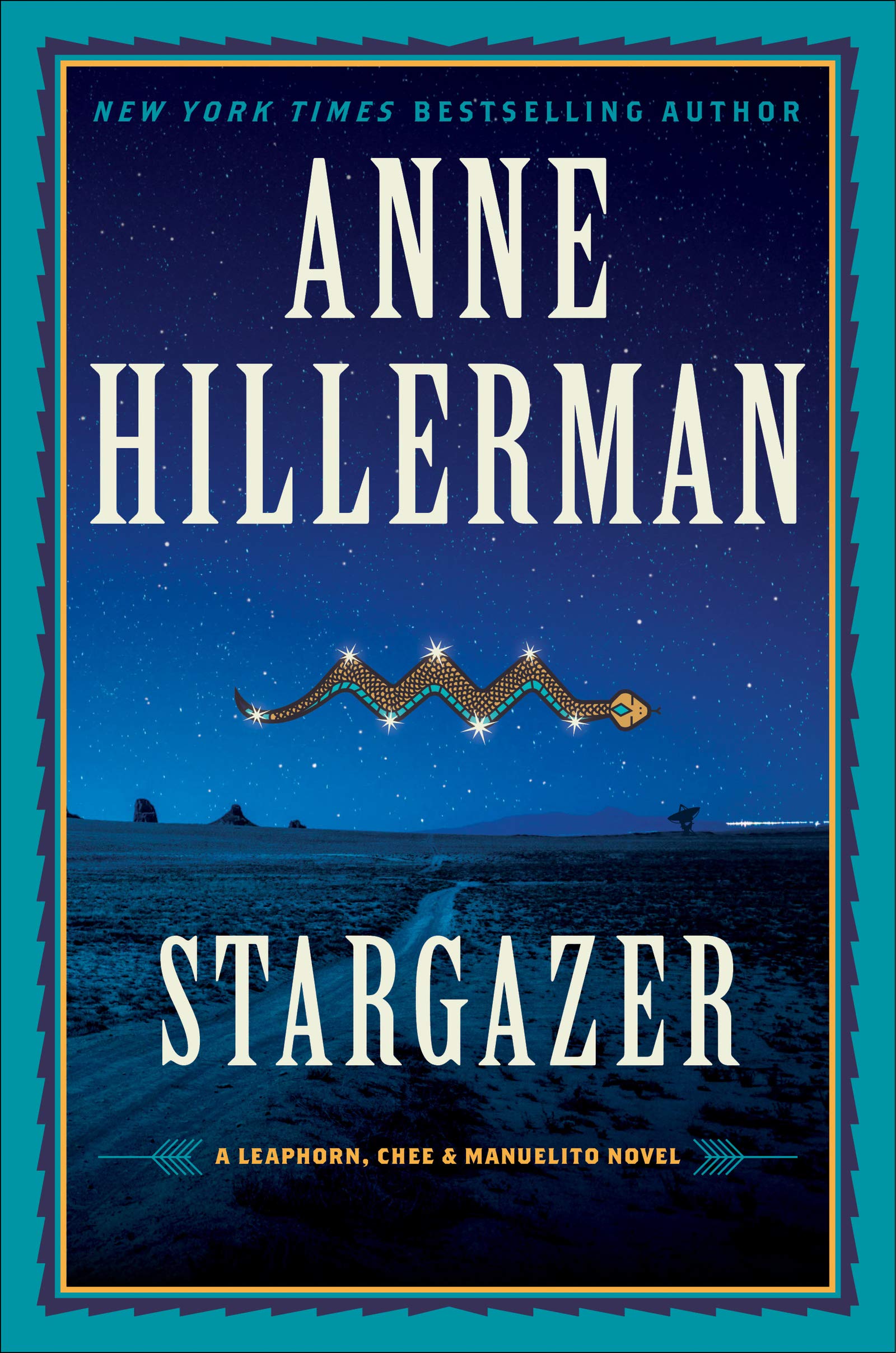
A New Mexico Mystery Review: Stargazer by Anne Hillerman

The protagonists have kept this series strong for years. Hillerman develops them further with each book. As an elder, Joe Leaphorn is still growing and learning. Bernie Manuelito and Jim Chee navigate the challenges of their police work and their marriage. And the new characters are memorable and deep. The multiple suspects in the crime were all plausible, and I was never sure who was responsible until near the end. The settings are intriguing. The Alamo Navajo Reservation near Socorro, New Mexico is a lesser known section of the Navajo Nation, yet still part of the nation and its culture. Also near Socorro is the Very Large Array, the site of high tech studies of the stars. The victim, a scientist who worked there—the star gazer of the title—is revealed in depth as a person.

Anne Hillerman has knack for creating colorful, utterly real, and very regional people as minor characters, also. Bernie’s attempt to serve a warrant on Melvin Shorty presents one of these gems. And how Shorty behaves in the end is true to the way he and Bernie met as human beings, not just as officer and law breaker.

Hillerman gives realistic complexity to the characters’ lives. Leaphorn, Chee and Manuelito are never dealing with just one case. There’s a primary mystery plot, but there are other demands on their professional time as well, including a painfully sad case Bernie stumbles across while attempting to deal with stray cattle. The leads’ private lives are not neglected by the author or the characters. I like having fully functional sleuths. They attend to their relationships and friendships, not just their work.

The author’s prior writing career in nonfiction serves her well. She integrates research  fluidly as needed, resulting in a poetic balance between the science at the Very Large Array and Bernie’s Navajo view of the stars and constellations.

The ending is satisfying. Major issues are wrapped up, yet the reader is left thinking about the characters’ future plans.

No spoilers, but Joe Leaphorn’s encounter with a child who is traveling alone is wonderful. And if you read the author’s notes at the end, that scene gets even better. Hillerman’s notes are as good as the story, as she shares more about the Very Large Array, Navajo cosmology, and her writing process.


A New Mexico Mystery Author Interview: Kaye George

I’m a huge fan of the People of the Wind series. It’s a pleasure to have Kaye George as my guest today to talk about the latest book in the series, Death in the New Land, which I recently reviewed.

BIO: Kaye George, award-winning novelist and short-story writer, writes cozy and traditional mysteries and a prehistory series, which are both traditionally and self-published: two cozy series, Fat Cat and Vintage Sweets; two traditionals featuring Cressa Carraway and Imogene Duckworthy; and the People of the Wind prehistory Neanderthal mysteries.  Over fifty of her short stories have also appeared, mostly in anthologies and magazines. She reviews for Suspense Magazine and writes a column for Mysterical-E. She lives in Knoxville TN.

AF: What drew you to writing about prehistory? And about Neanderthals in particular?

KG: I became more and more excited about Neanderthals after the genome was first sequenced and so much was being learned about them, almost every week. About that time, I read something in a short story magazine by a guy who writes an ancient Roman character. Someone asked him why he wrote about Romans and he said that he thinks the further back you go, the better. I remember saying this out loud. “I can go WAY further back than that.” The idea was born and I started working on it.

AF: The language you use in the narration of this series is unique. Simple, a bit formal, and lacking certain constructions normal to English such as “taller.” The Hamapa concept is “more tall.” Did the speech patterns come to you intuitively? Did you construct them consciously?

KG: I had many versions of the language, both in narration and in their communication. At the time, I lived in Austin and had an excellent critique group who met in a book store every week. I brought version after version to them and most did not work.

When I started in on this, the thinking was that Neanderthals could not speak. I also knew that their brains were larger than ours. To solve both those problems, I decided to give them telepathy, using that brain. I was reading Temple Grandin and learned that she thinks in pictures rather than words. She also posits that animals think in pictures. Ms. Grandin is autistic and a renowned animal handler. A cattleman was having trouble getting his animals to enter a narrow, dark passage and he appealed to her for help. She immediately saw that the passage was dark, and had confusing light in it. When the animals could see clearly where they were going, they went with no problems at all.

This made me think that my Neanderthals should communicate solely with pictures. You can imagine how cumbersome that was! It didn’t work at all. Then newer theories came out that they probably could talk. Their voice boxes did not last all those thousands of years to be fossilized, which was the basis for the first theory, but the second one is based on the fact that they did actually have all the structures to be able to speak.

One early reader told me she didn’t want to see modern people dressed as Neanderthals in my books. I didn’t either! I had to give them a language at this point. I studied how children first learn to speak, how people who have trouble speaking are helped, and what the universal sounds are among many languages. I gave them a language with sounds in the front of the mouth, which are easiest to pronounce. But I didn’t have them speaking very much because I still like the telepathy idea.

As for the narrative, I wanted it to convey something of another time, a vastly different time. So I made my own grammar rules. No contractions, nor –er and –est comparatives, and a few more. I wanted it to be slightly stilted, but readable. I hope I accomplished that.

AF: What was the hardest part of writing this book? And what was the most fun?

KG: I guess the research is both, the hardest and the most fun. At least the most rewarding anyway. I do find creating my characters and following them through their lives and adventures satisfying also. But the best of all of this is having fans like you who appreciate the series.

AF: Thank you. Your fictional Neanderthal tribe, the Hamapa, migrate to the place that later became New Mexico. What made you choose this location?

KG: I’m not sure. I did calculations using Google maps to see how far they could get in a day, at my best guesstimate anyway. I found a detailed study of the terrain in that area, around Tucumcari Mountain, so I knew I could portray it accurately, as it was those thousands of years ago. I also liked the idea of the mountain, or mesa, itself, because it’s so distinctive looking. I thought that I could describe it accurately (it hasn’t changed much since then, except for what grows there and lives there) and people could figure out where this was. I actually pictured having it on the cover, but my publisher came up with such a good one, that I let that idea go.

AF: Your research is impressive, and I appreciate the way you share tidbits of it at the beginnings of chapters. Is there anything you learned that you wish you’d been able to fit into a book but couldn’t—some favorite fact or discovery you’d like to share?

KG: I’ve mentioned my love for the mega fauna of the last Ice Age. I have a bare mention of giant beavers in a legend told by the Storyteller, and a meeting with a glyptodont in the new land, but I wish I could cram a lot more of these fascinating animals into the plots. It’s hard to make up reasons to stick them in there! What would be fun would be movies of these with the mega fauna portrayed on a big screen. Or a little one, if people are watching at home.

AF: You’ve blended history with fiction, with deviations from the record in some cases and adherence to the facts in others. How did you choose this blend?

KG: My one main deviation, as I’ve said, it locating the tribe in what is now North America, and locating a bunch of other types of people there also. These all did live concurrently on this planet, but many did not meet each other. I liked to think about what would happen if they did, so I wrote that. My other “invention” isn’t a deviation, since the social structure isn’t known, and probably never will be. But the matriarchal society is my idea, kind of as a feminist, and kind of for logical reasons.

In everything else, I try to stick to the facts as we know them. What their art and dwellings were like, how they hunted, how they lived, what they ate and wore, clothing and burial methods. The ancient flute is controversial, but I took the stance that it was an actual instrument and that they made it and used it.

AF: The Hamapa are a female-led society. Can you share your process in creating the roles they assign to females and to males?

KG: I wanted an elder female for the leader, and she had to have a mate, even though she didn’t always keep the same one. When I decided to give them handed-down folklore, I had to have a person designated to learn it and to tell it, so that’s the Storyteller. It made sense that one person would know the most about healing herbs and practices, so she’s the Healer. Her son may one day succeed her, and none of the other roles aside from leader are gender specific. One guy is the best at flint knapping, one at making clothing, several are the best at throwing spears, and one is innately good at tracking people and animals. And, since fire was probably very important to them, one person is assigned to be the Firetender as his full time job. I tried not to have strict division of labor, but for people to naturally find where their talents lie.

AF: I know you have multiple series to keep up with, but this one is my personal favorite. Will there be another People of the Wind book?

KG: I’m ending this one so it can wrap up and end the series. I’m not saying I won’t write another one, but I’m not planning on it now. These are intense and difficult to pull together and, although I love doing them, I’ll take a break and maybe think about it later.

AF: Is there anything you wish I’d asked you but didn’t? Feel free to answer that question now.

KG: I might mention how hard it was to get this published. When you write the only series in a genre, no one knows what to do with it. I queried every agent on the planet and it was well-received, but no contracts. One agent told me she loved it, it’s “better than Jean Auel” (author of the Clan of the Cave Bear books), but that she had no idea how to sell it (to a publisher). I wanted to tell them to look at Harry Potter and maybe try harder, but I didn’t. I finally found a publisher who loves the series and has done everything they can for me and for these books. I couldn’t be happier than I am at Untreed Reads, unless I could sell a million copies. Somehow.

AF: Thanks for taking the time to answer my questions. I appreciate getting an inside look at these books.

*****

To purchase books by Kaye George, click here.

Visit Kaye’s website


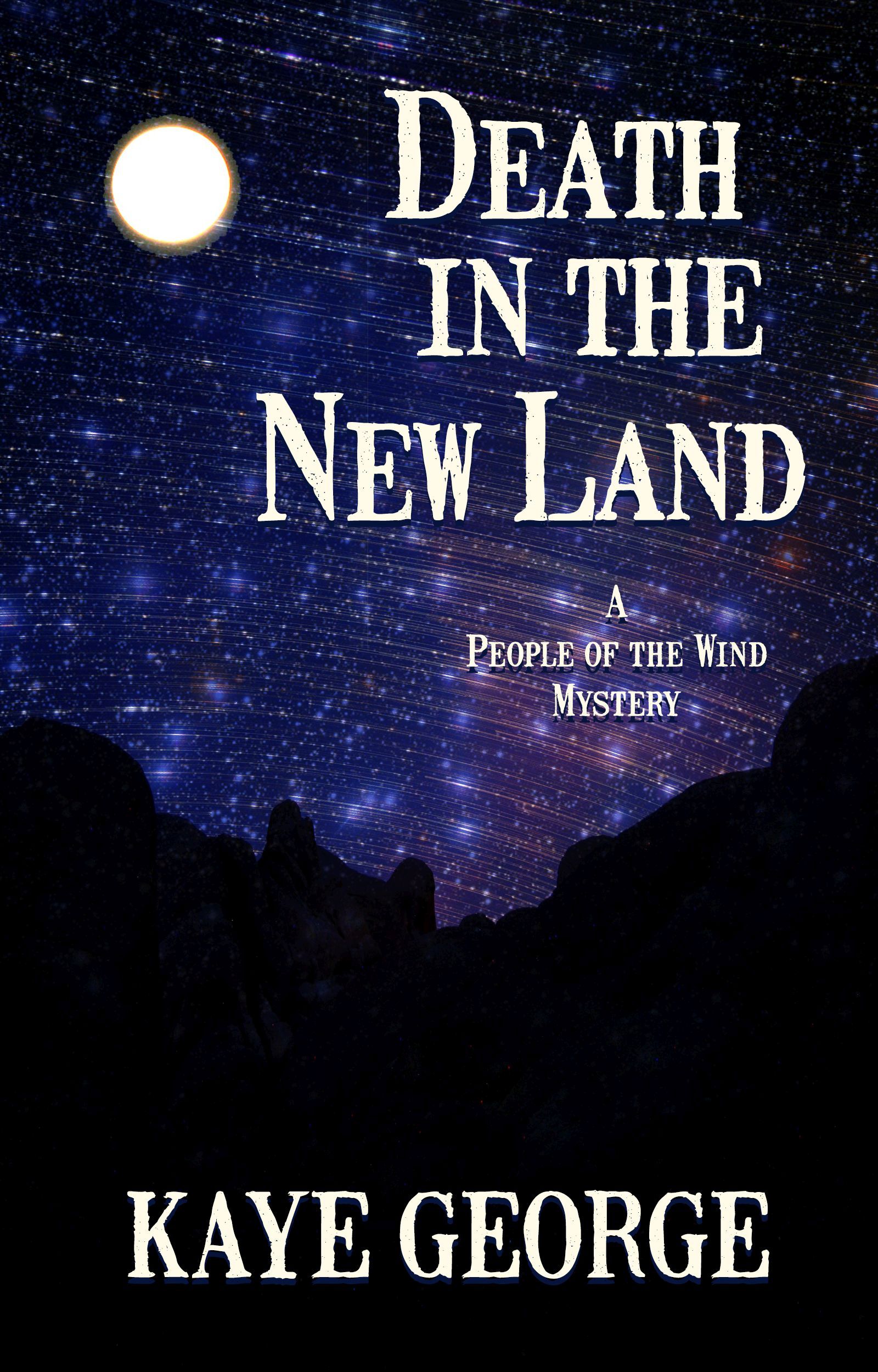
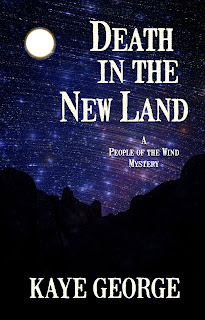
A New Mexico Mystery Review: Death in the New Land by Kaye George

In this third book in the People of the Wind series, the Neanderthal tribe the Hamapa have escaped the growing ice in their former homelands to the north and found refuge in a place where the sun is hot—prehistoric New Mexico, where mammoths and giant capybaras roam. Despite the strange wildlife and the denser vegetation, the buttes and mountains and caves felt familiar to this modern New Mexican.

The word use and thought processes of the characters fascinated me. Blending deep research with creative breaks from the historical record, Kaye George has created a complete culture, with language, rituals, and social customs. The Hamapa seldom speak, but use a form of communication that while fictional feels plausible. They and other Neanderthal tribes are telepathic, sharing ideas and images directly. To them, the “Tall Ones” the closest beings to modern humans in this book, seem noisy with their constant talking.

The Hamapa have no preconceived archetype of a detective or an investigation. A murder and the disappearance of a child distress them, but they’re dealing with hostile tribes, their own migration and resettlement, and the need to hunt. The protagonist, Enga Dancing Flower, is determined to find the child and to learn who killed a tribal elder, but she’s not at leisure to do what the lead character in a modern setting would do. I found this deviation from the expected genre conventions briefly disorienting, then refreshing. It’s true to the People. The mystery is solved in their way.

The novel is as much an adventure as a mystery, a saga of the Hamapa filled with the drama of hunts, battles, explorations, love stories, and discoveries. The writing style gives the reader the sense of being inside the mind of a very different type of human, yet a recognizable one nonetheless. I was wrapped up in the story, moment by moment, seeing through Neanderthal eyes.

Though one can read this book as a standalone, I highly recommend the first two books in the series, which introduce the tribe in their original homeland and then follow them on their journey south. Many of us have a little Neanderthal DNA. Enjoy some time with your ancestors.

Purchase the series

Author web site

An interview with the author will follow in my next post.

New Release: Chloride Canyon, Mae Martin Book Eight

Chloride Canyon

 The eighth Mae Martin Psychic Mystery

Could a faked haunting in a ghost town stir up a real one?

Mae Martin’s college summer session is off to a rough start. A classmate is out to make her life miserable. Her English professor is avoiding her. And the Paranormal Activities Club plans to investigate her psychic abilities. Her boyfriend, Jamie, is on a song-writing retreat in the ghost town of Chloride, New Mexico, population fourteen humans, twenty-three cats, and—supposedly—zero ghosts. He’s working with a famous friend who doesn’t want Mae, or anyone, to visit. But then Jamie’s neighbor claims her house is haunted, and Mae has to learn who’s behind the frightening events—the living, or the dead.

The Mae Martin Series

No murder, just mystery. Every life hides a secret, and love is the deepest mystery of all.

Buy

New Mexico Mystery Review: The Pot Thief Who Studied the Woman at Otowi Crossing by J. Michael Orenduff

The question is not only why someone killed a man crossing the Old Town plaza toward Hubie’s shop, but who the man was. And why he wanted to see Hubie.

Like all Pot Thief mysteries, this one takes the reader on entertaining detours which turn out to be part of the plot. Unconventional though it is, the book is well-paced. (There are a few genuine digressions, but they aren’t dull. I can’t object to Hubie reciting a list of New Mexico mystery writers in order to prove his extraordinary memory.) The trips to Silver City and to Tucumcari are educational as well as revealing. The Albuquerque settings and many of the characters are familiar, of course, to series fans. I especially enjoy Hubie’s conversations with his friend Susannah. She disagrees with him more than others close to him do, which makes for lively reading, especially when they’re trying to solve a crime. Many amusing scenes satirize academia. There are also moving, touching moments such as Freddy’s return to freedom. No spoilers. It’s an extraordinary moment. And the solution to the mystery is also emotionally profound.

I was glad to see Hubie commit a little breaking and entering toward the end. I was afraid he’d given up on that sort of thing. He thieves no pots in this book, an activity which I miss, but he does steal something of great personal value to himself. And to solving the mystery. And after all her years of reading mysteries and roping calves, Susannah contributes heroically as well.


New Mexico Mystery Review: Shaman Winter by Rudolfo Anaya

This third book in Anaya’s Sonny Baca series is the most mystical, filled with visions and shamanic dream journeys. Sonny’s detective work takes place in both the ordinary realm and the spirit realm, as he travels through layers of time and identities to confront his ongoing antagonist, the sorcerer Raven.

Raven, in this story, has allied with a white supremacist militia, a plot element that’s surprisingly current, though the book is old enough that doing detective work on the internet was new when it was first published.

The action at all levels is intense, once the story gets moving. The journeys into New Mexico history are exciting, integrating the past with the present. Sonny matures. He has always idealized his fiancée, Rita. In this book, he finally seems to understand her whole, vulnerable humanity as they endure a shared crisis. The curandera Lorenza, however, is still on the pedestal where Sonny tends to put women. He appreciates her, yet I never felt he perceived her entire self. Sonny’s neighbor, friend, and shamanic teacher  Don Eliseo plays a profound role. The end of the book is extraordinary in both the writing and the main character’s spiritual development, as well as the humility with which Sonny concludes this particular case.

This is a book only Anaya could have written. The beginning has some slow spots, so slow I might have stopped reading if I didn’t know the author’s work well enough to keep going, trusting he would reward me. I was right. It well worth reading the beginning to reach the finale.