None of These Places are Real

I’m living in the middle of a movie set. As a writer, I find the experience fascinating, seeing how storytelling and setting are handled in film production, and also picking up inspirations for my own stories.

The streets on either side of where I live have been closed at times for filming. Most of downtown Truth or Consequences is playing the role of Eddington in a movie of that name, and the many buildings have temporary new fronts and even new interiors, like actors putting on costumes and make-up, getting into character. Tourists find it bewildering, not sure what’s real. Good thing we’re entering the off season. A commercial laundry is a gun shop. The Chamber of Commerce is a DWI program office. The sign on the Geronimo Springs Museum on Main Street is subtly changed to the Eddington Valley Museum, but otherwise the building looks the same as always. There are many more transformations. I won’t list them all, but you get the idea. Downtown is more Eddington than T or C for now. If a town could get an Oscar for best supporting actor, T or C would deserve it.

The street behind my apartment was closed a week ago for filming a scene of a protest march. Peering out my back window and between the buildings, I saw people with signs and heard them chanting and shouting slogans, heading up and down the street, doing the scene over and over.

Sometimes I can’t walk where I want to because of a scene is being filmed, but at other times I can freely explore and look into some of the windows. The ordinary becomes intriguing when it’s a work of art. I admired the perfect realism of the movie sheriff’s office in all its mundane practicality.

During the Saturday night Art Hop in May, townspeople could walk through one of the sets, where a former antique store on Foch Street is playing the role of Garcia’s Bar. (My photo shows the bar’s creation in progress.) Members of the movie crew were in there playing pool and having drinks. Not filming, just using the bar as a bar. I was intrigued by all the detail that’s not necessarily part of the plot but has to be included on a set. Because if it’s not there, the movie won’t feel authentic. Photographs of Truth or Consequences Miss Fiestas from prior years were displayed along one of the walls. If I were writing a scene set in a bar, I might only need to say “a small, dimly lit bar with a pool table.” I wouldn’t need to describe all the glasses and exactly what kind of beer signs or liquor brands were displayed. I probably wouldn’t need to mention the Miss Fiesta portraits unless a prior Miss Fiesta was part of the plot.

I have to highlight sensory information that tells the story, sets the mood, and which gets the attention of my point of view character, and then trust my readers to fill in the rest. A writer can—and should—include tastes, smells, temperatures, and textures, giving more internal depth to fiction than a film can offer. But a film can give you a hundred percent of the visuals. The mix of imagination and thoroughness on the part of the set crew is extraordinary.

The prolonged presence of this movie crew, living among us for March and most of May, reminds me I’d like I to write a book taking place during the making of a film. I thought of the idea years ago when a different movie came to town for just a few days, and I worked as an extra. The extras had a lot of down time together and developed relationships ranging from friendship to massive annoyance. I didn’t care to do such a job again and didn’t apply for Eddington. Walking half-way down the block over and over again for an entire morning was not exactly exciting. But it entertained a friend who watched me from the window of Ingo’s Art Cafe and waved every time I appeared. I can use the experience in a book along with this two-month immersion in a movie set.

The film company bought the town a beer twice, paying for free drinks at the Brewery for “Eddington social hours,” to thank us for enduring all the street closures and other inconveniences, such as simulated gunfire at night. The beer was generous, but residents are enjoying the strange experience more than they object to it. There hasn’t been a lot conflict or drama. In fiction, though, the potential for conflict is great. I’ve got at least two other books to write first, but I don’t think I’ll forget the idea.

More from the Archives of the Little Pink Phone: Character Insight

When I found pictures of the stairway descending from the mesa at Acoma, I recognized an image I used in Ghost Sickness, the fifth Mae Martin mystery, and looked for the scene that featured it. In my search for the word “stair,” I assumed I would find the gallery scene with the paintings of the stairway.

 The stairway

I found it, but first, I discovered a connection I hadn’t consciously created. A major character in the book, Acoma Pueblo artist Florencia Mirabal, left her family—one of the last families to live on the high mesa—and eventually settled in Truth or Consequences. For Florencia’s house in T or C, I selected the one that is, like Acoma Pueblo, perched up high, with an extraordinary view … and a stairway. Writing the book, I was unaware of the parallels.

Mae pulled the truck into the weedy patch of dirt that qualified as a side yard, drawing near to the porch’s side steps. The front steps led to a long, winding set of stone stairs set into a steep cliff, giving the little house the feeling of a castle. On their way in, she and Niall paused on the porch, looking down at Main Street and the view of the Rio Grande and Turtleback Mountain beyond the town.

 Mae said, “This is such a perfect place for an artist to live. It must have been hard for her to leave.”

Then, I found the scenes featuring Florencia’s stairway paintings.

  • Several small canvases with what appeared to be drafts of the work she had in mind stood around her, images of a narrow rocky staircase like a crevasse in a mesa.
  • Clemens circled the room again and paused in front of a pair of paintings. Both showed the exact same scene, a stone stairway winding between steep rock walls. The perspective was slightly distorted, suggesting multiple parts of the twisting path seen from different angles. A shadow of someone’s legs and a foot lifted to take a step fell on the stairs, but no human figure was shown. One version of the painting was in shades of yellow, brown, and gold, the other in shades of blue.

Much of the mystery centers around Florencia’s art and her separation from her family. I knew I was writing that part. But I didn’t realize how her choice of a home reflected the one she left but never let go of in her paintings. And since I didn’t realize it, I think it was her choice, not mine.

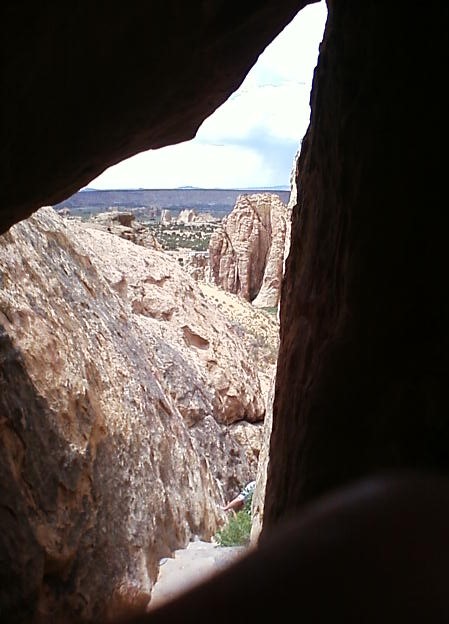
The view from the stairway

T or sCenery

I do my best to capture the colorful character of my town in my books, describing enough to give a flavor of the setting and to ground the story in a place. For fun, I’m sharing a little more of what makes Truth or Consequences unique. A full tour would take many blog posts. If you enjoy this glimpse, I’ll do another T or sCenery post in the future.

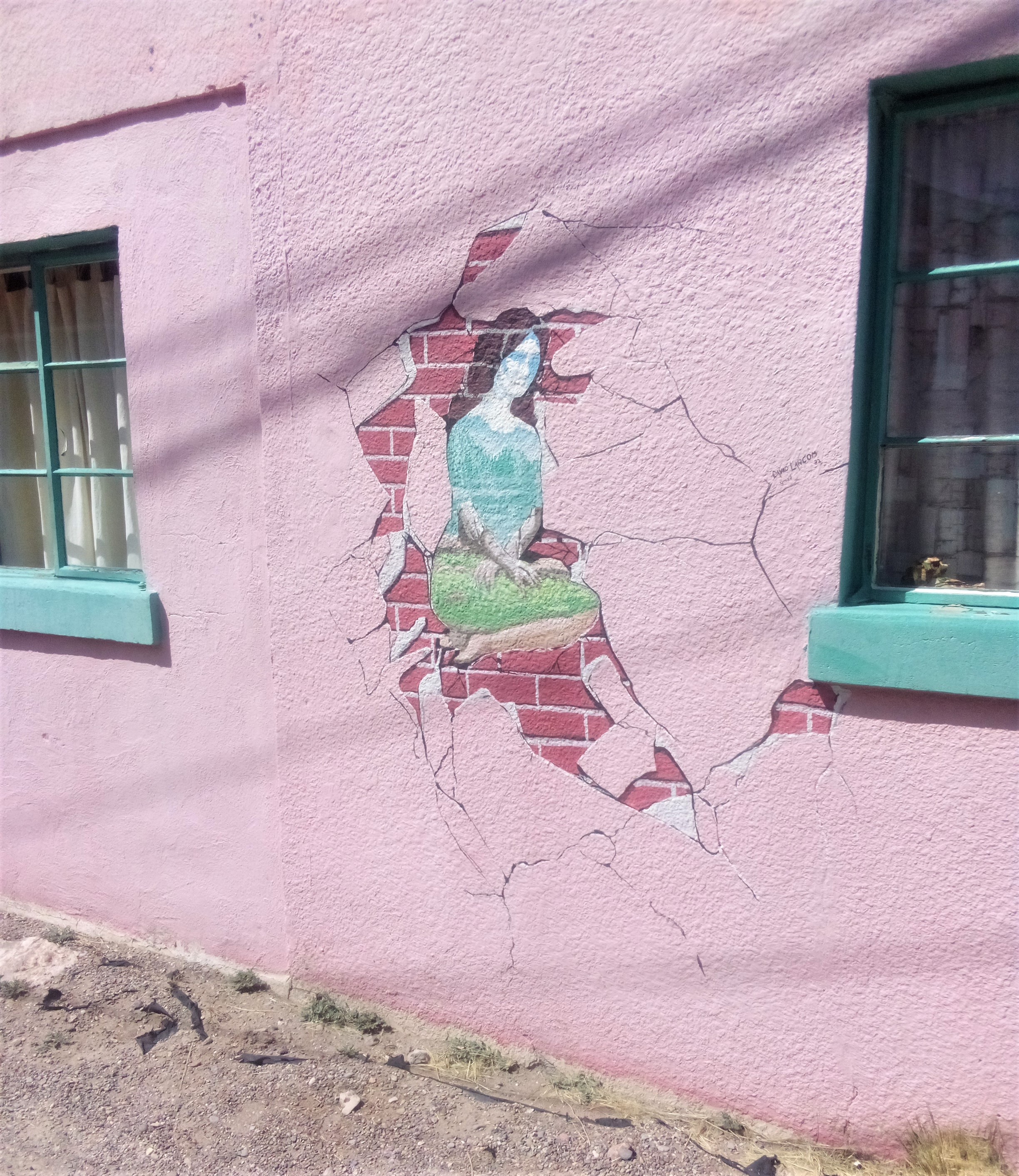
The mural above is in an alley beside the Pink Pelican, a portion of the Pelican Spa. Mae Martin book six, Death Omen, has many scenes set at the Pelican.

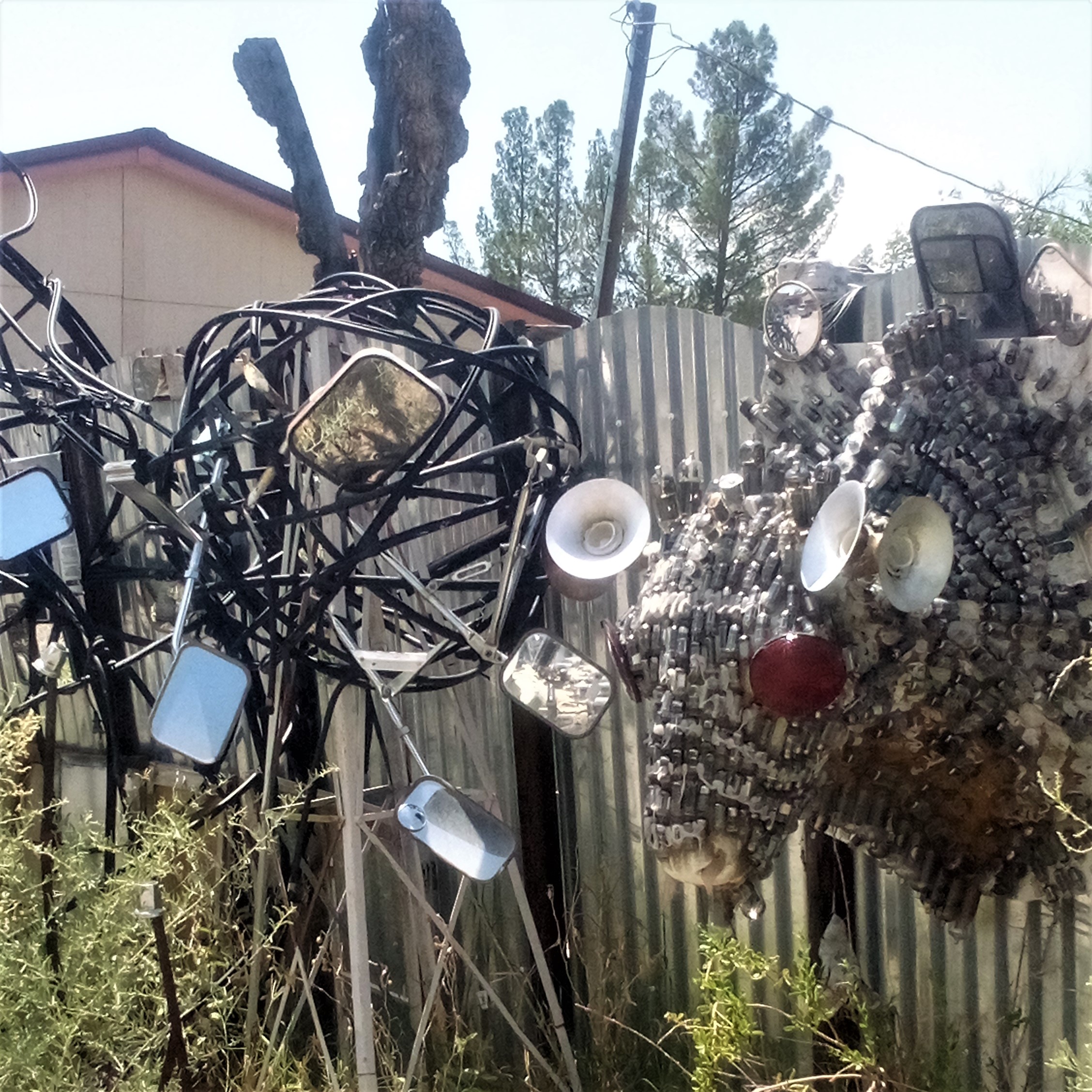
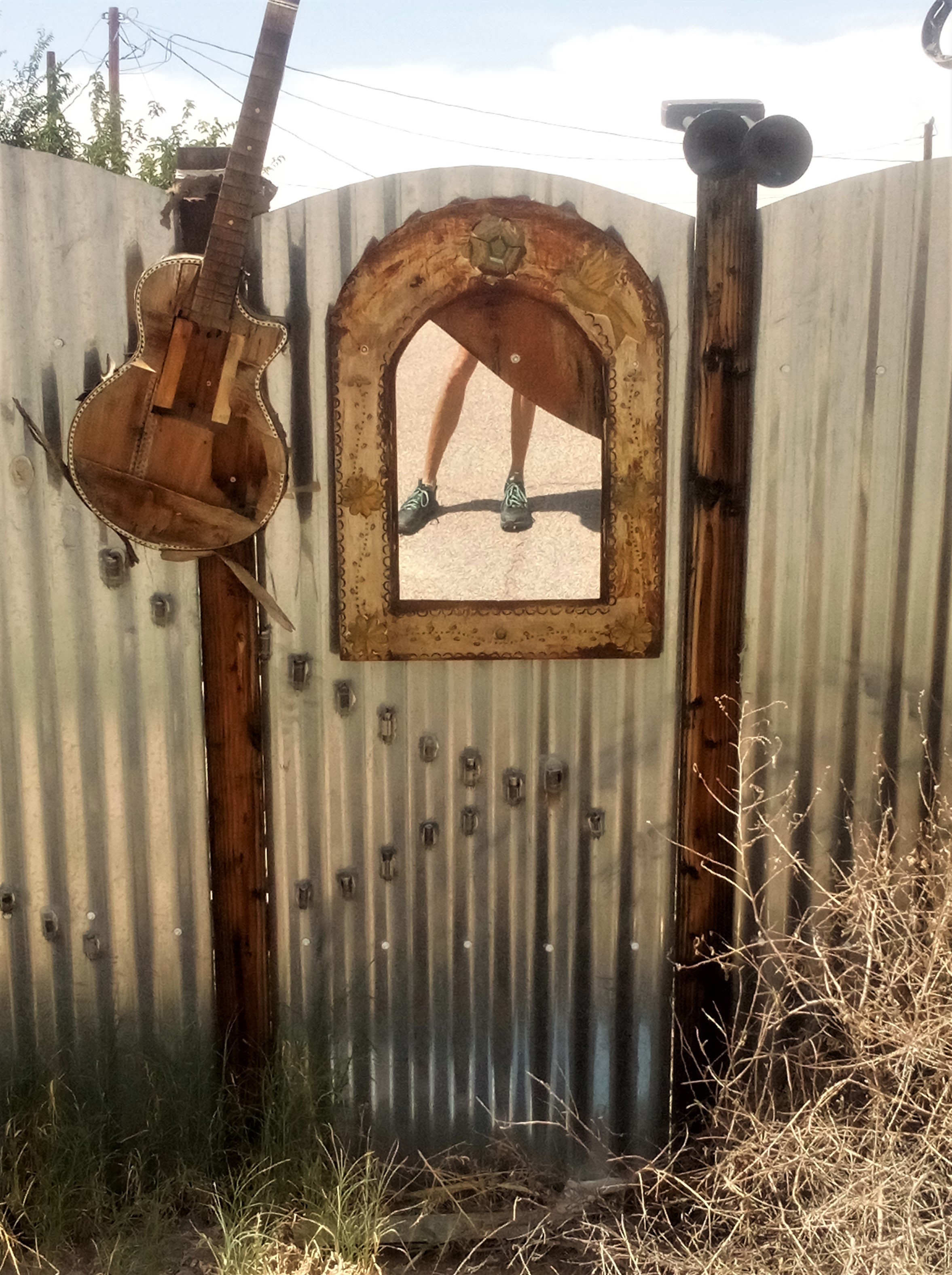
New murals pop up all the time, many in unexpected places. This one is an an alley across from the the main Pelican Spa building.The wild fence below is on Riverside Drive, near Niall and Marty’s fictitious house which has an eccentric, art-embellished wall. (The mirror shot is as close as I’ve ever come to a selfie.) The guitars on the fence, and the hats that used to crown it, gave me the idea for the fence and gate at Joe Wayne’s house in Snake Face. (His fence is far tamer than this, though.) One of my neighbors claims this is not the weirdest fence in T or C. He says that his bears that distinction. I’ll have to take its picture and few others for a future post and let you decide.


Behind the Scenes: Writing Death Omen, the Sixth Mae Martin Mystery

Now that the book has been out a little over a month, and readers have had a chance to get into it, I thought it would be interesting  to share some of the background for the story and the setting.

The idea for the plot first came to me when I was reading a book I reviewed in depth almost two years ago, The Healing Path by Marc Ian Barasch. In it, the author chronicles his search for healing, and the choices he made when he was seriously ill. He also interviews people who took a variety of alternative, conventional or combined paths. Some were healed in body and spirit; some were healed only in spirit. He visited one healer who was so tactless and blaming, her words stunned me. My antagonist character was born, blended with aspects of a director I worked with in my theater days, a gifted young woman with control issues who could be domineering and aggressive in her methods of getting actors to find their feelings.

When I read a book review describing some unusual ideas about reincarnation, it added other ingredients into my mental stew, along with several articles on Tibetan traditional medicine in a medical journal on alternative therapies. It was the healer who made me angry that got the ball rolling, though. I live in a place where alternative healing is popular, and I would hate to see sincere seekers misdirected.

Another component of the story was the stress of being a medical mystery. No one wants to be one, and yet all illnesses and treatments have an element of the unknown. When symptoms show up, some people put off getting the mystery solved. They’re like the people who would call in to Car Talk and say their car was doing something terrifying but they managed to drive it home. Click and Clack always marveled at these callers. “If it could kill you, why do you feel like you have to drive it home?” We can be that way with our bodies, too. There’s such fear of what the symptom means, it’s an incentive to avoid the diagnosis. We go into denial. Or we don’t trust our doctors and go to alternative practitioners—some good and helpful, some not.

Midway through writing the book, I had an injury that an orthopedic doctor assumed was a labral tear in my hip joint—something that would require major surgery and time in a wheelchair for recovery. It was scary, wondering what was coming. However, suspecting he hadn’t listened to me very well, if at all, I postponed the MRI for a suspenseful month, observed my symptoms, then wrote him a letter thoroughly covering all the facts. He gave me a referral for physical therapy, and I’m well now, no surgery. Not all medical mysteries turn out this well, but the experience helped me understand some of my characters who are dealing with frightening prognoses.

Earlier in the writing process, I resided in one of the suites at the Pelican Spa. It was the summer of 2016, my last summer as a part-year resident of T or C before moving here. I got the idea to have the antagonist characters offer their healing retreat at the Pelican, and asked the manager if it would be okay to write a book in which some wacky people from Santa Fe rent the Red Pelican portion of the spa for a weekend program. She said, “That’s really happened.” The staff was incredibly generous, giving me tours of the Red Pelican rooms that summer and again this year, when I wanted to get the finishing touches right. The setting with an Asian flair turned out to be perfect, since a Tibetan traditional doctor plays a role in this mystery. The Pelican Apartment Motel, the section of the spa where I spent that summer, is where Jamie stays during the retreat, and I lived in the in the green-walled room he is given.

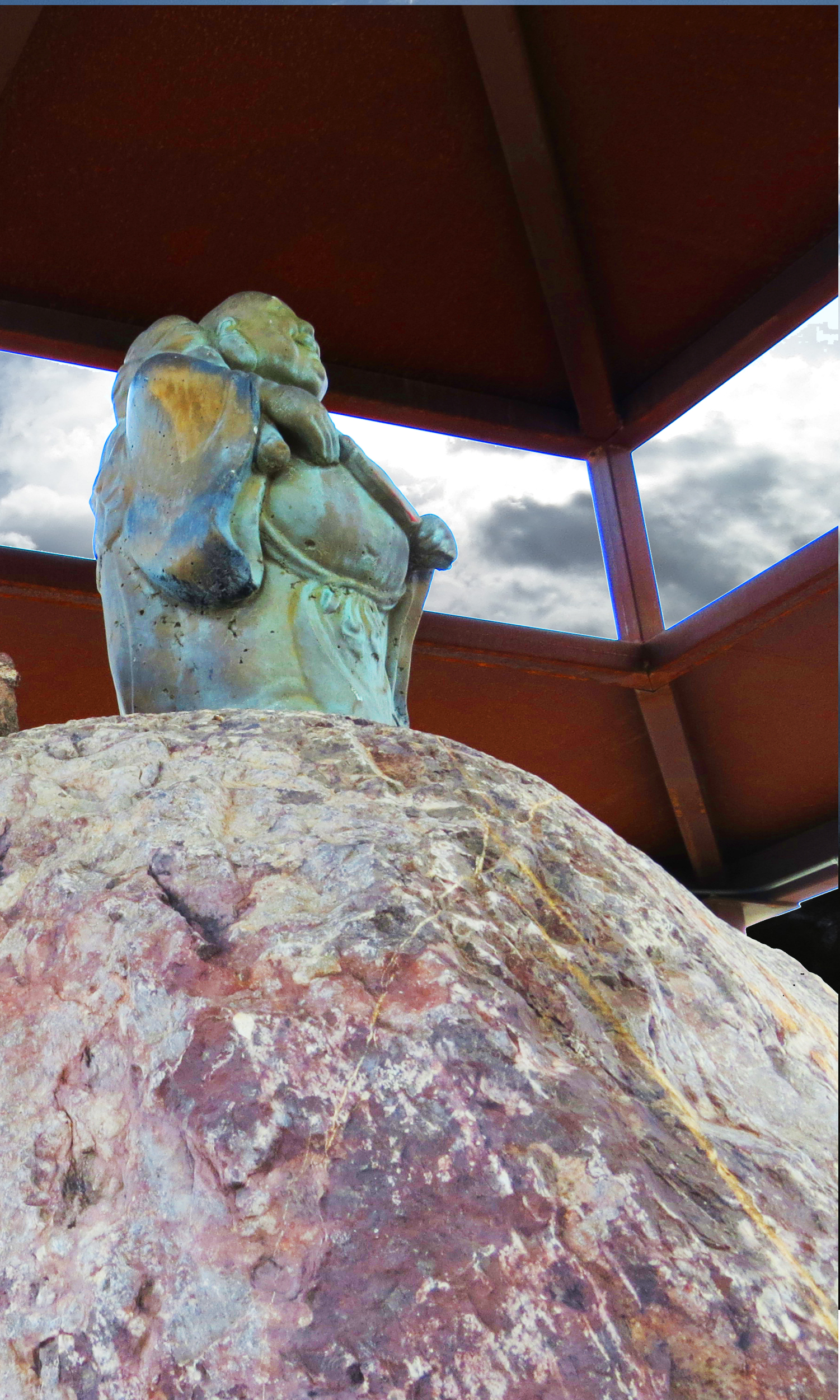
The bright laundry line visible from Jamie’s room is one of the features of the setting I couldn’t resist using. The laundry shot was taken by Donna Catterick, who took the picture for the cover, and was originally posted on her blog. I also like this picture of the Red Pelican’s courtyard rock and Buddha that Donna took. My characters often gather on the benches around that rock.

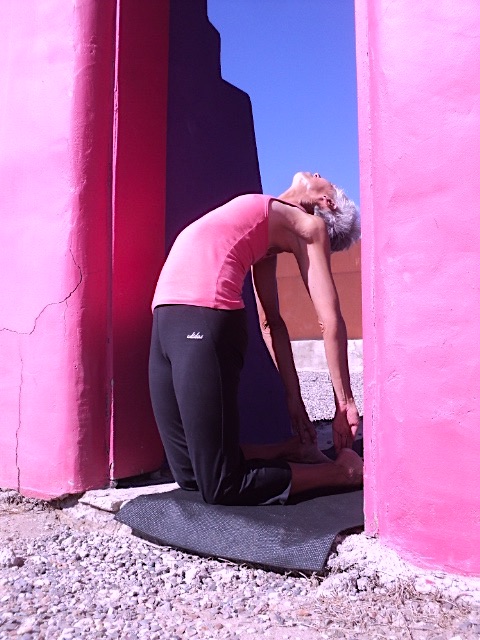
I didn’t tell my cover designer anything about the Pelican. I considered asking her to incorporate something of its color schemes and then decided to trust her judgment. She considered many options but found she kept coming back to the pink lettering. If you look at the cover next to this picture that a friend took of me doing ustrasana, camel pose, for a yoga  studio web site (I teach at a studio attached to the Pelican), you’ll see that the colors match remarkably. The archway where I’m posing is at the back entrance to the Red Pelican Courtyard that my characters often use.

A second real location in Truth or Consequences that I used is The Charles, another classic hot springs spa. When I arrived in T or C in June this year, I asked the owner if she would be willing to fictionally employ Mae Martin as an energy healer at the Charles. This was a healing modality they hadn’t offered in the past, though they’d had massage and reflexology there for years. She told me they’d recently added an energy healing room, and urged me to talk with her manager. I did, and he not only gave me permission to use the space in my book, but encouraged me to take pictures and make sure I got it just right. When I saw the room painted as a healing cave with blue sky in the ceiling, and crystals on the shelves, even lamps made from crystals, I knew Mae was meant to work there. Sometimes reality and fiction line up perfectly.