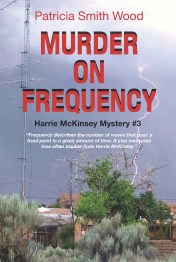
A New Mexico Mystery Review: Murder on Frequency by Patricia Smith Wood

murder-on-frequency

A New Mexico man long missing and presumed dead seems to have come back to broadcast on ham radio, only to fade out as if something terrible has happened to him.

Patricia Smith Wood has crafted another tight puzzle of a mystery in this third in the Harrie McKinsey series, once again blending multiple mystery genres—a touch of cozy, a touch of police procedural, and now a touch of the PI story as well. Amateur sleuths Harrie and Ginger, the Albuquerque police department, and the FBI come together on a complex case with help from a new character, private investigator Bernie Thomas, a former member of the APD. His role as a liaison between the professionals and the amateurs is an effective device. The amateurs take some risks, and they use their brains and their ability to gain trust and talk with people, but they don’t do what’s better done by the pros.

Harrie and Ginger, who are studying to become amateur radio operators, are naturally and believably drawn into investigating the apparent broadcast from the missing Alan Whitney. I like a mystery that gives me glimpse into a hobby or occupation I previously knew little about, and this book provides a fascinating exploration of amateur radio without ever losing the pace. Wood slips the exposition into the energetic dialog as part of a page-turning plot.

 Much of the detective works, realistically, takes place through interviews, asking the right people the right questions, and through research and the use of creative intelligence to understand the clues. Most of the violence takes place offstage, though there are suspenseful scenes in which danger threatens characters the reader comes to care about. While this isn’t in the category of a humorous mystery, there is humor in the characters’ banter, and one of the criminals was an incredibly amusing diversion. He’s a bit like someone who walked out of a 1940s black-and-white movie in a way, and yet also wholly original.

 Wood is the master of the chapter-ending hook that makes you want to keep going. Surprises kept coming around the corner right to the very end. If you like to challenge your brain to solve a mystery, Patricia Smith Wood is an author you’ll come back to again and again.

To read more about this author, see my interview with her and my reviews of her first two books, The Easter Egg Murder and Murder on Sagebrush Lane


Attention Span

It’s been said that we teach what we most need to learn. Many of my classes involve critical thinking and information literacy skills. While I’m still teaching, I want to pay attention to the lessons I learn from my work.

Back in November, I asked my first year seminar students to write down topics they felt were important and challenging to discuss. We then used the randomly drawn slips of paper like the talking stick in a talking circle. The person holding it got to say whatever he or she needed to say while others listened, and then that person handed the paper along. Anyone could pass who was not ready to talk. We got through three topics that day and I saved the rest for when we had time to do this again. Two weeks later, the first topic someone drew from the heap was “Politics.” Most of the students said they had cared about it before the election and right after, but now they didn’t pay much attention to it. One young woman said the election had been so unpleasant that she changed her major from political science. It drove a thoughtful, moderate Republican who understands that conservative includes conserve out of wanting to engage in politics. That’s a loss to her community. Every time a young person with a good mind gets disillusioned, we lose their years of future leadership. I hope she’ll get involved again in the future. Her burnout is deep, though.

Her classmates’ loss of interest in something they felt passionate about two weeks before is alarming. As a culture, we may be getting trained to the media’s attention span and the media’s focal point, forgetting that our personal lives’ deep needs interact with issues that take prolonged, thoughtful, patient engagement, regardless of the headlines.

The lack of information they had was also troubling. Not because they’re not smart—they are, but the only student who knew recent world history well was from Palestine. He was the only one able to knowledgeably talk about the Cuban revolution and who Fidel Castro really was and why people felt so strongly about his death. And of course, he was well-informed on the complexities of the Middle East, and the pros and cons and unintended consequences of American presence there, something his classmates barely understood. I was relieved that the majority do understand climate change and that only one person in two classes of nineteen didn’t. Even the most politically conservative of them comprehended the reality of climate science. They don’t see it as a political issue so much as a scientific one with an impact they’ll have to live with.

Today in my January term health class, students shared and discussed articles on their chosen research topic for this half of the week, public health issues and the environment. This discussion was encouraging. I think the young adult attention span is only short for things they don’t fully understand, which for some includes politics, but it’s steady for the concepts they grasp. I hope this understanding ultimately translates into engagement. The earth needs them.

Writing about this motivates me to stay engaged as well, and to pay attention to issues in depth after the headlines fade.

Something for Real

t-or-c

I don’t make New Year’s resolutions. January 1 is just another day. I decided to change my life for reasons that have nothing to do with the transition of numbers on a calendar. A plan I’ve been gestating for years is finally real. I made the commitment. I have a lease. My future landlady and I signed it on Main Street, Truth or Consequences, at an outdoor table in front of Passion Pie Café the morning of Wed. Dec. 28th. Friends in T or C have congratulated me, telling me it’s the best decision I ever made. The to-do list is growing. It’s hard not to keep thinking about it or imagining disasters that could intervene in my plan. I’m glad I have writing to focus my mind and yoga and meditation to quiet its hundreds of questions, or I’d be spinning inside. I’m focusing on the constructive work of getting ready and on trusting life’s unfolding process, trusting the flow of synchronicities that made this change possible. The process of winding down one phase of my life and beginning the next will be complicated even though the goal is simplicity. I hardly own anything but I’m going to own even less. Travel less, need less, and be more. Retire early and fully embrace T or C. Art. Hot springs. The Rio Grande. The desert. People who get me. I love the place. It’s been my heart’s home for years. At the end of this academic year it will be my full-time home. I may teach a college course or two online, teach a few yoga classes around town, but writing will be my full-time occupation.

“I’ve been a dreamer so long now. It’s time I did something for real.

There’s just no point in being alive if you don’t live the way you feel.”

    From the song “Something for Real” by T or C artist Don Hallock.


A New Mexico Mystery Review: Feliz Navidead

feliznavidead-cover

This third installment in the Santa Fe Café mystery series is tightly plotted, funny, and as full of local color and eccentric characters as the others. Ann Myers does a great job with the flow of the series—neither too much nor too little backstory. It’s a delicate balance that not all series authors have mastered. A new reader could pick this up and not be lost, and someone who has followed the series can enjoy it without any sense of interruption.

Protagonist Rita Lafitte’s rather conventional mother is visiting her in the City Different, encountering Rita’s eccentric friends and colleagues, hot chiles, devils in a Christmas pageant, and of course, Rita’s odd luck—if one can call it that—of running into murder scenes. There is some dark humor in the choice to set a murder in the middle of Christmas festivities, but it works. There’s also plenty of light humor, character-based and authentic.

The mystery revolves in part around the process of repatriating an old family collection of Native artifacts to their tribes. The conflicts in the wealthy heiress’s family—which includes Rita’s ultra-Santa-Fe-spacey-spiritual neighbor Dalia—and between the experts hired to help with the collection lead down some twisting paths, while several intriguing side plots make for more suspects and more motives. I was right in step with Rita in trying to solve the mystery, which to me means it was set up well.

Rita and café owner Flori’s amateur sleuthing is written to effectively make the reader suspend disbelief, an important aspect of this genre of mystery. Their interaction with Rita’s ex, Manny, who is so often the cop on the case when she’s investigating on her own, is well done. Manny isn’t all bad, and neither is his police work. He comes across as a competent if sometimes annoying officer, and a caring father as well as the kind of man you wouldn’t want for a husband. Celia, Rita’s artistic teenaged daughter, gets involved in the sleuthing this time, a fun change of pace. I love the relationships in this series, so it was great to meet another member of Rita’s family with her mother’s visit. It was also good to see how her romance with criminal defense lawyer Jake Strong develops. Jake’s character is given more depth and flair in this story. I got to know him better and therefore liked him better.

One thing I especially enjoyed about this book is that it gets outside of the downtown area into some other neighborhoods of Santa Fe, while still giving a view of holiday events around the Plaza and Canyon Road. (I expect it will make quite a few readers want to schedule a Christmas vacation there.) The diverse characters include one of Flori’s old schoolmates—another peculiar octogenarian—and her grandson. To avoid spoilers, I will say no more about them, but they were my favorite new additions to the cast of this series. And Flori’s latest weird hobby is her best yet. As always, there are recipes for some of the foods that are served up during the course of the story. I enjoyed the plot so much I tended to forget the culinary theme, but readers who love to cook will not. (Actually, the fact that I hate to cook and still enjoy these books so much says a lot.)

Other books in the series include Bread of the Dead and Cinco de Mayhem. Click on the titles to see my reviews, and on the author’s name for my interview with Ann Myers.


Santa Claus Checks in at the Fat Buddha Spa

This short story is an annual tradition (when I remember to share it). It’s an interlude that takes place “offstage” during Snake Face, book three in the Mae Martin series, while Mae is in northeastern North Carolina over the holidays.

Santa Claus Checks in at the Fat Buddha Spa

             Mae Martin raced her twin stepdaughters to the pasture fence and almost let them win, making it a three-way tie. The llamas looked up from grazing on the dry winter grass, blinking their long lashes. Taking walks to visit the neighbors’ animals had been a favorite pastime for Mae and girls when she’d lived with them. Now, on her first holiday visit after separating from their father, she was trying to keep everything as normal as possible. As the six-year-old girls clambered onto the fence, Brook shouted. “That’s what I want for Christmas. A llama.”

“Are you sure?” Mae picked up a small purple glove from the weeds and put it in her pocket. The late December day was growing warm and both girls had taken off their gloves and hats. “I thought y’all wanted a tarantula.”

“We do, but Miss Jen is scared of spiders.”

Their father’s new girlfriend didn’t share Mae’s appreciation for crawly critters. “She might think a llama was cuter, but I don’t think anybody can afford one right now. You do know your presents come from family, right? Your daddy said y’all don’t believe in Santa anymore.”

“Yeah. We figured it out.” Stream perched on the top rail, swinging her legs. “We watched this TV show with Grampa Jim and Granma Sally about these people who have reindeer in some place near the North Pole.”

“Lapland?”

“Yeah. And those things are big. There’s no way they can fly.”

“What about magic?”

Brook sat beside her sister. They studied Mae as if they felt sorry for her. Poor mama. She’s not caught up with us yet. “Magic is for little kids who can’t figure things out. We’re gonna be bug scientists when we grow up—”

“Nun-uh.” Stream wriggled and sat straighter. “That’s your job. I’m gonna be a race car driver.”

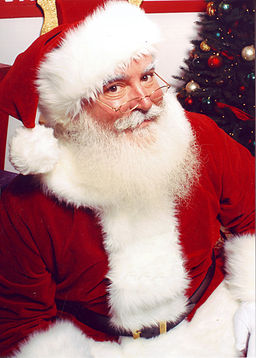
Mae walked up and placed her hands on their knees. She loved their independence and eccentricity, but they could be tactless about how smart they were—like her ex-mother-law—and she needed to take that attitude down a notch. Gently. “Now what in the world is Santa Claus gonna do if all these kids don’t believe in him?”Santa_Claus

Brook frowned, saying he couldn’t do anything if he wasn’t real, but Stream started to laugh. “He’ll pop like a bubble.”

Mae did her best to act serious. “Did you tell your friends there’s no Santa?”

The girls exchanged glances. Brook said, “We got in trouble for it at school. It made some kids cry.”

“It might be hard on ol’ Santa, too. Popping like a bubble. Before you tell any more kids he’s not real, I think I’d better give him a call and see how he’s feeling.” Mae took her cell phone from her jacket pocket and pretended to make a call. She rolled her eyes and sighed as if waiting a long time for an answer.

The girls poked each other and giggled. Stream whispered to her sister, “She can’t call him. She’s making believe.”

Mae raised her eyebrows, giving them the oh yeah? look, and then a triumphant smile as if she’d finally heard a voice. “Well hey, Santa buddy. What’s up? You know Summer Stream and Autumn Brook Ridley don’t believe in you anymore? … Oh. Of course. I can’t surprise you. You know who’s naughty and nice. “

Brook protested, “We weren’t naughty. We told the truth.”

“But did you tell it nice?” Mae turned away, lowering her voice to resume her conversation with Santa. “I hope they didn’t hurt your feelings. They told half the kids in Bertie County, North Carolina—You’re kidding! … So what are you doing now? … Really? Shut up! I live there. I just left for my vacation.” She put her hand over the phone. “You won’t believe it. He’s checked into a spa back in Truth or Consequences, New Mexico. So many kids stopped believing in him, he’s taking this Christmas off.”sign_-_new_mexico_-_truth_or_consequences_-_exit_4892943477

“What’s a spa?”

“It’s sort of like a motel with extra stuff. The ones where I live have hot springs. People go there to relax and get healthy.” She got back to Santa Claus. “Which one? You at the Charles? La Paloma? … I never heard of that one. The Fat Buddha? … Oh. Reckon I wouldn’t see it.”

She explained to the girls, “He’s at a spa for supernatural beings. Regular folks can’t see it.”

Both girls frowned, and Brook asked, “A spa for what?”

The_Laughing_&_Lucky_Buddha!_A_stroke_of_Luck!_(413428647)    “Supernatural beings. Kinda like ghosts or angels, but not exactly. It’s run by a big fat Buddha. You know who he is?”

Stream nodded. “Granma Sally has his statue on her desk. She says he helps her stay calm when she does taxes.”

“He’s helping Santa, too. And they’re hanging out with another fat supernatural, Ganesh. He’s this Hindu god with an elephant head.”

“An elephant head?” Stream whooped.

Brook asked, “How come they’re all fat?”Ganesh_2

Mae repeated the question to Santa and listened while she worked on an answer.

“He says it’s because they’re supernatural. They don’t have to be in shape to be healthy. Ganesh …” She had to stop and think again. Her neighbors in T or C were into yoga and they had a Ganesh poster in their living room. Finding it strange but beautiful, she’d asked Kenny to explain it. “Ganesh is fat but he’s big and strong, too. People call him the remover of obstacles. Like an elephant can pull a fallen tree off a road but a human can’t.”

Stream looked skeptical. “Do people believe in the elephant-head guy? Like they believe in Santa?”

“Some do, but a lot of people just believe in what they all stand for. Like being generous and happy and enjoying life. Santa says they’re hanging out in the hot spring together and these other guys helped him with something he was worried about. So, you did him a favor, giving him a vacation, but he wants to go back to work next year, and he’ll need kids to believe in him again.”

“We can’t make them.”

“No—but you can keep it to yourselves if some new believers come along. You know why he wants to go back to work?”

Brook asked, “Does he get paid a lot?”

“No—he does it to be kind. And this is what those other fat dudes at the spa told him. He’s been too generous. See, they don’t get as carried away with their roles as he does. They help people by changing their lives, not giving stuff. He’s been giving people way too much expensive stuff, and they’re starting to think Christmas is about getting big, fancy gifts. So next year, he’s gonna cut back. Give stuff that means more and costs less.”

Mae took a deep breath and let it out. She hadn’t known she was going to say that. But as a college student with a part-time job and not much cash, she’d had to buy small gifts this year—child-sized team T-shirts for the College of the Rio Grande Tarantulas and a pair of stuffed toy versions of the mascot. She’d wanted to do more, but the trip east had cost all she could spare, and yet she didn’t want the girls to think she loved them less because she didn’t live with them anymore.

“Like when we make you presents,” Brook said.

“Exactly.” Mae smiled in relief.

“Good,” said Stream, “because we—”

Brook dug a fist into her sister’s arm. “Sh. You can’t tell her.”

“That’s right.” Mae put her phone in her jacket pocket. “Being surprised is part of the fun.”

The girls stared at her pocket. “Mama,” Brook said, “That was rude. You hung up on Santa without saying goodbye.”

“Oops. Look like I’ve been naughty, too. Good thing he’s taking the year off.”

“Yes, and …”

How often do we say, “Yes, but …?” Sometimes, it’s how we decline unwanted advice, but it’s also what we say when we’d like to do something but automatically think we can’t. I heard Bob Harris, travel writer, microfinance lending enthusiast and author of The International Bank of Bob, as a convocation speaker at my college. He described how he came to embrace microfinance through some of the adventurous jobs he’s taken, experiences that broadened his world view.

The attitude of “Yes and…” got him there. It’s an approach he learned when doing improv comedy. Suppose a fellow actor suggests, “We’re in Spain.” If you say, “Yes but,” the scene is dead. If you say, “Yes and,” you can build on it. One of his examples was how he responded to a job offer asking if would write for a telenovela in Mexico. “Yes, but I don’t speak Spanish” would have closed the door. Instead, he dared to walk through it, answering: “Yes, and I can learn the language fast.”

A travel writing job reviewing the world’s top fifty luxury hotels brought Harris face to face with painfully glaring income inequality in a way that made him deeply uncomfortable. The contrast between the lifestyles of the guests and owners of these resorts and the lives of the people who built and maintained them led to his interest in micro-lending. Later, he visited microfinance recipients around the world, to see the impacts of the small no-interest loans he and others had made through Kiva, a microlending nonprofit. It took hard work on the part of the people who received the loans to grow their businesses—a chicken farm in Bosnia, a little shop in Rwanda, a barbershop in Beirut, and others—and little risk or effort on the part of people who each loaned them around $25.00. All it took was a “yes, and…”

I’m thinking of the various yes buts and yes ands in my life, such as letting new love or friendship in, or getting involved in a good cause. Turning it down would be a yes but. Yes and is more rewarding and yet it can be mentally difficult. It’s not just negative events that can be disruptive. Positive adjustments are disruptive, too.

In some ways, the world appears to be taking a dark turn right now. A backwards turn away from compassion, away from stewardship of the earth. When I look at the work to be done, it’s huge, overwhelming, urgent and complex. Can my small efforts make any difference? The answer is “yes, and…”

Wobbly

I had to share this wonderful image of Truth or Consequences. There’s a scene in Ghost Sickness that takes place right here, on this sidewalk in front of Passion Pie Café. And I wanted readers who haven’t been to T or C to get a glimpse of my town. I highly recommend the photography blog this came from, Always Backroads.

Donna Catterick's avatarAlways Backroads

wobblyMain Street, Truth or Consequences, New Mexico, USA.

View original post

From the Shadow Side of My Bookshelf

shadow1

That’s the side I never look at. The side scarcely touched by my superficial housework. Where the dust is.

This week, I stuck the duster behind the books, though I didn’t bother to pull them out, and I encountered a slender volume that had shifted into the shadow side. I’ve always believed that if a book literally, physically jumps out at me, I may need to read it. This one had ducked back and hidden from me. I pulled it out. It was Jungian psychologist Robert Bly’s A Little Book on the Human Shadow. I’m Jungian enough to appreciate synchronicity. shadow3

I opened it at random and found a chapter that’s an interview with Bly and his editor William Booth. It starts with Booth asking Bly how some ordinary person, a hypothetical woman in a small town in Minnesota without access to a Jungian therapist, might find her shadow. (The shadow, by the way, isn’t necessarily the bad side of the mind, it’s the unacknowledged side, the aspects of ourselves that we have, in Bly’s imagery, stuffed into a bag we carry around on our backs.) In his answer, Bly suggests that this hypothetical ordinary person look where her attention is drawn. Does she tend to think too much about a member of her community that she sees as sexually loose and immoral? Does she find herself obsessing on a member of her PTA who she thinks is fake and dishonest? If these other two women dominate her attention, her shadow may be calling her to look at her own sexuality and at her own level of sincerity and honesty.

In essence, Bly says, to find your shadow, look at what you hate.

That’s different from what you disagree with. It’s quite possible—more so face to face than in social media conversations—to disagree without hatred. I find it valuable to talk with people with whom I disagree so we can stay in a constructive relationship. But I hate yappy dogs that won’t shut up. I’m an extravert, a talker, and I’m persistent as heck. Maybe I need to acknowledge my inner yappy dog. The other day during my outdoor yoga practice between the tennis courts and the college president’s house, the president’s dog objected to my presence exactly at the time I was ready to practice savasana. Deep relaxation. Quietness. What could I do? I focused on the spaces between the barks. Maybe I can do this with my own yapping thoughts. My tendency to object to things.

Back to the book. Bly chose Abraham Lincoln as an example of a well-known person who seemed to have incorporated rather than rejected his shadow. I agree. One thing I admire about Lincoln is how he handled anger. He would write his “hot” letter to the person he was angry with, then put it in a desk drawer. A few days later or whenever he felt calmer and could think more clearly, he would communicate rationally with the individual, never sending the angry letter. He felt anger and expressed it, but processed its meaning rather than lashing out. That’s my reason he seems integrated. Bly gives the illustration of Lincoln’s sense of humor, his ability to laugh at himself and not take offense.

A woman meeting Lincoln on a train told him that he was the ugliest man she had ever set eyes on. Lincoln asked her, “What do you suggest I do about it?” She said, “You could stay home.” He liked her answer and enjoyed telling the story.

The shadow, once explored, might be a source of lightness, or of strength, peace, or beauty.shadow_of_a_dune_in_death_valley


Image: Shadow of a dune in Death Valley by Brocken Inaglory

A New Mexico Mystery Review: The Pot Thief Who Studied Einstein

tptwseMy delight in reading the Pot Thief books never fades. As I dive into each story, I find something cozy and familiar and yet full of surprises, a quality much like pot thief Hubie Schuze’s happy hour conversations over margaritas with his friend Susannah.

This book has the best opening I’ve read in years. It sets the tone, revealing Hubie’s sense of humor, while introducing the instigating event for the mystery immediately. “I was trying to remember if I’d ever been blindfolded before. I didn’t think I had, but the cloth over my eyes felt vaguely familiar, almost nostalgic. I couldn’t imagine why. The only images I could connect with blindfolds were kidnappings.”

 Hubie is brought in this mysterious way to appraise a pot collection. In that collection, he finds something that shouldn’t be there. And the appraisal fee gets sneaked out of his pocket on the return trip. The lengths he goes to in order to get it back are clever (and illegal) and get him into trouble for something he didn’t do: kill the pot collector. An unexpected new romance results from his attempts to sort out his situation.

Orenduff does something I’ve seen one other author do successfully (Martyn V. Halm, in his Amsterdam Assassin thriller series, which in all other ways is as different from the Pot Thief series as it could be, though just as good). He inserts interludes. These are short chapters which tell a story within the story, about a personal aspect of the main character’s life. These interludes are few, well-crafted and beautiful, revealing details about life in New Mexico and showing Hubie’s appreciation of old friends and of the place he lives. They aren’t unnecessary, though it may sound as if they are. The nature of these books is such that this is the pace. This is the personality. There is suspense, but it’s suspense from the point of view of a man who has some amusing opinions that he freely shares, and who savors the taste of life, from traditional New Mexican cooking and Gruet champagne, to friendships, the scenery on Sandia peak, and the unexpected companionship of a funny-looking dog.

As always, the story is full of fascinating information about what Hubie is studying. The book he’s reading on Einstein and quantum physics plays a key role in the plot and in his thinking, as he struggles to understand the uncertainty principle and figure out who really killed the pot collector.

If you haven’t started this series yet, begin at the beginning and make friends with Hubie in The Pot Thief Who Studied Pythagoras.

I’ve also reviewed the most recent book in the series, The Pot Thief Who Studied Georgia O’Keefe, and had the pleasure of interviewing the author, J. Michael Orenduff.


Dialogue and Discomfort

488px-gradual_change_heart_image_red_strawberry-svg

This isn’t about writing dialogue in fiction, although it’s related in a way. In fiction, an author has to sustain conflict. In real life, we have to resolve it. Keeping the drama up can be engaging for readers, but it can be destructive when people actually need to hear each other. Contrived and exaggerated conflict is the meat of reality TV, but that’s not reality. And we’re not on TV.

My college, like many across the country, has a Dialogue Club. Students are trained to facilitate conversations on difficult topics. These conversations give students a method for expressing their experiences, opinions and feelings without attacking, blaming or accusing. The participants learn to listen without arguing back. The purpose is not to persuade anyone, but simply to understand each other.

I had already planned a Dialogue Club activity in my freshman seminar this week, and the timing was right. We talked about the topics my students had chosen in advance: Black Lives Matter, and athletes who kneel during the national anthem. And then, once we had practiced our skills in civil discourse, I asked if they would be willing to share their thoughts on the election in the same way. They did. It was amazing. My class found this dialogue process valuable enough that they want to do it every week. This is so promising, I’ve volunteered to part of an upcoming campus-wide dialogue about the election results.

The origin of dialogue clubs, to my knowledge, is with a group of women in Massachusetts who had pro-life and pro-choice views and were tired of the anger and even violence that had arisen in disagreements about abortion rights. Their purpose was to hear each other, and they found that there were not just two sides. If there were ten people in the room, there might be ten sides to the issue. Venting to our like-minded friends is a relief, of course, and we all need to do that. But then, we need to move out of our comfort zones, our echo chambers. Reducing our stress often begins with raising it—by doing what makes us uncomfortable. Getting involved in anything controversial (in a role other than audience) can make most people uncomfortable, unless they are the type that thrives on conflict. The rest of us need to be as engaged, or even more so, than the people who enjoy being angry.

Dialogue clubs have been used not only on college campuses. They have been effective working through national conflicts, in places like Rwanda. Talk doesn’t replace action, of course. What it does is do is give people the courage to become part of the public conversation, the first step toward peaceful, constructive action.