Teaching Myself to See

Years ago, at a party on the Damariscotta River waterfront in Maine, I met an artist with whom I struck up a long, thoughtful conversation. We stayed in touch for quite a while, but what I remember most about him is this. He said, “I paint to teach myself see.” I was making my living acting at the time, so I responded, “I wonder if I act to teach myself to feel.”

Writing, I have to be actor, artist, and playwright, teaching myself to observe more mindfully, to listen to others and the sounds of the world, to experience my own emotions with awareness, and to notice textures and scents. A smell can trigger a memory more powerfully than anything else. The more I pay attention, the more seeds I have in the seed bank of ideas from which stories, scenes and characters grow.

As well as being part of the creative process, this practice of awareness pops the bubble of busyness and brings me into the present moment. It’s an eye-wide-open meditation I can do at any time, cracking the shell of the ordinary to reveal its depth.

The Back Yard Buddha

My landlord put a Buddha on the back deck of the house I’m renting. This statue is about two feet tall at most, a slender Indian Buddha, not the jolly fat Chinese kind, and he has a seam on his right shoulder that shows where he was broken out of a mold. He’s a mass-produced Buddha.

A few weeks ago, I was sitting for meditation after my yoga practice and noticed that his hands were in dhyana mudra, which I was about to use to center my mind. (Imagine the classic thumb-to-first-finger jnana mudra joined by sliding the hands together so the tips of the thumbs and the nails of the first fingers touch.) Dhyana means concentration, the most difficult stage in yoga for many people, myself included.

His eyes are closed and he has an infinitely subtle Buddha smile, an expression that somehow conveys deep and effortless focus, immersion in what Buddhists call “lovingkindness.” As I sat with my eyes open, held the mudra and gazed at him, I felt the peace and stillness of that smile. I’ve never used any kind of spiritual or religious imagery for meditation, so I found this effect intriguing. I’m an extravert by nature, and I wondered if this mirror of true inwardness was what I needed, or if I was just borrowing serenity.

Over time I’ve started to feel my mind fall into quietude from a mere glance at the Buddha, whether he’s glowing in the moonlight or showering in a thunderstorm. I like to think that the artist who made the original put something special in that face, and understood that mudra. It makes me glad this Buddha is mass-produced. Somewhere, someone else is smiling back at him. Hundreds of people, hundreds of smiles, petals of peace in a single flower.

Ten Things I Love about Truth or Consequences

Conversations. I’ve never been in a situation where anyone was at a loss for words. The line in Bullock’s grocery store, Art Hop, the pool, a drum circle by the Rio Grande at night … it doesn’t matter. People will talk to you anywhere. I met all my friends here through random conversations with strangers.

Passion Pie Café. The place has art on the walls, art on the tables, great tea and coffee, vegan date bars, a free book shelf, and plenty of the above-mentioned conversation.

Hot springs. Of course. That used to be the town’s name. A soak can restore mind and body and spirit.

A history of healing. Magnolia Elis was an important part of the town’s life as a healing destination in the middle of the twentieth century. Her capacities as a healer were reputed to be extraordinary. Her building is a historic landmark now, with her name glowing on the roof in blue neon at night.

Critters. Bats come out at dusk to hunt insects near the Rio Grande, swooping and dancing over the river and the wetlands. If I go to the right spot at the right time, they surround me. Sometimes I’ve seen them crossing the stars as I lay in a hot spring at night. If there’s been rain late in the day, tarantulas emerge from their burrow to seek mates. Lizards seem to be everywhere—scurrying from one patch of shade to the next by day, occasionally sticking to walls and windows in the evening. They look bland at first, but on closer inspection I’ve found that some are pearlescent gray with a subtle peachy glow and others have a delicate brown-and-white checkered pattern with hints of orange. There are hummingbirds, butterflies, and also few of the most impressively vile bugs I’ve ever met, such as big black ants that can bite through your socks and a few summers ago we had a bizarre inundation of skunk beetles. I don’t want them to visit again, but they were interesting.

Stars. Okay, everyone in the desert gets excited about stars. Anyone who has ever come from the humid East to the dry West has had the same dazzling discovery: there are a lot stars up there, and they are really bright.

Rain. It’s so special when it rains in the desert. A big black cloud is not threatening but promising.

Turtleback Mountain. The serene turtle draped gracefully on its crest really looks like a turtle. (I can’t see the elephant in Elephant Butte, can’t even tell which of those gray buttes is supposed to be the elephant)  The turtle is always relaxed, as if he has just done yoga and is now in an amphibian’s version of savasana. With the recent rain he’s looking a little like a chia pet as the red-brown rock fuzzes up with patches of green.

Color. Much I love adobe-brown-pink-beige Santa Fe, I like the way T or C mingles that esthetic with wilder décor (and a lot of trailers). There is a candy-cane striped law office on Main Street. Homes range from adobe-normal to pink, purple, yellow, turquoise, and covered with murals. A shop on Broadway has Lakota-style ledger art on its stucco walls. The next one is bright green with orange and blue turtles parading over the door. An old van drives around town wearing the word “whatever” on its collage-covered side.

This isn’t a rich town; in fact quite the opposite—it’s always struggling. And yet it never collapses in on itself. It’s vibrant, full of art and originality.

 Do you know and love T or C? What’s one of your favorite things about it?

Art that Inspired Me

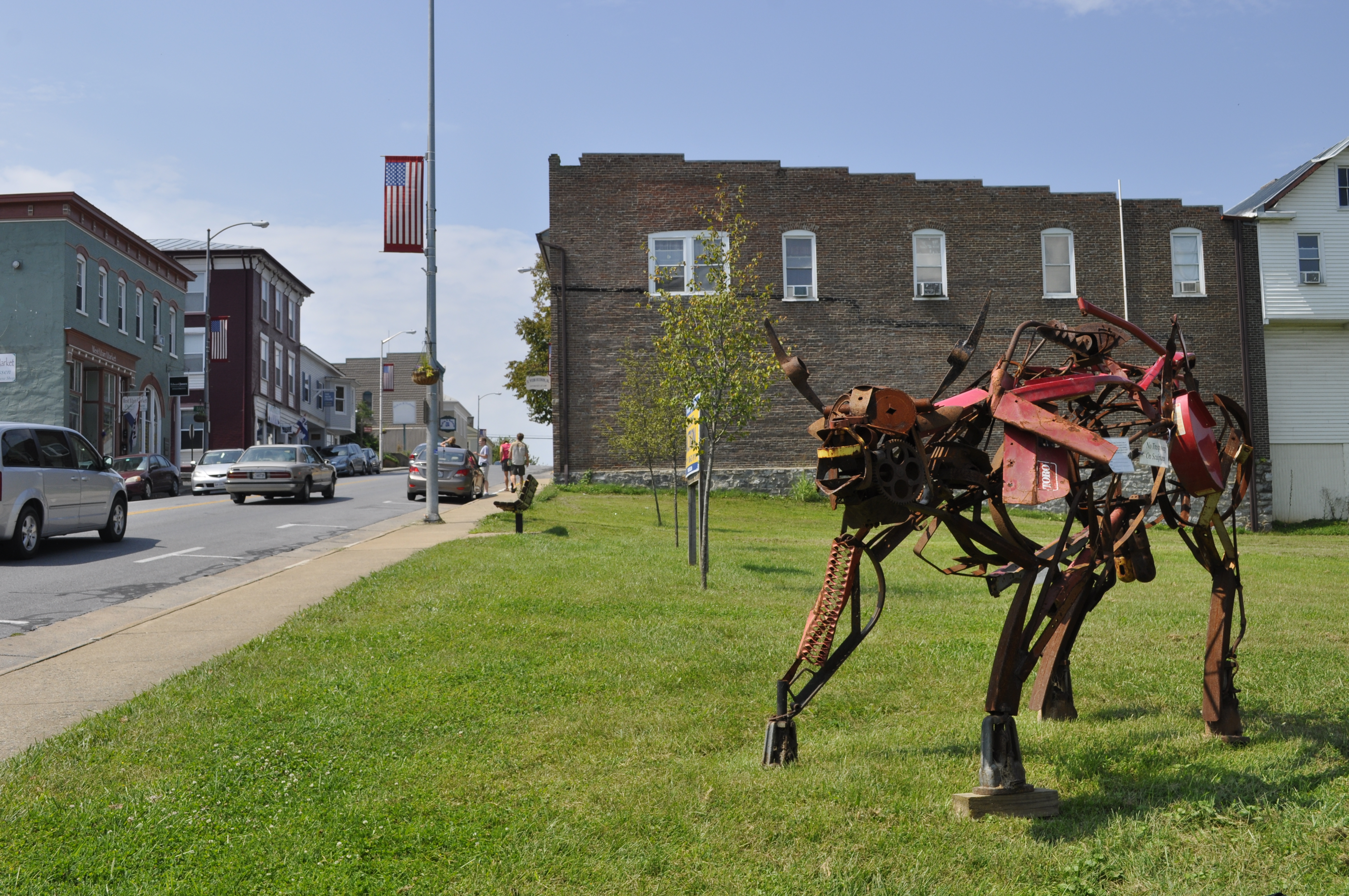
The Bull

I can’t take full credit for the images of Niall Kerrigan’s sculptures. If you’ve read Shaman’s Blues you know the art I’m talking about—rusted metal, parts of old tools and machines recycled into creatures or people. Take a look at the art that inspired the art in my book. Sculptor Alexandra Soler’s work amazed me when I encountered it in person. Her animals aren’t just inventive, but practically alive. They seem to be filled with some inner vitality, ready to move, supported by anatomically believable muscles and bones—and yet they are made from recycled metal scraps. She finds parts that are shaped like the parts of the animals and reuses them with perfect fits. I have no idea how long it takes her to create these sculptures, but even finding the right materials must be challenging, not to mention the process of building them. My favorite is the bull made from Toro lawnmower parts. He is every inch the bull. I wish you could stand face to face with him. It makes you feel as if he’s making a turn to charge you.

See more of her work on Art by Alex. The horse made of horseshoes is startlingly real. The chicken made me smile.

https://www.facebook.com/ArtbyAlex