Outdoor Yoga and Bushy Neurons

I’m still exploring Hare Brain Tortoise Mind at a tortoise pace, and I came across this concept in it: Animals that live in highly stimulating environments grow bushier neurons in their brains. That is, the neurons develop more dendrites, make more connections with their neighbors, and become capable of new and varied patterns of interaction. They can get out of a rut.

I think of T or C as a bushy neuron kind of place. A friend who visited from Virginia tried to explain what she found so remarkable about it. She said I’d described it well in my books, and yet those descriptions hadn’t captured a certain aspect of its vibe, something she struggled name or explain. Then she finally realized what it was. “There’s no pattern.”

While she was here, she mentioned how odd it was to look down an alley and see not only a dirt alley with dumpsters, but also an explosion of murals—not graffiti, but murals. The town kept surprising her. And it can still surprise me.

She’s right; there’s no pattern, unless the two blue-and-purple houses on my block constitute a pattern. But one has a moon goddess on it and the other has a Kokopelli. On the same block are trailers and the stucco-and-stick-fence gated wall of a spa that will never be built. For some reason, someone bought the lot quite a few years back and began construction, although you can’t build anything that size in this location. It’s a nice wall, though.

Doing some volunteer work that takes me all over town, I recently discovered a section of Juniper Street I never knew existed. The street has three disconnected parts, and I’d only known about two of them. This third part is around a hidden curve. From there it suddenly drops down, becoming so steep no one could ever ride bike up it and so narrow you’d hate to meet another car on it. On one side is a great wall of wind-and-water-sculpted red dirt and on the other side, two residential streets, one with little houses, and below that, one with super-bright crayon-colored trailers. When I’ve looked down at the town from the water tower hill, I couldn’t figure out where the street with those trailers was and how one got to it. That third leg of Juniper was hidden by the wall of dirt.

In other neighborhoods, I’ve food an orange-and-blue building, stone buildings, a yellow house with Lady of Guadeloupe murals, little hidden cottages behind other houses, magical gardens, art gardens, hoarder yards, collapsing houses, yards with so much trash in them I worried how people could live that way, serene little adobe apartments with winding paths and desert gardens, and many of these coexist on the same streets. No pattern. The appeal of T or C to artists and musicians makes sense. It’s not neat, cute, or pretty, but it makes your neurons bushy.

The recent exposure to so many new off-beat places seems to have broken my habitual perceptual patterns. I discovered a perfect spot for outdoor yoga in the courtyard outside my apartment that I never noticed as such, though the small square of bricks was always there. Smooth and flat, partly shaded, it faces the autumn-yellow fig tree and a tall purple aster. Yoga feels more spiritual under the open sky with nature around me, even if it’s nature in the courtyard. And the shapes of the fig tree and the flowers reminded me what the novelty was doing for my neurons.

*****

Read more of Amber Foxx’s essays on this blog and in the collection Small Awakenings: Reflections on Mindful Living.

 

Brain Wash

Wednesday was an insanely busy day. I moved back into my place over the Labor Day weekend. The bad neighbor is gone! But I’ve had a lot of catching up on my life to do. The last thing I felt like doing was laundry. It’s the one aspect of retiring and downsizing that’s been unsatisfactory, because I have no room in my otherwise perfect apartment for laundry machines. I’ve adapted to the laundromat as well as I can. I bring books and magazines and read outside, I take walks, or sometimes I bring my exercise tubing and work out, but I still don’t like it. On this super-busy day, the laundromat was also busy, full of people doing noisy things on their phones, and there were noisy activities outside too. I read, but it wasn’t peaceful. I ran an errand while my clothes were in the dryer. More busyness. When I got back, one of the dryers hadn’t started when I thought it had, so I had to restart it and wait longer.

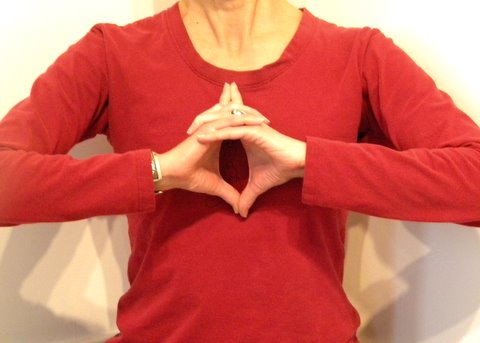
Normally, I do a meditation practice with mudras late at night, to clear the day away and cleanse my energy. I did it there, in the laundromat. The only other remaining customer had gone outdoors. I didn’t care if she came back in and saw the mudras, though. This is T or C, after all. People here talk with strangers freely, and she’d already shared something pretty personal in our short conversation. I was free to be myself.

All the churning and spinning of machines echoed my state of mind. Then, five minutes of mudras in mountain pose in front of that misbehaving dryer changed everything. The washing was done. Inside me.


*****

Enjoyed this post? You may also like Small Awakenings: Reflections on Mindful Living.

Change

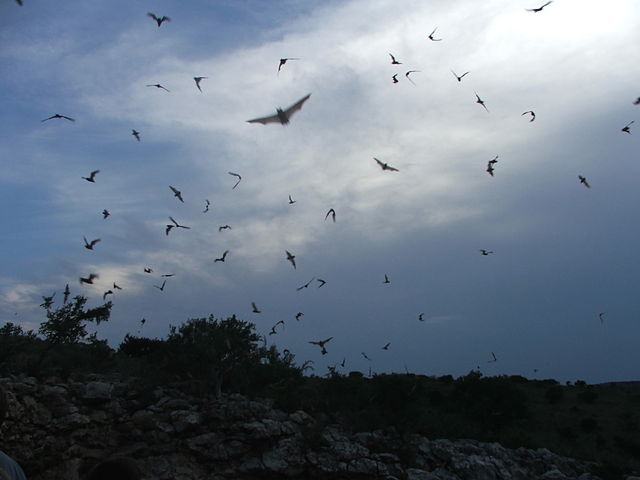
The bats have relocated. It’s an unwelcome change for their fans, but it was inevitable. They couldn’t stay in a man-made structure forever.

The old warehouse where they resided has been sold and cleaned out, and repairs are in progress. The building was crumbling, and the bats, delicate and magical as they are, made it stink. The man working on the place said the bats were welcome to back if they wanted to for now, but of course they don’t want to. He had the doors wide open and daylight was pouring in. The building is going to be converted into several apartments. As one of my neighbors said, even bats have the sense not to like developers.

Years ago, the bats lived in the Methodist church, also known as the pink church. Then, after a fly-out, the church had wire mesh installed over the vents so the bats couldn’t come back in. They moved to the warehouse. Now they’ve moved again. Bat lovers in the T or C hot springs historic district have been watching the sky at sunset. Our little relatives are still around, though in smaller numbers, and we don’t know where they live now. We’ve checked various possible new bat homes. The Baptist Church. No bats. The ice house, an empty building between Rio Bravo Fine Art and the community youth club. No bats. Though I miss the clouds of them in the evening sky, I hope for the bat colony’s sake that they have moved to a nice private cave on protected land where they can stay for generations.

Several evenings ago, I took a sunset walk, and a few bats hunted bugs over the streets. I counted seven bats fluttering over the river and the wetlands, but I couldn’t stand by the water and be immersed in them. And gnats are gathering on my ceiling again, though only by the dozens, not swarming the way they do when the bats are entirely out of town.

A speckled and striped gecko, no more than an inch long, with a rosy patch on its tiny head, was attempting to sneak into my apartment when I got home from running today. I was tempted to allow it to move in. It was cute and it would eat gnats. But I caught it, admired it, and carried it across the courtyard to a rocky area under a tree. Better for all of us, in the long run.

Launch

On June 1st 2017, I left my apartment in Virginia for the last time. With the help of an amazing friend, I had most of my belongings miraculously crammed into my very small car, and had already sold my furniture and excess books. I said my good byes and gave away my bed, my landlord inspected the place, and I hit the road. Bit by bit, plan by plan, I downsized to the minimum and retired early. I’d say more, but why? It was interesting to me, of course, but not because of any adventure or drama that would make a good story, but because it went so smoothly.

On June 1st 2018, I went for a walk to enjoy one of T or C’s amazing full-circle sunsets— pink clouds in the south and in the east, orange and purple mingling in the West—and to commune with the bats that emerge from an old warehouse in the middle of town, next door to the trailer I use as Mae’s house in my books. (I’ve not used the bats in my books yet, but Mae would like them.)

I watched the bats pour from a crack in the brick wall in a flow of perfectly sequenced flights, one bat right after another, and tried to imagine how they organized this exit. One squadron would take off, and then no one came out for a while, but after the pause there was a lot of squeaking high up in the old warehouse. Whenever the squeaking got loud and then stopped,  more bats came out. Sometimes a solo bat popped out of a small hole lower in the wall or shot out of a hole to the right of the main exit, while the main surge of fliers swept out from the big crack and headed for the river. Their orderly formations dispersed into every-which-way flutters, a few independent bats leaving the crowd altogether to stay and hunt bugs around the neighborhood.

One reason this multi-bat take-off is so amazing is they can’t run; they can only take off by dropping and launching like hang gliders. Imagine the launch sequence inside the old warehouse as one bat after another lets go of the ceiling and aims for the exit. Somehow, they organize it, and it works.

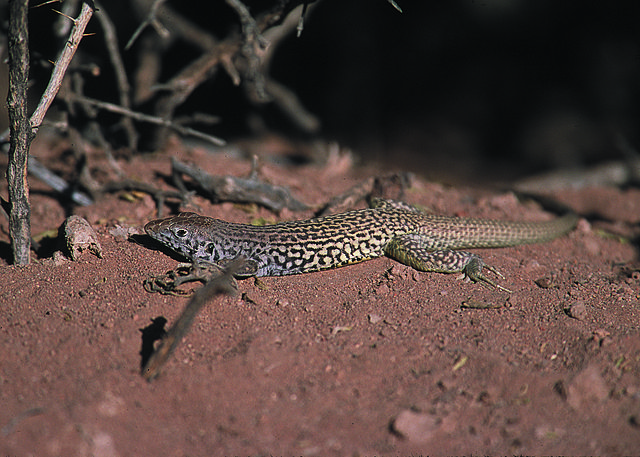
A year after my move, I have no regrets. It was the right decision, a successful launch. I can live happily as a writer and yoga teacher in a very small apartment in a wonderfully weird town. I’ve made new friends and no enemies (that I know of) and am still discovering the simple beauties of this place. I ran in the desert on June 1st 2018, aware that a year earlier I was in my car. On my way to the quail, the jackrabbits, the mule deer, and the checkered whiptails that made my run so beautiful. On my way home.


Happy Coincidences

Dear Susan,

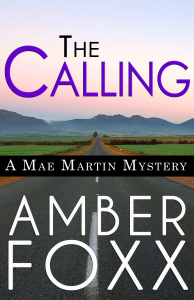
First, happy birthday. I’m honored that you wanted to treat yourself to my books to celebrate. Second. I want to thank you for telling me why. You said reading The Calling had a positive impact on your life. Writing it had a positive impact on my life, too, as I explored healing and loss, friendship and enmity, and the lessons learned from all of them. When you said the book had an effect as you were making changes in your place, working with its energy, I understood. I’m part-way through book seven in the series, which introduces a character who is a house healer, so this was an intriguing coincidence.

Your call to Black Cat Books to order the rest of the series was another synchronicity. My neighbor and I had gone there for tea and book shopping before the store takes its summer vacation. (The off-season in T or C starts after Memorial Day. It’s already in the upper nineties.) Your birthday happens to fall right before the store closes up for three months. I was just about to head out the door when I heard Rhonda, the store owner, mention my name. So I stayed and had the opportunity to talk with you and then signed the books dedicated to you.

Authors don’t often get to talk with readers. I hugely appreciate those who review or get in touch, but I don’t expect it of the majority. All I want is for them to read, enjoy, and repeat. Hearing how you connected with The Calling at a psychological and spiritual/energetic level meant a lot to me. Your input reminds to keep taking my protagonist on her healing journey, through mysteries that challenge her emotionally and ethically and require her to learn (often the hard way).

Thank you for supporting a small, independent bookstore and for making an author’s day—not only by buying my books, but re-grounding me in the reasons why I write them. Next time you visit T or C, perhaps the book with the house healer will be in Black Cat for you.

Amber

Cactus Flowers, Colander Hats and Other May Musings

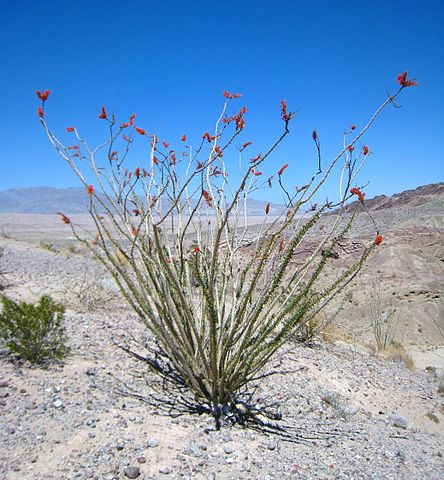
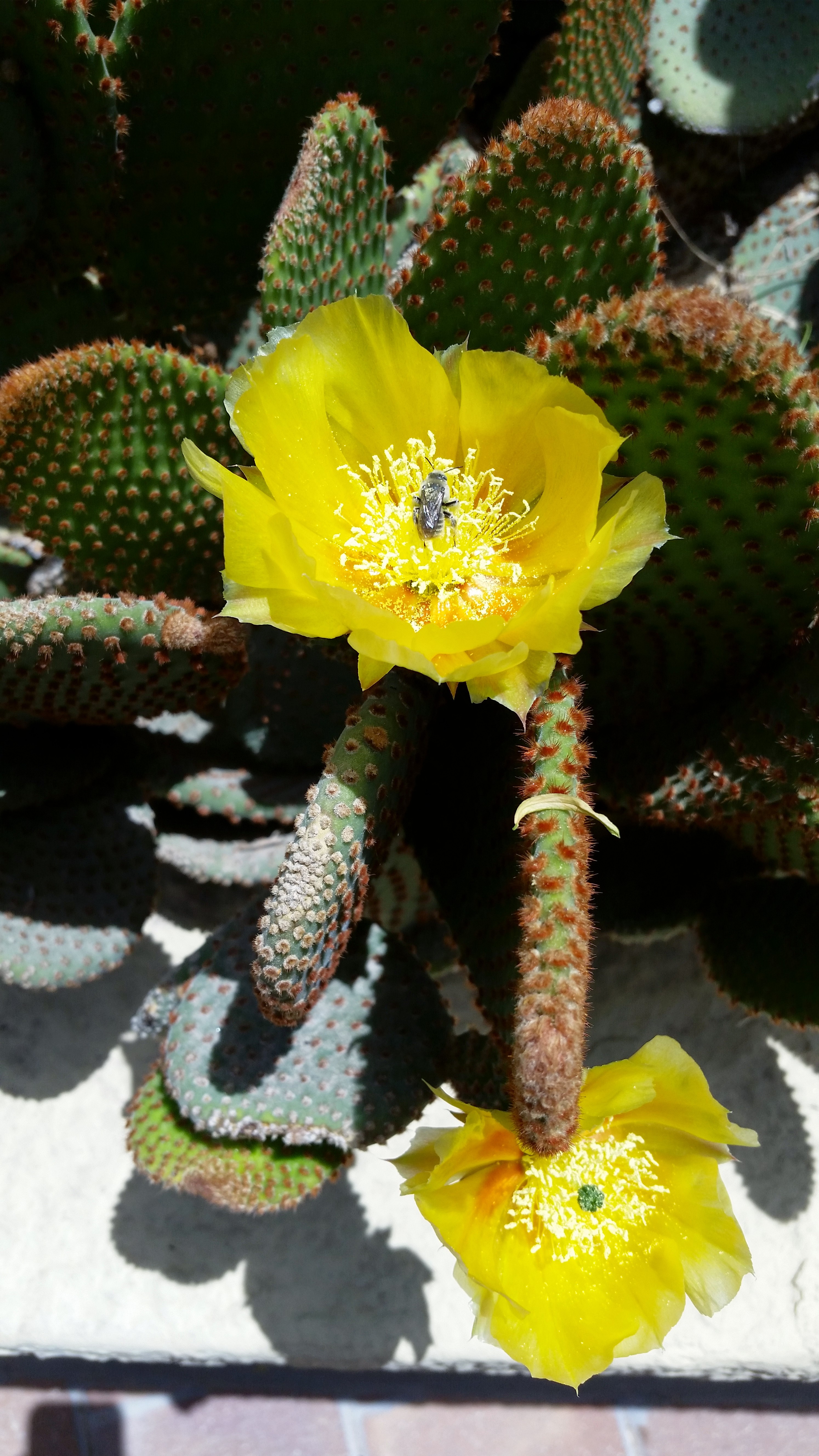
This is my first May in Truth or Consequences. I may have complained about the wind a little (or a lot) but there’s much to love, and when the wind stops, this hot spring/summer month is beautiful. We don’t have green grass and tulips and daffodils here, but May does bring out some amazing flowers. Ocotillo! It’s not a cactus, though it can be mistaken for one when its leaves have fallen off. In the winter, it looks like a spray of long, thorny sticks. In the summer, it wears small green leaves. And in May, scarlet blossoms flare from its tips, stunning against the bare blue sky, attracting bees and hummingbirds. Tree cholla displays purple-pink blossoms on the ends of its long, spiky arms, prickly pear cacti are blooming with orange or yellow cups, and ice plants, low-growing succulents with daisy-like flowers in a rainbow of colors, cover swaths of ground all along the streets.

A year ago, I was teaching my last college classes, grading finals, preparing to move, and somehow keeping up with writing and yoga. This year, instead of marching in commencement in hot black academic regalia, I was walking with a float in T or C’s Fiesta Parade. Fiesta is a celebration of the town. Local businesses sponsor floats, political parties and candidates join the parade, and of course there are horses and a marching band. My favorite part of the parade was the Stationary Parade on the sidewalk, where residents in extraordinary costumes waved at the moving parade. Some of stationary parade “marchers” were “walking” in no-impact Gazelle workout equipment, legs swinging back and forth on airborne pedals. One man wore a suit of big silver sequins. And they wore, of course, colander hats.

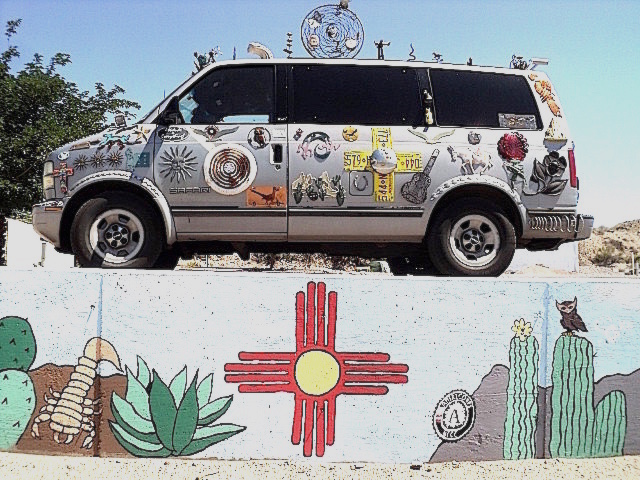
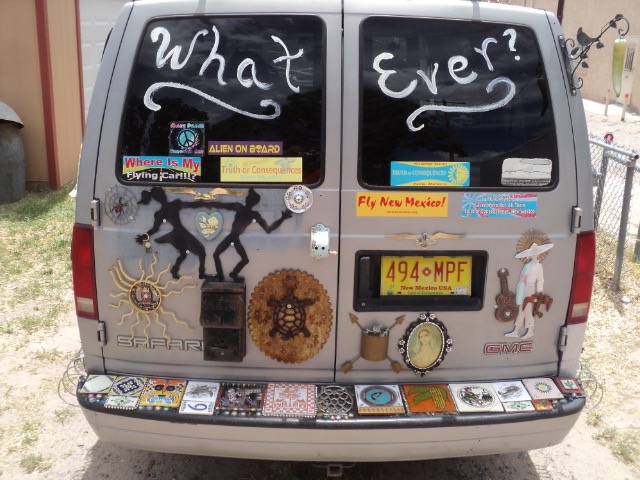
This is not a mere kitchen item on one’s head. It’s millinery art. The Colander Krewe has been part of Fiesta for eleven years, and it’s catching on. The prize-winning float sponsored by Desert Archaic Gallery, Don’s Den, and Truth or Consequences Brewing Company—a float featuring a pink-wigged woman in a top hat beating a large drum, pulled by the iconic Whatever-mobile—was followed by people in costumes topped by astoundingly strange and original hats, including at least one colander.

Fiesta also includes a car show at the Moose Lodge, music and vendors in Ralph Edwards Park by the river, and a junk boat race. By trying to squeeze in the car show and the boat race, I missed all but the final junk boat, a strange creation heading off down the Rio Grande with what appeared to be tiny wheels on long arms like spider legs poking out from its floating center.

The vendor who caught my attention for the longest time was selling crystals, some of them enormous, and he had tubs full of geodes, most of them not broken open, so one could purchase a surprise. I didn’t—crystal-bearing rocks cover a corner of my desk already, some plucked from local trails—but I liked the idea of buying that gray rough sphere, knowing it holds a crystal cave, and waiting until the time is right to open it and reveal the magic. It’s a metaphor waiting to be used. I hope I can find a reason to use it, and to write a scene that includes colander hats.

*****

Totally off topic, but if you haven’t read The Calling yet or want to recommend it  to someone, it’s on sale through May 21 for 99 cents all e-book retail sites.


Road Trip

I recently took a week and a few days to go back to Virginia and North Carolina to visit friends and collect some art I’d stored in one friend’s house. I enjoyed the reconnections with people, and the brief exposure to snow and cold and to architecture that was neither adobe nor trailer. T or C, with a population of a little over 6,000—it’s been shrinking—seems tiny next to Harrisonburg, Virginia (pop. 52,000), though it’s also considered a “small town” by some people. To me, Harrisonburg felt downright urban. So many ethnic restaurants with healthy choices, so many building over two stories tall, and so many traffic lights. (T or C has one.)

I dropped in on former colleagues, and due to snow, I was grateful that retired faculty have access to the college fitness facility. Running on an indoor track takes mental endurance, and if there hadn’t been so many students playing basketball to keep me amused, I wonder if I could have managed my usual distance. I taught a couple of yoga classes at the studio where I used to work in Harrisonburg, and it was a special and meaningful opportunity.

Part two of my road trip took me to Asheville, NC, where I found myself wondering what a trip to the mountains of North Carolina would be like for Mae Martin, my series’ protagonist.  (I was visiting the friend who inspired  the character.) Mae grew up in that area and she has connections in Asheville. What it would feel like for her to go back, after living in New Mexico? Asheville is a lot like Santa Fe and T or C in some ways, with its artists and yoga teachers and massage therapists, but in many ways it’s entirely different. The mountains are old and green. And the smaller towns beyond the city, such as the place where Mae’s grandparents lived, are another world, culturally and spiritually as well as physically, from the funky, eccentric town where she’s made a new home. (I moved her to T or C years before I made the permanent move myself.)

And what about a road trip itself as part of a story? Travel is inherently challenging. I drove through rain in the Blue Ridge on my way in, and on my way back through wind that started to peel the rubber rain-channel seal off my windshield, wind that made it hard to open the car door when I stopped for gas, wind that made big truckers struggle to open and close the doors of the truck stop. There were two wildfires on the outskirts of Amarillo and the flames and smoke mingled weirdly with the sunset. Any events in a story that I could set in weather like that would be doubly difficult for my characters, and it’s my job as a writer to make their lives difficult.

The outcome of all this? I’m glad to be home in this peculiar town with its colorful people and murals, its hot springs, and its art and music scenes. I was glad to see my T or C yoga students, to run in the desert again with the lizards and jackrabbits and roadrunners, and to go out dancing at the T or C Brewery. The art I brought back is either consigned for sale or on my walls, and I feel even more at home now with the pieces I chose to keep all around me. More complete, focused and inspired to create, with new ideas for the work in progress.

Conversations and Story-Telling


My eighty-two-year old neighbor hasn’t been able to walk his dog since he fell off his bike and injured his shoulder. His dog is strong and energetic, and his balance isn’t as good as it once was. We worked out an arrangement where I hold the leash, and the three of us walk together. He’s there to give his dog commands as needed and pull occasional thorns out of her paws, and I’m there for a steady grip and good balance. One reason I offered to do this is because I knew we’d have great conversations. In an hour-long walk, we never ran out of interesting topics. With eighty-two years of engaged, thoughtful life plus a great sense of humor, my neighbor is a delightful story-teller, and I was happy to prompt him to keep going.

At a popular fishing spot on the curve of the Rio Grande, we ran into another gentleman of advanced years with his dog, and the men immediately struck up a conversation about fishing, dogs, and various other things. Normal T or C behavior—talking to strangers.

Later in the day, I went out to dinner with a friend, and when the server came to check if we were okay, since our meals hadn’t arrived yet, we’d been so busy getting caught up with each other we hadn’t noticed the kitchen was a bit slow. A young couple came in and was seated across the room from us. I had a view of them in profile, each hunched over a phone, heads bowed, making no eye contact and no conversation. They looked like a satire on smart-phone addicts. I wondered about the state of their relationship. First date and painfully shy? Together too long and bored? Or was this, to them, normal?

Maybe they’ll stay in T or C a while and put the phones down. I’ve seen local young people doing things like skateboarding the wrong way down the middle of Broadway, earbuds hanging loose and blasting music to passersby (I can use that for one of my characters—Misty Chino would do that), but so far I’ve never seen them doing the blind-to-the world phone-walk my college students so often did. I imagine the young tourists, phone-walking, bumping up against a cluster of locals yakking on the sidewalk with someone who pulled a truck over to the curb to join the conversation. And the couple makes eye contact with the strangers. They answer friendly questions and tell their stories, and go on their way, talking with each other.


People My Own Age

When I was a kid, I was close to my older sister and tended to share friends with her, people a year ahead of me in school. In college and when I first started working, I mingled with my own age group, and I also retained a close connection with a couple who were my father’s good friends. These mature people stood as a contrast to the crazy mistakes my peers and I made in our twenties. I would visit their home, leaving the sea of drama that is young adulthood for an island of sanity, culture, and intellectual engagement, and become aware of the difference, enjoying the respite and the chance to be a little more like them.

As I got older, my friends tended to become younger. I didn’t do this on purpose; they were the people I met through work and yoga, and I seldom felt older than them. By the time I retired, I was generally socializing with people twenty years my junior.

At work, I was surrounded by eighteen-year-olds five days a week, teaching primarily first-year courses. Since I taught in health and exercise science, the subject of aging naturally came up in classes. I often heard students say, “I love old people. They’re so cute.” It was good to know they loved their elders, but that adjective made me cringe.

My former backdoor neighbors had a frantic, poorly trained little dog which they let out in the yard to yap nonstop at all passersby. One morning, a stooped, gray-haired woman passed through the alley between my apartment and dog-owners’ trailer, and of course, the little beast barked hysterically. The woman muttered, “Someone ought to kick that f___ing rat in the head.” I wonder if my former students would think she was cute.

I live in a town where, according to one of its younger residents, the average age is “retired.” My friends are in their fifties, sixties and seventies. Vigorously engaged in their work, their creative pursuits, and in community organizations, they defy stereotypes of aging. Many of the poets who gather at Black Cat Books and Coffee are in their silver-haired years, and the vibrancy and originality of their work is impressive—perhaps because of the years behind the words.

At first I thought the predominance of fellow Boomers and creative people in T or C made it too easy to fit in, and I wondered, is this good for me? While I don’t miss the daily hassles of dealing with college freshmen or grading their papers, I realize I benefited from the abrasion. The longer I’m here, the more I see that everyone, in their own way, will challenge me to adapt and grow. People who are superficially and demographically like me are just as different from me in many ways as my eighteen-year-old students were. This is good. People who are not like me help wear the rough edges off my personality and opinions, like the wind sculpting desert rocks. With that softening comes access to the place where we are more alike, the essence, the humanness, the spirit.

Behind the Scenes: Writing Death Omen, the Sixth Mae Martin Mystery

Now that the book has been out a little over a month, and readers have had a chance to get into it, I thought it would be interesting  to share some of the background for the story and the setting.

The idea for the plot first came to me when I was reading a book I reviewed in depth almost two years ago, The Healing Path by Marc Ian Barasch. In it, the author chronicles his search for healing, and the choices he made when he was seriously ill. He also interviews people who took a variety of alternative, conventional or combined paths. Some were healed in body and spirit; some were healed only in spirit. He visited one healer who was so tactless and blaming, her words stunned me. My antagonist character was born, blended with aspects of a director I worked with in my theater days, a gifted young woman with control issues who could be domineering and aggressive in her methods of getting actors to find their feelings.

When I read a book review describing some unusual ideas about reincarnation, it added other ingredients into my mental stew, along with several articles on Tibetan traditional medicine in a medical journal on alternative therapies. It was the healer who made me angry that got the ball rolling, though. I live in a place where alternative healing is popular, and I would hate to see sincere seekers misdirected.

Another component of the story was the stress of being a medical mystery. No one wants to be one, and yet all illnesses and treatments have an element of the unknown. When symptoms show up, some people put off getting the mystery solved. They’re like the people who would call in to Car Talk and say their car was doing something terrifying but they managed to drive it home. Click and Clack always marveled at these callers. “If it could kill you, why do you feel like you have to drive it home?” We can be that way with our bodies, too. There’s such fear of what the symptom means, it’s an incentive to avoid the diagnosis. We go into denial. Or we don’t trust our doctors and go to alternative practitioners—some good and helpful, some not.

Midway through writing the book, I had an injury that an orthopedic doctor assumed was a labral tear in my hip joint—something that would require major surgery and time in a wheelchair for recovery. It was scary, wondering what was coming. However, suspecting he hadn’t listened to me very well, if at all, I postponed the MRI for a suspenseful month, observed my symptoms, then wrote him a letter thoroughly covering all the facts. He gave me a referral for physical therapy, and I’m well now, no surgery. Not all medical mysteries turn out this well, but the experience helped me understand some of my characters who are dealing with frightening prognoses.

Earlier in the writing process, I resided in one of the suites at the Pelican Spa. It was the summer of 2016, my last summer as a part-year resident of T or C before moving here. I got the idea to have the antagonist characters offer their healing retreat at the Pelican, and asked the manager if it would be okay to write a book in which some wacky people from Santa Fe rent the Red Pelican portion of the spa for a weekend program. She said, “That’s really happened.” The staff was incredibly generous, giving me tours of the Red Pelican rooms that summer and again this year, when I wanted to get the finishing touches right. The setting with an Asian flair turned out to be perfect, since a Tibetan traditional doctor plays a role in this mystery. The Pelican Apartment Motel, the section of the spa where I spent that summer, is where Jamie stays during the retreat, and I lived in the in the green-walled room he is given.

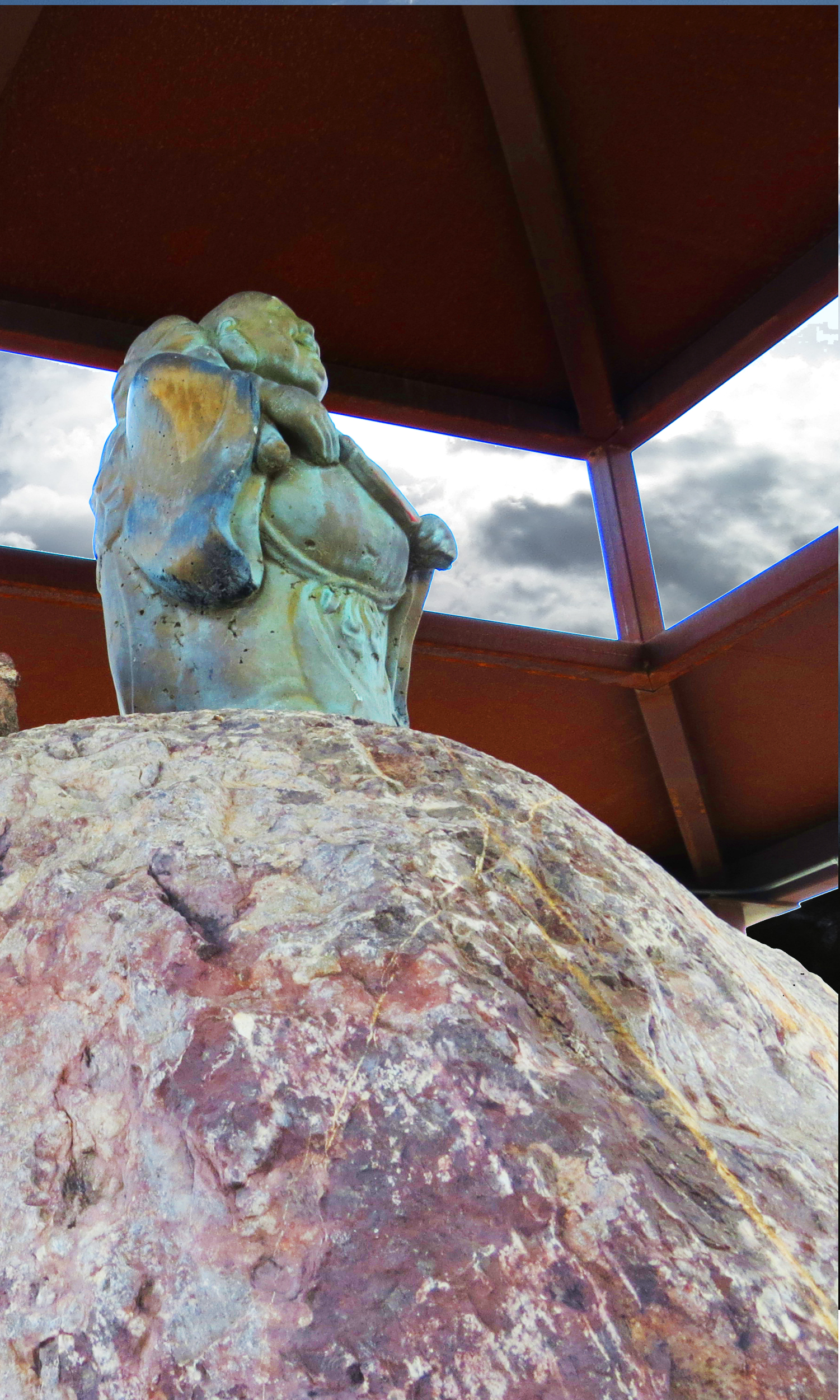
The bright laundry line visible from Jamie’s room is one of the features of the setting I couldn’t resist using. The laundry shot was taken by Donna Catterick, who took the picture for the cover, and was originally posted on her blog. I also like this picture of the Red Pelican’s courtyard rock and Buddha that Donna took. My characters often gather on the benches around that rock.

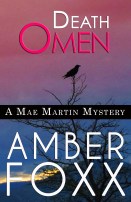
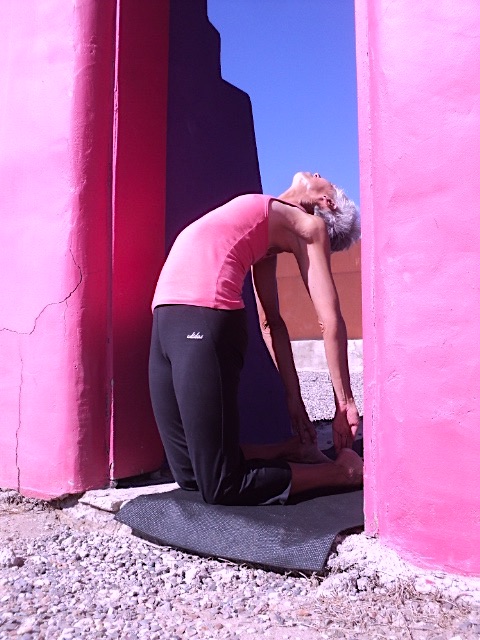
I didn’t tell my cover designer anything about the Pelican. I considered asking her to incorporate something of its color schemes and then decided to trust her judgment. She considered many options but found she kept coming back to the pink lettering. If you look at the cover next to this picture that a friend took of me doing ustrasana, camel pose, for a yoga  studio web site (I teach at a studio attached to the Pelican), you’ll see that the colors match remarkably. The archway where I’m posing is at the back entrance to the Red Pelican Courtyard that my characters often use.

A second real location in Truth or Consequences that I used is The Charles, another classic hot springs spa. When I arrived in T or C in June this year, I asked the owner if she would be willing to fictionally employ Mae Martin as an energy healer at the Charles. This was a healing modality they hadn’t offered in the past, though they’d had massage and reflexology there for years. She told me they’d recently added an energy healing room, and urged me to talk with her manager. I did, and he not only gave me permission to use the space in my book, but encouraged me to take pictures and make sure I got it just right. When I saw the room painted as a healing cave with blue sky in the ceiling, and crystals on the shelves, even lamps made from crystals, I knew Mae was meant to work there. Sometimes reality and fiction line up perfectly.