Reading over a Character’s Shoulder

Readers who picked up Snake Face when it came out in November may have had time to finish it by now. I thought it would be interesting to share this while the book is fresh in those readers’ minds.  In the scene where Joe Wayne Brazos is reading Yeats, the poem he’s reflecting on is The Mask, a dialog between a man and a woman.

Put off that mask of burning gold

            With emerald eyes.”

            “O no my dear, you make so bold

            To find if hearts be wild and wise

            And yet not cold.”


            “I would but find what’s there to find,

            Love or deceit.”

            “It was the mask engaged you mind

            And after set your heart to beat,

            Not what’s behind.”


            “But lest you are my enemy,

            I must inquire.”

            “O no my dear, let all that be;

            What matter so is there is but fire

            In you, in me?”

It would break up the scene to have him say what he read, and I don’t use his point of view. If you’ve read the book I think you’ll understand how the poem fits. And if you haven’t, I’m sure you’ll enjoy this lesser-known Yeats work on its own.

A New Mexico Mystery Author Interview: Rebecca Grace


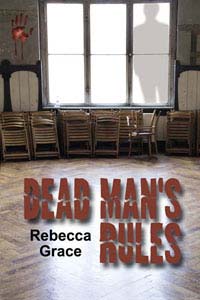
BeckyMartinez-1DeadMansRules-4Last week I reviewed Rebecca Grace’s Dead Man’s Rules. This week I’m happy to have her for an interview about the book and her writing life.

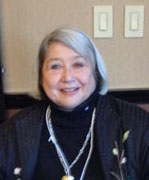
Rebecca Grace is the pseudonym of Becky Martinez, a former broadcast journalist who has worked in TV newsrooms from San Diego to Seattle and from Denver to Los Angeles with a stop in Las Vegas for good measure. After 30 years she left the newsroom for five years in public relations before turning to the world of fiction writing full time. She also teaches writing classes online and has presented workshops at a number of writing conferences.  Her short story, “Trouble in the Rockies” was part of an anthology, The Trouble with Romance, that was a 2006 New Mexico Book Award finalist. Her latest book, is Dead Man’s Rules, was published by The Wild Rose Press. It is the first of a three book series. Her next book will be a humorous cozy mystery, Blues at 11, coming in January 2015 from The Wild Rose Press.

AF: How has your background in journalism has influenced you as a fiction writer? I’m curious about the thinking processes, the writing skills, and the research skills, as well as the authenticity it brings to Cere’s character.

RG: When I first started writing stories at the age of 12, I knew I would always want to write in some form. That turned me to majoring in journalism in college where I worked for the school newspaper, the CSU Collegian, and I never looked back. A lucky break got me into television where I had the opportunity to work with some great news people who helped me with my writing.  Several skills I learned as a journalist have carried over into my fiction writing. One was making certain that each sentence made sense and being willing to edit whatever was written. That made it easier for me when it came time to work with an editor. I always knew things could be written differently and I was willing to improve. Another thing I learned was to re-read my work out loud. It might make people around me crazy to hear me reading my work as I write, but in a TV newsroom lots of us did it so we knew how it would sound on the air. It also helps to pick out awkward phrasing, and it’s great for dialogue.  Being a journalist also made me a slave to deadlines. You couldn’t just say you didn’t feel like writing and you might do it later. You didn’t have the luxury of waiting. You had to write no matter what every single day. And I pretty much do that. If I’m not writing every day, I miss it. When I’m not writing, I’m researching. As a journalist I’m very aware of my surroundings and the people around me and always looking for a story (or book) in almost any situation. That partly influenced my view of Cere. I can see her looking for a story, even in an old newspaper story. But not just any story—a story that helps her career.

AF: How much of you shows up in Cere?

RG: I think a part of me shows up in most of my characters, or perhaps my characters have qualities that I wish I had.  The part of Cere that is like me is that person who is determined to find out the truth and get to the bottom of things. I think, though, that I probably wouldn’t carry things as far as she does—that may be the part I wish I was.

AF: What made you choose the northern New Mexico setting?

I grew up in southern Colorado but three of my grandparents were born in New Mexico and we visited there often. Our family vacations were usually spent in the mountains and towns of northern New Mexico. My uncle worked as a cowboy on the Vermijo Park Ranch for years and we would drive over to see him every summer and sometimes camp outside the cabin where he was working. He’d take my dad and brother fishing while my mom and sister and I went hiking in the hills. It was so beautiful and untouched. The fishing was great and sometimes we’d wake up in the morning and there would be deer right outside. I loved that part of the country. Then we would come down into Cimarron or Raton or drive over to Questa, Eagles Nest or Taos. Later my parents retired in Trinidad, Colorado, which is only ten miles from the state border so their favorite places to drive were northern New Mexico. They’d think nothing of going down to Springer or Maxwell for lunch or over to Folsom, or Capulin.

I still have ties to New Mexico because my older brother retired in Santa Fe several years ago. Just like me he loves the region and the special nature of the people who live there. He spends a lot of time exploring and whenever I visit we always hit the road and just see where we end up. When I was there in November we ended up in Abiquiu because he had never been there and he had been reading about Georgia O’Keefe. But we don’t just do the tourist haunts. We like to get on the back roads and just drive.

AF: Is Marco Gonzales based on any historical figure? If not, what inspired you to create this character? He’s dead throughout the whole book and yet he really came to life.

RG: Marco was one of those characters who just seemed to keep growing in my mind for years. He is totally fictional, but the first time I wrote the story it was partly in his viewpoint. He is a tragic figure who kept speaking to me, sort of like that ghost figure that spoke to Cere.

AF: I loved the ghost tour of the old dance hall. I’d have gone on it for sure, if I’d been a kid in Rio Rojo. Have you ever seen a ghost? What do you believe about them?

RG: I’ve never seen a ghost, though I like to believe that some people see them and they might be out there in the form of a spiritual connection.  My description of the ghost tour of the old dance hall was one of those things that was a real life incident—just not the ghost part. There is an old mining company store right outside one of the Vermijo Park gates that you can’t get to anymore where there is an old handprint on the wall. The story was that the handprint was made by a bloody hand, though I don’t know if the person died. My college friends and I sneaked in one late afternoon to see it, and I think I sort of glorified my memory of that afternoon as I described the building. We did see the handprint, though, and it did give us all a spooky sensation.

AF: Freeda lived on a commune for a while as a child. (I notice her name is spelled Freeda, not the normal Frieda. Nice hippie touch.) What made you decide to include this connection to the Taos area hippie communes?

RG: Back in the late 60s and early 70s, my uncle complained about the hippies who would try to settle at Vermijo and he would have to run them off the privately owned ranch, so I was very aware of the hippies in the area. I also spent my early college years at Trinidad State Junior College and we would go over to the Taos area. We also had several communes that sprang up right outside of Trinidad. A few of my buddies were always threatening to drop out and go live off the land until we went over to visit and they saw the primitive living conditions and how hard people were working to survive.

AF: There’s a fair amount of cooking in Dead Man’s Rules. Two of the important secondary characters are restaurateurs, and their establishments come to life on the page.  Are you a good cook? Are these familiar recipes or did you have to research the food?

RG: Okay, I have to admit that I am not much of a cook, but the one thing I can do is make a mean pot of red chile (I actually won a cook-off once) while my younger brother is great with green. My older brother spends much of his time going from place to place in Santa Fe and sampling both!

As for the restaurants, they are a combination of so many places I have visited. As I mentioned, my mom and dad were always going to different small cafés in the small towns in northern New Mexico and I always loved going with them. The food is always tasty and there is plenty of it. My family still loves to visit those small restaurants and cafés when we are down that way.

AF: Red or green?

RG: How about Christmas?  Or for those unfamiliar with that saying, I like both red and green.  It actually depends on my mood at the time.

AF: Tell me about your writing classes. What do you like best about teaching?

I teach classes on a variety of topics. In the past I have taught regularly for Savvy Authors. This month (January) I am teaching a villain class for Colorado Romance Writers.  Next month I will be teaching a class on writing short stories for Maryland Romance Writers.

For me the best part of teaching is watching my students develop. I enjoy their enthusiasm and get a special feeling of accomplishment when one of them says they made a breakthrough in their writing as a result of my teaching.

At the same time, I enjoy learning from my students. There are times I find myself noticing problems in their work and then I realize I am doing the same sort of thing. Helping others also helps me improve my own writing.

AF: I hope to see a lot of Freeda in the next book. Will I? When does it come out?

RG: You’ve hit the nail right on the head. When I first put Freeda into the book I found that I had fallen in love with her as a character. She was everything I would have liked to be if I didn’t have to worry about anything or had someone around like Cere to take care of me. She was such a joy to write that I found she was taking over the story. The only way to calm her down was to give her a book of her own. And that is the second part of my series, Dead Man’s Treasure, as she continues to look for her Dad and get caught up in a mystery of her own. I am putting the finishing touches on it right now and hopefully it will be available within the year.

AF: I’m looking forward to it. Thanks so much for being my guest.


Buy Links

http://www.amazon.com/Dead-Mans-Rules-Rebecca-Grace-ebook/dp/B00I28UXFY

thewildrosepress.com

On the Web

www.rebeccagrace.com

www.Rebecca-grace.BlogSpot.com

www.rebeccagracewrites.wordpress.com

www.writethatnovel.com   (get help with your writing)

Twitter: @RebeccaGrace55

Facebook: https://www.facebook.com/rebeccagraceauthor


A New Mexico Mystery Review: Dead Man’s Rules

DeadMansRules-4

This is a true genre blend, as much romance as it is mystery. The multiple layers of the plot—ghost story, new love, old loves, a new murder, and a cold case—are woven into a web that keeps tugging on the reader’s curiosity.

I found the primary setting in the small town of Rio Rojo in northern New Mexico authentic, with its mix of Anglo and Hispanic residents and its close village life that is touched but not changed by nearby Taos. In this town with few newcomers and many generations of history, everyone has some kind of connection and many know fragments of each other’s secrets.

Los Angeles-based television reporter Cere Medina and Rafe Tafoya, the sheriff who is her mother’s neighbor in Rio Rojo, come into conflict over her investigation of a cold case on his turf—conflict complicated by attraction. These are people who challenge as well as charm each other. Their exploration of the case integrates all the threads of the story and forces both Rafe and Cere to reexamine some of their choices.

Both the major and minor characters have good reasons to care about the mysteries—those keeping the secrets and those trying to uncover them. The large cast of secondary characters is handled well, giving the town its personality and giving meaning to the friendships and family ties that affect the murder plots. Both the murder victims are complex people who remain fascinating long after death. Even the businesses in Rio Rojo have personalities, especially the Matador, the casual, home-style restaurant where locals hang out. I could see it, hear it, and smell it.

A nice New Mexico touch is the way Cere’s connection with the ghost of Marco Gonzales is handled. A few people are skeptical, and others accept it readily. Her experience is subtle as well as powerful, not overblown. It’s treated fittingly for the Land of Enchantment. Spirits happen.

Dead Man’s Rules is part one of a three-part story. Author Rebecca Grace handled closure on part one well. The major plot lines all get wrapped up. Subplots revolving around some intriguing secondary characters are left open. These are strong and interesting enough to make the sequel appealing, but not central enough to leave gaping holes to frustrate the reader at the end of part one. I understand that Grace teaches some writing skills classes. The way she finessed this difficult balancing act inclines me think she’d be a good teacher.

The Fifth Soul

In Charles Hudson’s Conversations with the High Priest of Coosa, a fictionalized ethnography of the early Native people of the American South, the priest explains the four souls to the Spanish narrator. The Coosa, the ancestors of the Creeks, Seminoles and other Southeast tribes, believed that a human had four souls. The life soul, residing in the crown of the head, was the first to depart the body after death, and also the one that could linger as a ghost; the liver soul, which lingered for seven days after death and then dissipated; the heart soul, which lingered for a month and then went into the earth; and the bone soul, which stayed for year, and still connected with the feelings of loved ones. It wasn’t a ghost, but an awareness that could recognize when the living honored its memory. The people who had this belief were my ancestors on my mother’s side.

In modern world, I think we have a fifth soul. The word soul. It lives on even longer than the bone soul. It resides in papers, letters and books. A few years after my father’s passing, my sister and I finally sorted through a huge box of family pictures and papers he’d left us so we could donate them to the state archives. They dated from the civil war through to the twentieth century. The letters written in World War II were touching and charming, and the vacation pictures from the nineteen-twenties, in those modest swimming costumes, delightful.  Among those papers were two short stories I’d written. I’d forgotten about them. One had been published in a teen magazine when I was twelve. The other was one I’d written when  I was in high school.

I felt my father’s word soul with me, not only in his letters that were in the box, but also in the love of words that made him save other people’s letters and my stories.  That box was what made me get serious about writing. I had novels in progress and a head full of ideas and characters, but hadn’t thought about trying to get published. In retrospect, I realize it did it to honor my father’s word soul. He loved theater, especially Shakespeare, and he also loved a good mystery series. (His favorite was the Brother Cadfael series by Ellis Peters.)

By writing books and short stories, blogging and reviewing, I’m honoring the word souls of other ancestors as well. My mother was an English professor. She taught mostly freshman English—my sympathies are strong now that I teach freshman health and intro-to-college seminars—but her pet project was a course on the development of mystery novel. She loved Sherlock Holmes, and Dorothy Sayers’ Lord Wimsey novels. I grew up surrounded by mystery books. When we were too young to read them, my sister I used to pull them off the shelves and look at the scary covers. If I’d kept any of those old paperbacks, I think I’d meet my mother’s word soul in them.

Her father was also an English professor, and a poet. Through some bizarre coincidence, the college where I now teach has his papers. His word soul is in its museum, though he was a professor at another college altogether. I wonder if, like the bone soul, it knows when it’s being honored, and feels the nearness of a descendent.

The past, the present and the future walk into a bar …

… and the bartender says, “this could get tense.”

The only stories we normally tell in present tense are jokes. It’s hard to stay in the present, either in telling a story or in daily life. I’ve been thinking about this because of two books I just read. One is Jack Kornfield’s The Wise Heart, a Buddhist approach to psychology. The other is a short literary novel, Escaping Barcelona, which is written in the present tense. The pairing got me thinking about awareness of the present moment, narrative in the present tense, the nature of what’s in our minds, and whether or not the stuff which fills our heads makes for good fiction.

My freshman seminar students read The Wise Heart with me. One said the most valuable section of the book for him was the one on Delusion, especially the topic of inattention. In his words, “I know there are plenty of moments where I walk around lost in thought, not focusing on my surroundings, to the point that I’m basically sleepwalking.” Mind full, but not mindful.

In class, we did a thought-counting exercise from The Wise Heart. As we noticed our thoughts and began to find space between them, the messy and nonlinear nature of thinking showed up. Thought is seldom focused in the ongoing flow of experience. If consciousness is a stream, the water is full of floating debris: the repetitive cycle of “top ten thoughts” and stuck songs, digressions into past and future, sudden awareness of bodily processes, or commenting and judging and craving, interspersed with moments of clarity and attention.

In a May 2013 article in the New Yorker, Giles Harvey examined stream of conscious in literature from its early roots to the present. (I encourage anyone interested in the topic to read the whole article at http://www.newyorker.com/books/page-turner/minds-are-the-strangest-thing.) Here are few of his observations I found relevant to my recent readings.

How much thought can a novel contain before bloating, or bursting, occurs?

 Does the pleasure we get from seeing the mind at work, or the illusion of seeing the mind at work, cover the cost of the tedium involved in reading this? Art is meaningful because it is life-like without incurring the disadvantages of actually being life—that is to say, without being boring and formless. …

 Minds are weird, without a doubt. But not everything that goes on in them is worth our attention.

Author Henry Martin has described Escaping Barcelona as being written in first person, present tense, stream of consciousness. It is intimate and internal, but no more so than any literary novel written in the past tense. Most of the book doesn’t resemble the actual stream of consciousness. Martin usually shows inner processes fluidly embedded in a compelling story. Once in a while he stalls for a long rant or ramble from the nineteen-year-old narrator, Rudy—and like most mental chatter, Rudy’s inner material, while authentic, isn’t profound. Overall, however, Martin avoids tedium, and his book is neither boring nor formless.

To achieve this, he has to compromise the flow of the present tense, which at times compromises the flow of the story. For around two thirds of the book—not a continuous two thirds—the present tense is inconspicuous as events take place in dramatic sequences with the protagonist’s thoughts and feelings smoothly integrated into them and the clutter filtered out. Rudy encounters situations that provoke intense awareness—new places and people, relief after deprivation, and danger. Such moments could be told effectively in the present tense in poetry or a short story. In a novel, though, the story takes place over time, and the author has to skip over the dull parts and cover the gaps with summaries as he would in the past tense. Because of the present tense wording, I found myself jerked out of the plot by the awkwardness these transitions and summaries. Some of these shifts implied the perspective that what was being narrated in the present tense took place in the past. I want to be fully absorbed when I read, and this distanced me from the story.

In one of the last chapters of The Wise Heart Kornfield gives detailed descriptions of the inner experience of deep concentrated attention, a state of consciousness few of us will ever reach. “With concentration, no matter where we place our attention, it will stay focused.” He explores how this translates into concentration on bodily sensation, on a wide-angle perspective on our whole experience, or on a feeling like loving-kindness. After years of study, a practiced meditator might be able to stay in a state like this for an hour or two. Such a person’s stream of consciousness could stay in the present moment, and with that expanded wide-angle attention, could make a readable, continuous story. Except, a person with that level of wisdom wouldn’t make a good fictional protagonist. He or she wouldn’t make impulsive decisions such as Rudy makes that get the events in Escaping Barcelona started.

On p. 247 in The Wise Heart. Kornfield quotes a Jungian teacher and analyst. “There is in life a vulnerability so extreme, a suffering so unspeakable, that it goes beyond words. In the face of such suffering all we can do is stand in witness, so no one needs to bear it alone.” Escaping Barcelona portrays one young man’s suffering and vulnerability, and asks the reader to stand witness.

I cared about Rudy. He goes through hell without losing his humanity, struggling to maintain what he can of his integrity in a situation that challenges him just to survive. When he gets his big “aha” about himself, it’s a lesson worth learning, though it’s one the reader can see coming long before it hits him. I suspect most of our life lessons are like this. Other people can perceive that we need them, but we can’t until we suffer. The value of a story like this is the engagement of compassion. Escaping Barcelona has many strengths, but sometimes I found myself watching the author write instead of living the protagonist’s struggles. I reached the end impressed by Rudy’s resilience and wishing him well in the next stage of his journey, but I won’t be reading the sequels unless there should be special past tense editions.

I’ll read The Wise Heart again. It has made me stop more often to examine my inner noise and find the stillness beneath it, conscious in the present moment.


A New Mexico Mystery Author Interview: Patricia Smith Wood

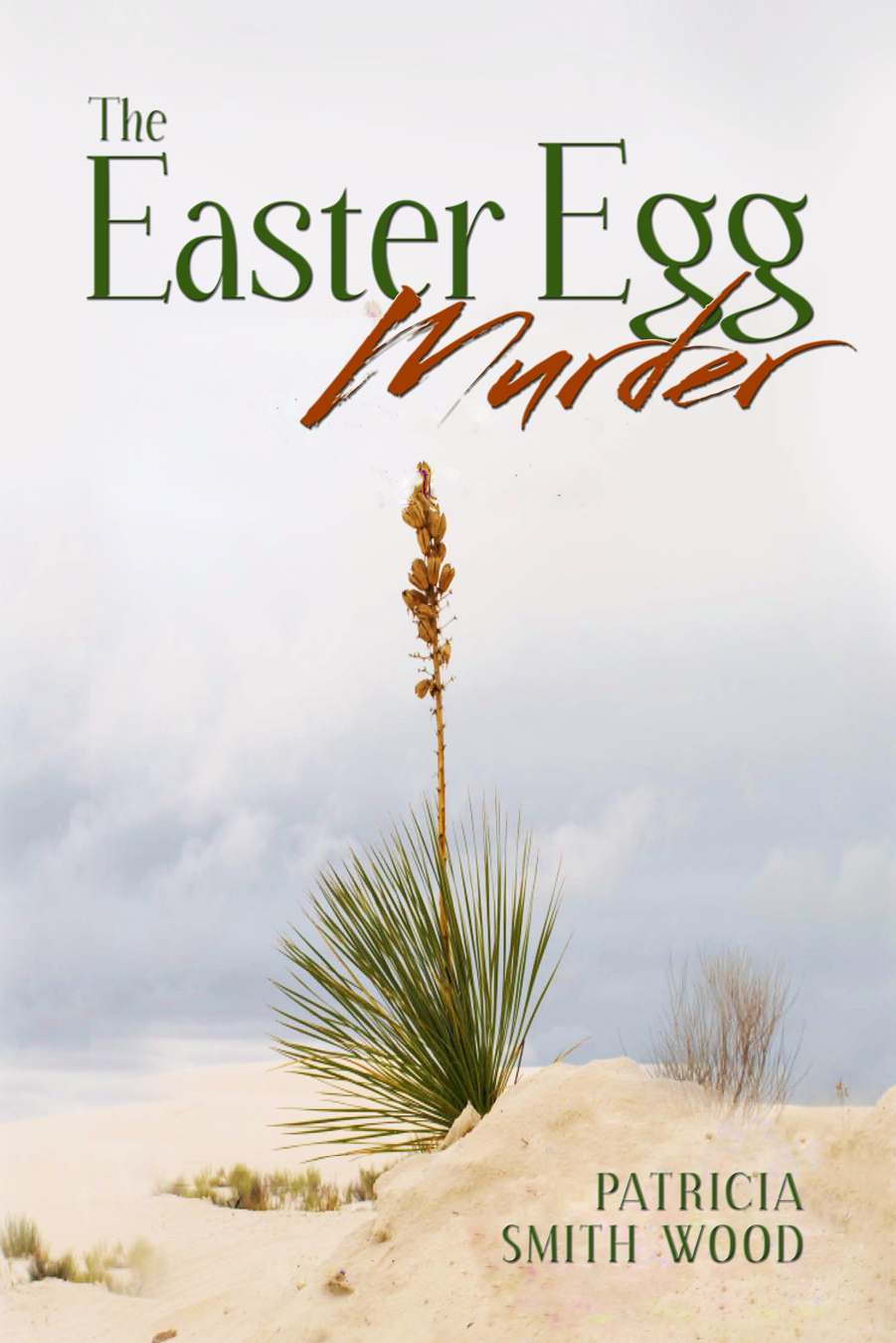
high1952front cover Easter Egg


Patricia Smith Wood’s father, first as a police officer, and later as a career FBI agent, sparked her own interest in law, solving crime, and mystery. After retiring from a varied and successful business career (including eighteen months working at the FBI, being a security officer at a savings & loan, and owning her own computer business) she attended writing seminars, conferences, and in 2009 graduated from the FBI Citizens’ Academy. Aakenbaaken & Kent published her first mystery, The Easter Egg Murder, on February 14, 2013. Murder on Sagebrush Lane, the second in the series, is finished and awaiting publication.

Last week I reviewed her book and this week she’s here to talk with me about it.

AF: The Easter Egg Murder has one of the most complicated plots I’ve ever read. How did you keep track of it as you wrote? (I picture you with a wall-sized chart covered with color-coded diagrams, or moving some sort of double-layered chess-board of characters around.)

PSW: It really wasn’t a problem for me. I’m a “pantster” and I didn’t map it out. The story simply developed as I wrote. Sometimes I’d start a chapter with a vague idea of it going one way, but it ended up completely different. I would finish and think, “Well, now what?” Then the next idea would just be there, and I’d go with it. I routinely found myself surprised at the twists that came out.

AF: Was there a historical event similar to the murder of Chipper Finn that inspired this book? Are any of the characters from that 1950 part of the plot based, even loosely, on actual people in New Mexico history?

PSW: Definitely! The actual murder of Cricket Coogler happened in Las Cruces, NM in 1949. But her body wasn’t discovered in the desert until sixteen days after she disappeared. Four young men (17-18) found her partially buried body in the desert on the Saturday before Easter when they went rabbit hunting. I used the basics, but changed the details to suit my version. Many of the actual people make an appearance (usually in disguise) in my version. And of course, Cricket’s murder was never solved.

AF: 21st century Albuquerque is the main setting in your book, and easily recognizable. Tell me about Los Huevos. I looked it up and found a rock-climbing site of some apparent difficulty, but no town. Is it based on a real place? Do you have any connection with a little town like that?

PSW: Los Huevos is a completely made up town, located conveniently at the foot of Los Huevos Peak (also fictional). Since the body in my story is discovered on Easter Sunday morning at the foot of Los Huevos Peak, that would be a natural reason to call it The Easter Egg Murder. I had been told I should have a title that stood out, and that seemed to me to fit the bill. I have no connection with such a town, but I suppose the small town of Los Lunas (which is actually southwest of Albuquerque about 20 miles) might have given me the idea.

AF: The story of the murder in 1950 and all the events around it, all the characters involved, could have been a book by itself. Did you ever consider writing it that way? How did you decide to make it a story within the story?

PSW: The story of the actual murder (in 1949) has already been written. In fact, I read everything I could get my hands on about Cricket Coogler’s murder. An excellent book by Paula Moore, titled Cricket in The Web, came out in 2008, right about the time I finished my first draft. I wanted to use some actual things, but ended up fictionalizing most of it. No one in New Mexico who knows about this murder wants to say, on the record, who they think was responsible. It was much more fun (and safer) to make it up.

AF: Harrie has precognitive dreams which add a sense of foreboding to the early part of the story. Was there any additional reason behind your decision to integrate this into the plot? I have this kind of dream myself so I liked that you treat it as only a little unusual. Also, it seemed true to “the woo” of New Mexico to have it in there but not make big deal of it.

PSW: I know several people who have some form of precognition, or “knowing”, about events. It’s always fascinated me and seemed like an interesting story-telling tool to use in fiction. I hoped to convey the mystical atmosphere that weaves it way through New Mexico’s history and culture, from the Anasazi and Chaco Canyon ruins to present day native practices.

AF: Tell me about your research. The illegal gambling and the political corruption in New Mexico back in the fifties were things I really hadn’t heard that much about, and I found them fascinating.

PSW: My father was an FBI agent who was transferred to the Albuquerque Office in 1951, two years after the murder. Events were still transpiring when he arrived here, and he later told me what he knew about the case. I also interviewed many people who lived through that era in New Mexico politics during the period 1949-1950. That included former FBI agents, former residents of Las Cruces, a couple of newspaper men who were around at the time, and even the former governor of New Mexico, who was elected mostly because of the Cricket Coogler murder. I also read books, and watched a film made on the subject: The Silence of Cricket Coogler. The book Cricket in The Web goes into the gambling issue in great detail, but I had also heard a lot about that from the people I interviewed.

AF: I know you have a good background in law enforcement, but you chose to give major roles in solving the mysteries to the two amateur sleuths, though you do include police and FBI. I’d love to know how you made that choice, and how you came around to casting two editors in the role of sleuths.

PSW: I have been a fan of the “cozy” mystery genre since I was a teenager. The cozy requires the sleuth (or sleuths) to be amateur, so it was always my intention to follow that basic rule. My favorite series at that age was the Judy Bolton mystery series by Margaret Sutton. In the early books, she was a teenager like me, and her boyfriend, Peter, helped her solve the mysteries. When they grew up, Peter became an FBI agent. Since my dad was an FBI agent, I thought that was a cool thing to do. Toward the end of the series, Judy and Peter eventually married, and she still managed to help him solve crimes.

As for making my sleuths editors, it seemed the best way to get them involved in a half-century old murder. By editing Senator Lawrence’s book about the murder, it gave them an excuse to become embroiled in digging out the answers. I didn’t stop to think how that might play out over a series, but in the beginning, I didn’t know it would be a series!

AF: Just for fun, I have to include this “outtake.” I made the mistake of asking Pat a question about some other books, and here’s the answer.

PSW: If you “Googled” my name, you might have run across a different Patricia Wood (which is why I insert my maiden name into the mix: Patricia Smith Wood) who has written at least one book (The Lottery) and perhaps more by now. She lives on a boat in Hawaii (which I obviously don’t). But that didn’t stop a local magazine from running a small piece about The Easter Egg Murder in which they stated that the author, Patricia Wood, lives on a boat in Hawaii!

It turns out Patricia Wood is a pretty common name. One day in 2012 I received a phone call from a local television station asking if I was Patricia Wood. I agreed that was me, and they then asked if I was the Patricia Wood who had stolen jewels from luggage at American Airlines and was I headed for federal prison in two weeks. Once I recovered my senses I assured them I was not that particular Patricia Wood, they thanked me and hung up.

AF: Tell me about your newest project.

PSW: My newly finished second book in the series is Murder on Sagebrush Lane. In the first chapter, Harrie McKinsey goes out to retrieve her newspaper at 5 a.m. on a summer morning and finds a small girl playing in her flower beds. She notices a dark stain on the child’s pajamas and teddy bear, and when she realizes it’s blood, her journey to find the child’s parents gets her involved in another murder. Of course, Harrie’s life is never that simple, and before it’s over there’s another murder, a race to uncover a plot to steal top secret data, an attempted kidnapping, and a desperate killer who intends to make Harrie his final victim.

AF: It sounds exciting. I’m glad to know there will be more of Harrie in the future. Let me know when the book comes out. Thanks so much for being my guest.

Pat’s web site:

http://www.patriciasmithwood.com

Winners, Santa Fe Reporter Writing Contest

I don’t usually post twice in one week, but the Santa Fe Reporter published the winners in its annual writing contest today. I’m honored to be in some excellent company among the winners.

http://www.sfreporter.com/santafe/article-9560-fiction.html

A New Mexico Mystery Review: The Easter Egg Murder

front cover Easter Egg

The best analogy I can think of for this book is a Rubik’s Cube. As I read it, I knew all the pieces of the puzzle could fit together, but I never did figure out how until the end. It’s the kind of mystery that engages the mind, with intricately constructed interlocking pieces and multiple layers of relationships, motives and history. It has a whodunit within a whodunit, as the team of amateur sleuths, police and FBI in 2000 work out who is behind the unsolved “Easter Egg murder” from 1950, as well as a murder and an attempted murder in their own time. In spite of this complexity there are no loose ends, no holes, and even its surprise ending is set up so the closure comes from the prior events, not out of the blue.

The cascade of events in this story is triggered when Senator Philip Lawrence starts writing two books—his memoir of his life in politics, and a book about a fifty-year-old murder that took place in the small New Mexico town of Los Huevos on Easter Sunday. The second book becomes more important to him than the first, and when word gets out that he’s working on it, the project stirs up some serious trouble. The retired senator’s editors find themselves in the middle of that trouble. I liked the way the two editors’ involvement in solving a mystery was handled. The amateurs don’t outsmart the professionals, but cooperate and communicate with them in a realistic way, as well as occasionally striking out on their own.

The characters are deft sketches, the pace brisk. The pieces of the puzzle keep moving. For those who like their books spare and fast, this will fit the bill. The tension is seldom at a life-threatening level, but it builds steadily to that point. There isn’t a dull moment or a single extra word that could have been cut.

I actually would have liked a few more words. The historical part of the mystery was so interesting I wanted to explore that time and place in more depth. I had a good sense of Harrie—one of the editors who is the primary point of view character—as a whole person, but I didn’t get to know the other major players as well as I would have liked. Almost like a radio play, a good portion of the story is told in dialog. I’m never in a hurry to have a good book end and I wouldn’t have minded if this slender 212 page novel had a little more meat on its bones.

*****

Next week I’ll have an interview with the author, in which she shares some fascinating background on this book.

Reflections on Mythologies

I’m in the middle of rereading a book I’ve owned for so long that it’s a $3.95 trade paperback. In Mythologies, W.B. Yeats collected the stories of Irish country people who believed in ghosts, visitations from the devil, strange spirit animals in the woods, and of course, those incomprehensible Others, the faeries. The convictions of those who have seen such apparitions seem profoundly unlike the modern mind, and yet Yeats collected these tales in 1902. Not that long ago. Just a few generations.

The mythical way of seeing the world is still alive.

Many American Indian tribes had—and in some cases still have—relationships with small, magical people. In James D. Doss’s Charlie Moon mystery series, shaman Daisy Perika communicates often with the Utes’ little man, the pitukupf. At an Art Hop in Truth or Consequences back in August I struck up a conversation with an Indian woman—I’ve forgotten her tribe—who was a strong believer in the Little People. She was pleased to meet someone who else knew about them.

I was introduced to them a number of years ago when I had a student who was Mohegan from Connecticut. She gave me a book, Medicine Trails, about her great aunt, Gladys Tantaquidgeon, a tribal leader and educator and a keeper of Mohegan traditions, including the relationship with the Makiawisug, the Little People. I was so intrigued, I located a beautifully illustrated children’s book about them, Makiawisug: The Gift of the Little People. In Mohegan beliefs, the health of the earth is interdependent with the care and wellbeing of the Makiawisug. Respect for them is one with respect for the mother earth.

North American Little People are more benevolent than the Irish faeries, who tend to cause mischief, or steal people away to their world. They can be beautiful, yet sometimes frightening. When they are helpful, it’s as puzzling as when they’re harmful. In Yeats’s book, woman of the faeries is described as having a face as calm as that of an animal. It’s a reminder of their otherness. They are neither good nor evil, and all the more mysterious because if it. Their motives are inscrutable, and they ask mortals not to look too closely or inquire too much. I love his description of their world as the dim kingdom.

I was stretching after a run a few days ago and the autumn wind and leaves and water seemed to be breathing with a layer of lives unseen. The idea of another world interwoven with ours, sometimes visible, sometimes not, is somehow most compelling at this time of year, when the days grow short and dreams grow long.

A friend who has no religious beliefs at all told me that when she was a child, she saw a fairy. She doesn’t say she imagined it, or thought she saw it, but says—with conviction— that she did.

Art that Inspired Me

The Bull

I can’t take full credit for the images of Niall Kerrigan’s sculptures. If you’ve read Shaman’s Blues you know the art I’m talking about—rusted metal, parts of old tools and machines recycled into creatures or people. Take a look at the art that inspired the art in my book. Sculptor Alexandra Soler’s work amazed me when I encountered it in person. Her animals aren’t just inventive, but practically alive. They seem to be filled with some inner vitality, ready to move, supported by anatomically believable muscles and bones—and yet they are made from recycled metal scraps. She finds parts that are shaped like the parts of the animals and reuses them with perfect fits. I have no idea how long it takes her to create these sculptures, but even finding the right materials must be challenging, not to mention the process of building them. My favorite is the bull made from Toro lawnmower parts. He is every inch the bull. I wish you could stand face to face with him. It makes you feel as if he’s making a turn to charge you.

See more of her work on Art by Alex. The horse made of horseshoes is startlingly real. The chicken made me smile.

https://www.facebook.com/ArtbyAlex