The past, the present and the future walk into a bar …

… and the bartender says, “this could get tense.”

The only stories we normally tell in present tense are jokes. It’s hard to stay in the present, either in telling a story or in daily life. I’ve been thinking about this because of two books I just read. One is Jack Kornfield’s The Wise Heart, a Buddhist approach to psychology. The other is a short literary novel, Escaping Barcelona, which is written in the present tense. The pairing got me thinking about awareness of the present moment, narrative in the present tense, the nature of what’s in our minds, and whether or not the stuff which fills our heads makes for good fiction.

My freshman seminar students read The Wise Heart with me. One said the most valuable section of the book for him was the one on Delusion, especially the topic of inattention. In his words, “I know there are plenty of moments where I walk around lost in thought, not focusing on my surroundings, to the point that I’m basically sleepwalking.” Mind full, but not mindful.

In class, we did a thought-counting exercise from The Wise Heart. As we noticed our thoughts and began to find space between them, the messy and nonlinear nature of thinking showed up. Thought is seldom focused in the ongoing flow of experience. If consciousness is a stream, the water is full of floating debris: the repetitive cycle of “top ten thoughts” and stuck songs, digressions into past and future, sudden awareness of bodily processes, or commenting and judging and craving, interspersed with moments of clarity and attention.

In a May 2013 article in the New Yorker, Giles Harvey examined stream of conscious in literature from its early roots to the present. (I encourage anyone interested in the topic to read the whole article at http://www.newyorker.com/books/page-turner/minds-are-the-strangest-thing.) Here are few of his observations I found relevant to my recent readings.

How much thought can a novel contain before bloating, or bursting, occurs?

 Does the pleasure we get from seeing the mind at work, or the illusion of seeing the mind at work, cover the cost of the tedium involved in reading this? Art is meaningful because it is life-like without incurring the disadvantages of actually being life—that is to say, without being boring and formless. …

 Minds are weird, without a doubt. But not everything that goes on in them is worth our attention.

Author Henry Martin has described Escaping Barcelona as being written in first person, present tense, stream of consciousness. It is intimate and internal, but no more so than any literary novel written in the past tense. Most of the book doesn’t resemble the actual stream of consciousness. Martin usually shows inner processes fluidly embedded in a compelling story. Once in a while he stalls for a long rant or ramble from the nineteen-year-old narrator, Rudy—and like most mental chatter, Rudy’s inner material, while authentic, isn’t profound. Overall, however, Martin avoids tedium, and his book is neither boring nor formless.

To achieve this, he has to compromise the flow of the present tense, which at times compromises the flow of the story. For around two thirds of the book—not a continuous two thirds—the present tense is inconspicuous as events take place in dramatic sequences with the protagonist’s thoughts and feelings smoothly integrated into them and the clutter filtered out. Rudy encounters situations that provoke intense awareness—new places and people, relief after deprivation, and danger. Such moments could be told effectively in the present tense in poetry or a short story. In a novel, though, the story takes place over time, and the author has to skip over the dull parts and cover the gaps with summaries as he would in the past tense. Because of the present tense wording, I found myself jerked out of the plot by the awkwardness these transitions and summaries. Some of these shifts implied the perspective that what was being narrated in the present tense took place in the past. I want to be fully absorbed when I read, and this distanced me from the story.

In one of the last chapters of The Wise Heart Kornfield gives detailed descriptions of the inner experience of deep concentrated attention, a state of consciousness few of us will ever reach. “With concentration, no matter where we place our attention, it will stay focused.” He explores how this translates into concentration on bodily sensation, on a wide-angle perspective on our whole experience, or on a feeling like loving-kindness. After years of study, a practiced meditator might be able to stay in a state like this for an hour or two. Such a person’s stream of consciousness could stay in the present moment, and with that expanded wide-angle attention, could make a readable, continuous story. Except, a person with that level of wisdom wouldn’t make a good fictional protagonist. He or she wouldn’t make impulsive decisions such as Rudy makes that get the events in Escaping Barcelona started.

On p. 247 in The Wise Heart. Kornfield quotes a Jungian teacher and analyst. “There is in life a vulnerability so extreme, a suffering so unspeakable, that it goes beyond words. In the face of such suffering all we can do is stand in witness, so no one needs to bear it alone.” Escaping Barcelona portrays one young man’s suffering and vulnerability, and asks the reader to stand witness.

I cared about Rudy. He goes through hell without losing his humanity, struggling to maintain what he can of his integrity in a situation that challenges him just to survive. When he gets his big “aha” about himself, it’s a lesson worth learning, though it’s one the reader can see coming long before it hits him. I suspect most of our life lessons are like this. Other people can perceive that we need them, but we can’t until we suffer. The value of a story like this is the engagement of compassion. Escaping Barcelona has many strengths, but sometimes I found myself watching the author write instead of living the protagonist’s struggles. I reached the end impressed by Rudy’s resilience and wishing him well in the next stage of his journey, but I won’t be reading the sequels unless there should be special past tense editions.

I’ll read The Wise Heart again. It has made me stop more often to examine my inner noise and find the stillness beneath it, conscious in the present moment.


A New Mexico Mystery Author Interview: Patricia Smith Wood

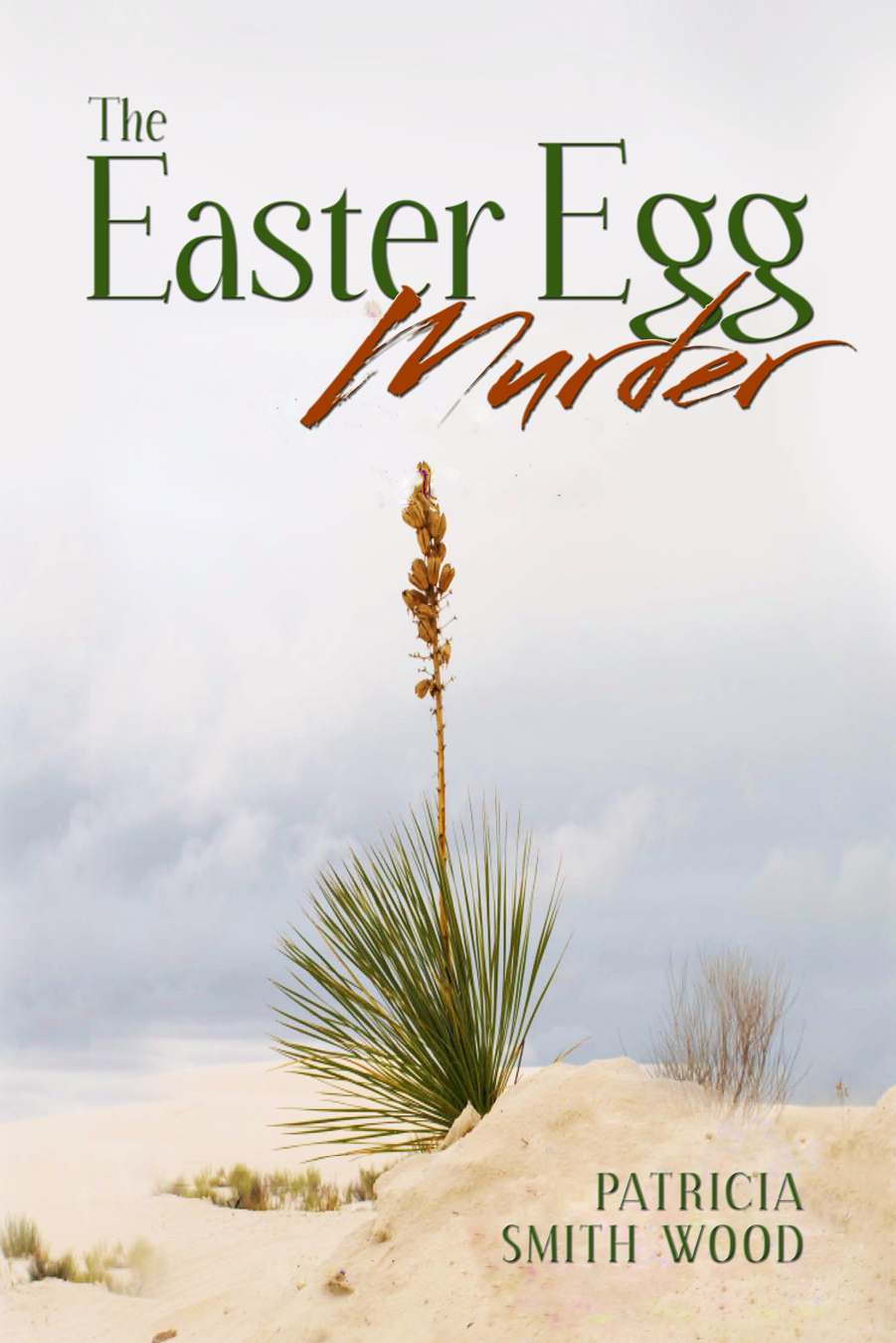
high1952front cover Easter Egg


Patricia Smith Wood’s father, first as a police officer, and later as a career FBI agent, sparked her own interest in law, solving crime, and mystery. After retiring from a varied and successful business career (including eighteen months working at the FBI, being a security officer at a savings & loan, and owning her own computer business) she attended writing seminars, conferences, and in 2009 graduated from the FBI Citizens’ Academy. Aakenbaaken & Kent published her first mystery, The Easter Egg Murder, on February 14, 2013. Murder on Sagebrush Lane, the second in the series, is finished and awaiting publication.

Last week I reviewed her book and this week she’s here to talk with me about it.

AF: The Easter Egg Murder has one of the most complicated plots I’ve ever read. How did you keep track of it as you wrote? (I picture you with a wall-sized chart covered with color-coded diagrams, or moving some sort of double-layered chess-board of characters around.)

PSW: It really wasn’t a problem for me. I’m a “pantster” and I didn’t map it out. The story simply developed as I wrote. Sometimes I’d start a chapter with a vague idea of it going one way, but it ended up completely different. I would finish and think, “Well, now what?” Then the next idea would just be there, and I’d go with it. I routinely found myself surprised at the twists that came out.

AF: Was there a historical event similar to the murder of Chipper Finn that inspired this book? Are any of the characters from that 1950 part of the plot based, even loosely, on actual people in New Mexico history?

PSW: Definitely! The actual murder of Cricket Coogler happened in Las Cruces, NM in 1949. But her body wasn’t discovered in the desert until sixteen days after she disappeared. Four young men (17-18) found her partially buried body in the desert on the Saturday before Easter when they went rabbit hunting. I used the basics, but changed the details to suit my version. Many of the actual people make an appearance (usually in disguise) in my version. And of course, Cricket’s murder was never solved.

AF: 21st century Albuquerque is the main setting in your book, and easily recognizable. Tell me about Los Huevos. I looked it up and found a rock-climbing site of some apparent difficulty, but no town. Is it based on a real place? Do you have any connection with a little town like that?

PSW: Los Huevos is a completely made up town, located conveniently at the foot of Los Huevos Peak (also fictional). Since the body in my story is discovered on Easter Sunday morning at the foot of Los Huevos Peak, that would be a natural reason to call it The Easter Egg Murder. I had been told I should have a title that stood out, and that seemed to me to fit the bill. I have no connection with such a town, but I suppose the small town of Los Lunas (which is actually southwest of Albuquerque about 20 miles) might have given me the idea.

AF: The story of the murder in 1950 and all the events around it, all the characters involved, could have been a book by itself. Did you ever consider writing it that way? How did you decide to make it a story within the story?

PSW: The story of the actual murder (in 1949) has already been written. In fact, I read everything I could get my hands on about Cricket Coogler’s murder. An excellent book by Paula Moore, titled Cricket in The Web, came out in 2008, right about the time I finished my first draft. I wanted to use some actual things, but ended up fictionalizing most of it. No one in New Mexico who knows about this murder wants to say, on the record, who they think was responsible. It was much more fun (and safer) to make it up.

AF: Harrie has precognitive dreams which add a sense of foreboding to the early part of the story. Was there any additional reason behind your decision to integrate this into the plot? I have this kind of dream myself so I liked that you treat it as only a little unusual. Also, it seemed true to “the woo” of New Mexico to have it in there but not make big deal of it.

PSW: I know several people who have some form of precognition, or “knowing”, about events. It’s always fascinated me and seemed like an interesting story-telling tool to use in fiction. I hoped to convey the mystical atmosphere that weaves it way through New Mexico’s history and culture, from the Anasazi and Chaco Canyon ruins to present day native practices.

AF: Tell me about your research. The illegal gambling and the political corruption in New Mexico back in the fifties were things I really hadn’t heard that much about, and I found them fascinating.

PSW: My father was an FBI agent who was transferred to the Albuquerque Office in 1951, two years after the murder. Events were still transpiring when he arrived here, and he later told me what he knew about the case. I also interviewed many people who lived through that era in New Mexico politics during the period 1949-1950. That included former FBI agents, former residents of Las Cruces, a couple of newspaper men who were around at the time, and even the former governor of New Mexico, who was elected mostly because of the Cricket Coogler murder. I also read books, and watched a film made on the subject: The Silence of Cricket Coogler. The book Cricket in The Web goes into the gambling issue in great detail, but I had also heard a lot about that from the people I interviewed.

AF: I know you have a good background in law enforcement, but you chose to give major roles in solving the mysteries to the two amateur sleuths, though you do include police and FBI. I’d love to know how you made that choice, and how you came around to casting two editors in the role of sleuths.

PSW: I have been a fan of the “cozy” mystery genre since I was a teenager. The cozy requires the sleuth (or sleuths) to be amateur, so it was always my intention to follow that basic rule. My favorite series at that age was the Judy Bolton mystery series by Margaret Sutton. In the early books, she was a teenager like me, and her boyfriend, Peter, helped her solve the mysteries. When they grew up, Peter became an FBI agent. Since my dad was an FBI agent, I thought that was a cool thing to do. Toward the end of the series, Judy and Peter eventually married, and she still managed to help him solve crimes.

As for making my sleuths editors, it seemed the best way to get them involved in a half-century old murder. By editing Senator Lawrence’s book about the murder, it gave them an excuse to become embroiled in digging out the answers. I didn’t stop to think how that might play out over a series, but in the beginning, I didn’t know it would be a series!

AF: Just for fun, I have to include this “outtake.” I made the mistake of asking Pat a question about some other books, and here’s the answer.

PSW: If you “Googled” my name, you might have run across a different Patricia Wood (which is why I insert my maiden name into the mix: Patricia Smith Wood) who has written at least one book (The Lottery) and perhaps more by now. She lives on a boat in Hawaii (which I obviously don’t). But that didn’t stop a local magazine from running a small piece about The Easter Egg Murder in which they stated that the author, Patricia Wood, lives on a boat in Hawaii!

It turns out Patricia Wood is a pretty common name. One day in 2012 I received a phone call from a local television station asking if I was Patricia Wood. I agreed that was me, and they then asked if I was the Patricia Wood who had stolen jewels from luggage at American Airlines and was I headed for federal prison in two weeks. Once I recovered my senses I assured them I was not that particular Patricia Wood, they thanked me and hung up.

AF: Tell me about your newest project.

PSW: My newly finished second book in the series is Murder on Sagebrush Lane. In the first chapter, Harrie McKinsey goes out to retrieve her newspaper at 5 a.m. on a summer morning and finds a small girl playing in her flower beds. She notices a dark stain on the child’s pajamas and teddy bear, and when she realizes it’s blood, her journey to find the child’s parents gets her involved in another murder. Of course, Harrie’s life is never that simple, and before it’s over there’s another murder, a race to uncover a plot to steal top secret data, an attempted kidnapping, and a desperate killer who intends to make Harrie his final victim.

AF: It sounds exciting. I’m glad to know there will be more of Harrie in the future. Let me know when the book comes out. Thanks so much for being my guest.

Pat’s web site:

http://www.patriciasmithwood.com

Winners, Santa Fe Reporter Writing Contest

I don’t usually post twice in one week, but the Santa Fe Reporter published the winners in its annual writing contest today. I’m honored to be in some excellent company among the winners.

http://www.sfreporter.com/santafe/article-9560-fiction.html

A New Mexico Mystery Review: The Easter Egg Murder

front cover Easter Egg

The best analogy I can think of for this book is a Rubik’s Cube. As I read it, I knew all the pieces of the puzzle could fit together, but I never did figure out how until the end. It’s the kind of mystery that engages the mind, with intricately constructed interlocking pieces and multiple layers of relationships, motives and history. It has a whodunit within a whodunit, as the team of amateur sleuths, police and FBI in 2000 work out who is behind the unsolved “Easter Egg murder” from 1950, as well as a murder and an attempted murder in their own time. In spite of this complexity there are no loose ends, no holes, and even its surprise ending is set up so the closure comes from the prior events, not out of the blue.

The cascade of events in this story is triggered when Senator Philip Lawrence starts writing two books—his memoir of his life in politics, and a book about a fifty-year-old murder that took place in the small New Mexico town of Los Huevos on Easter Sunday. The second book becomes more important to him than the first, and when word gets out that he’s working on it, the project stirs up some serious trouble. The retired senator’s editors find themselves in the middle of that trouble. I liked the way the two editors’ involvement in solving a mystery was handled. The amateurs don’t outsmart the professionals, but cooperate and communicate with them in a realistic way, as well as occasionally striking out on their own.

The characters are deft sketches, the pace brisk. The pieces of the puzzle keep moving. For those who like their books spare and fast, this will fit the bill. The tension is seldom at a life-threatening level, but it builds steadily to that point. There isn’t a dull moment or a single extra word that could have been cut.

I actually would have liked a few more words. The historical part of the mystery was so interesting I wanted to explore that time and place in more depth. I had a good sense of Harrie—one of the editors who is the primary point of view character—as a whole person, but I didn’t get to know the other major players as well as I would have liked. Almost like a radio play, a good portion of the story is told in dialog. I’m never in a hurry to have a good book end and I wouldn’t have minded if this slender 212 page novel had a little more meat on its bones.

*****

Next week I’ll have an interview with the author, in which she shares some fascinating background on this book.

Reflections on Mythologies

I’m in the middle of rereading a book I’ve owned for so long that it’s a $3.95 trade paperback. In Mythologies, W.B. Yeats collected the stories of Irish country people who believed in ghosts, visitations from the devil, strange spirit animals in the woods, and of course, those incomprehensible Others, the faeries. The convictions of those who have seen such apparitions seem profoundly unlike the modern mind, and yet Yeats collected these tales in 1902. Not that long ago. Just a few generations.

The mythical way of seeing the world is still alive.

Many American Indian tribes had—and in some cases still have—relationships with small, magical people. In James D. Doss’s Charlie Moon mystery series, shaman Daisy Perika communicates often with the Utes’ little man, the pitukupf. At an Art Hop in Truth or Consequences back in August I struck up a conversation with an Indian woman—I’ve forgotten her tribe—who was a strong believer in the Little People. She was pleased to meet someone who else knew about them.

I was introduced to them a number of years ago when I had a student who was Mohegan from Connecticut. She gave me a book, Medicine Trails, about her great aunt, Gladys Tantaquidgeon, a tribal leader and educator and a keeper of Mohegan traditions, including the relationship with the Makiawisug, the Little People. I was so intrigued, I located a beautifully illustrated children’s book about them, Makiawisug: The Gift of the Little People. In Mohegan beliefs, the health of the earth is interdependent with the care and wellbeing of the Makiawisug. Respect for them is one with respect for the mother earth.

North American Little People are more benevolent than the Irish faeries, who tend to cause mischief, or steal people away to their world. They can be beautiful, yet sometimes frightening. When they are helpful, it’s as puzzling as when they’re harmful. In Yeats’s book, woman of the faeries is described as having a face as calm as that of an animal. It’s a reminder of their otherness. They are neither good nor evil, and all the more mysterious because if it. Their motives are inscrutable, and they ask mortals not to look too closely or inquire too much. I love his description of their world as the dim kingdom.

I was stretching after a run a few days ago and the autumn wind and leaves and water seemed to be breathing with a layer of lives unseen. The idea of another world interwoven with ours, sometimes visible, sometimes not, is somehow most compelling at this time of year, when the days grow short and dreams grow long.

A friend who has no religious beliefs at all told me that when she was a child, she saw a fairy. She doesn’t say she imagined it, or thought she saw it, but says—with conviction— that she did.

Art that Inspired Me

The Bull

I can’t take full credit for the images of Niall Kerrigan’s sculptures. If you’ve read Shaman’s Blues you know the art I’m talking about—rusted metal, parts of old tools and machines recycled into creatures or people. Take a look at the art that inspired the art in my book. Sculptor Alexandra Soler’s work amazed me when I encountered it in person. Her animals aren’t just inventive, but practically alive. They seem to be filled with some inner vitality, ready to move, supported by anatomically believable muscles and bones—and yet they are made from recycled metal scraps. She finds parts that are shaped like the parts of the animals and reuses them with perfect fits. I have no idea how long it takes her to create these sculptures, but even finding the right materials must be challenging, not to mention the process of building them. My favorite is the bull made from Toro lawnmower parts. He is every inch the bull. I wish you could stand face to face with him. It makes you feel as if he’s making a turn to charge you.

See more of her work on Art by Alex. The horse made of horseshoes is startlingly real. The chicken made me smile.

https://www.facebook.com/ArtbyAlex

New Mexico Mystery Author Interview: Donnell Ann Bell

Donnell crop 48fd8ca735e9b58e796e7838d475801b

Donnell Ann Bell grew up in New Mexico and today lives in Colorado. A homebody at heart, she leaves the international thrillers to world travelers, and concentrates on suspense that might happen in her neck of the woods – writing SUSPENSE TOO CLOSE TO HOME.  She is the author of The Past Came Hunting, Deadly Recall and Betrayed, all of which have been e-book best sellers. Her fourth release, Buried Agendas, is due out November 6th and is available for preorder on Amazon Kindle. Her books have won or been nominated for prestigious writing awards, including The Epic Award for Best Thriller Suspense, Greater Detroit’s Booksellers Best for Best First Book and Best Single Title, and the Daphne du Maurier Award for Excellence in Mystery Suspense. Along with retired police officer veteran Wally Lind, Donnell co-owns Crimescenewriters, a Yahoo group for mystery/suspense writers. www.donnellannbell.com

Last week I reviewed her book, Deadly Recall. This week I’m happy to have her as a guest to talk about that book and about her writing process.

AF: You have some great turns of phrase. Examples: “the kind of woman who invited a man to look but don’t cross,” “catching her mother’s heat-seeking gaze,” and “looking like a poster child for the uncomfortable.”

Are your good lines like this the outcome of slow labor or sudden inspiration?

DB: These are such great questions, Amber.  It depends. Once in a great while something brilliant comes to me; other times what I think is brilliant falls flat and my editor says, “Huh?”

AF:I love your secondary characters. They are never just extras, but real people with personalities. Where did Father Slater come from?  And Mr. Lucero and The General? Did you plan and construct them, did they pop up whole, or somewhere in between?

DB: Oh, thank you!  I loved these secondary characters in Deadly Recall.  Originally, don’t tell anyone, I had planned to eliminate one of these characters.  They were so compelling, and held firm that they wanted to stick around.  They very much came fully developed.  I just knew that Father Slater was from Boston, and came from a family of cops.  Mr. Lucero was the same, and his cat . . . I knew nothing about Russian Blues. Nothing.  But the General had to be Russian to compete with his namesake.

AF: An influential teacher is a key part of Deadly Recall. Did you have a teacher who inspired you or motivated you at some point in your life?

DB: You caught me.  I had the meanest music teacher ever.  I played the piano by ear. I wasn’t a prodigy, but I could listen to a tune and play it afterward. My music teacher highly discouraged that.  Of course she was a nun.  I wasn’t fortunate to have a Sister Beatrice in my life, but I did have two nuns who came awfully close and discovered my love of writing.  When other kids were writing about space aliens and chocolate Chips Ahoy cookies, I was writing about a Texas town surviving a drought.  My sixth and seventh grade teachers, both Ursuline nuns, gave me improv assignments.  “Let’s see what you can do with this.”  They encouraged me, and to a child, that meant everything.

AF: You are one heck of a plotter. No loose ends, no “deus ex machina” solutions. All the gears mesh beautifully. Do you create the storyline first? What’s your process as a writer?

DB:  I had a firm plan where Deadly Recall was going, and knew who the murderer was from the start in the draft.  Then I attended a Donald Maass seminar in Albuquerque.  He said if you know who your killer is, chances are the reader will, too.  I was determined I was right and he was wrong.  But at the very end of the book, I weakened and a different killer showed up.

As for writing, I’m a linear writer. I wrote Deadly Recall scene by scene, and because I knew this topic so well (I’m Catholic) I knew what types of people would surround Eden, my protagonist. What’s more, I knew their mindsets, so out of the books I’ve written, Deadly Recall came the easiest to me. The police procedure was, of course, rough, but I had Crimescenewriters and a lot of help from law enforcement experts.

I should probably tell you here that I encountered a lot of outside obstacles in writing this book. I finaled in a well-known RWA contest with two perfect scores. The coordinator was so excited, and the published judge who judged me said, “I can’t wait to see this in print.”  I truly had my hopes up. What happened later was that the final editor of the contest, out of six finaling entries, gave Deadly Recall an honorable mention. In other words, I came in dead last.

Later, when I pitched the book, another well-known editor said, “Nice idea, now put it under your bed, and write something else. Catholic stories don’t sell.”

I couldn’t give up on this story, however. It finaled in the 2010 Golden Heart. The book was with a New York publisher at the time, when Bell Bridge Books made an offer on The Past Came Hunting and also Deadly Recall. I was so flattered when the NY editor said, “This is my loss.”  I do feel I made the better choice as a new author. I might have been lost at a larger house.  Bell Bridge Books has really stood behind me and my writing.

AF: As a former New Mexican, what’s your favorite NM memory?

DB: Oh, gosh!  This is probably the hardest question you’ve asked me, Amber.  So many invaluable memories, so many that shaped me.  I grew up in Farmington, New Mexico and attended Sacred Heart Catholic School.  I had so much diversity around me, Hispanic, Navajo, Caucasians. I went roller skating on the reservation in Shiprock, New Mexico. I went out to Navajo Lake to water ski and to swim. I never realized racial tensions existed until I was in high school, which is a terribly sad story and too long for this interview.

I have the utmost respect for the Indian culture, as some of these people were my closest friends. I lived in New Mexico for 18 years. I’ve lived in Farmington, Albuquerque and Las Cruces. My husband grew up in Tucumcari. We’ve traveled every inch of that state in his job. We have family there and it’s home for us. So many wonderful memories.

AF: Tell me about some of the research you did for this book. It seems it must have involved law, police procedures, the Catholic church, music, psychology and medicine.

DB: I am a former court reporter, so I had a good understanding of the law.  I did contact Leslie Budewitz* a time or two and Shaun Kaufman and Colleen Collins.  These people are invaluable resources. I have a dear friend who is psychologist and we talked at length what Eden might have gone through.  Most of it came from experience, though, and from my heart.

AF: Who are your favorite writers? What is it that you like about them?

DB: My favorite writer for International thrillers is Daniel Silva.  I was inspired to write and most probably developed my love of police procedures by Lawrence Sanders of the Deadly Sin series. I love Taylor Caldwell’s epics.  There are so many mystery and romantic suspense authors I probably should quit before I leave someone out.

AF: What are you working on now?

DB: I am writing my first suspense series for Bell Bridge Books.  It’s a challenge and a lot of fun.  I have a romantic suspense release coming out November 6th called Buried Agendas.

AF: Does your husband read your books?

DB: Ha!  He does now that I’m published.  To be fair, I asked him to read my first book, Loving Montana – the one that truly should be, and will continue to be under my bed.  I found it a few hours later on the coffee table, minus a husband.  Later, he returned from the library with “The History of Math.”  I said to him, you would rather read “The History of Math” than my novel?  He said, “You never know what people want to talk about at parties.”  I assumed from there that my work would never be on my chemical engineer husband’s to be read-list. He’s read all of the published books now, and paid me an off-handed compliment, by saying, “Hey, you’ve gotten better.”

AF: Thanks, Donnell. You’ve been a delightful guest.


*Note: Author and lawyer Leslie Budewitz has a blog that will appeal to mystery fans and mystery writers. http://lawandfiction.com/blog/


Deadly Recall - screen

A New Mexico Mystery Review: Deadly Recall

This is the first of a series of New Mexico Mystery features. In true New Mexico fashion, I don’t have schedule, but will post these at random intervals when I find the right books. (If I find a NM book I don’t like, it won’t be featured here, though I may review it elsewhere.) I’ll be following each review with an author interview a week later. The Land of Enchantment is a diverse place, and I hope to share a wide range of stories that highlight its many faces.


Review

 Equal parts mystery and romance, Deadly Recall by Donnell Ann Bell is tightly plotted and suspenseful, and has intriguing three-dimensional characters. With the male lead being a police detective and the female lead a defense attorney, conflict is natural to the plot and situation. (I found this to be a refreshing change after reading a number of romances in which the conflict felt contrived.) Kevin and Eden have a delightful and believable first encounter that sets both the love plot and their interwoven roles in the mystery plot in motion. Their attraction to each other is portrayed with depth, and their relationship in progress is often charming.  Bell has a knack for witty, natural banter between lovers and friends. Eden occasionally makes decisions which made me want to shake her but I could see that was her nature, not a plot contrivance. It made me empathize with Kevin.

The book is set in Albuquerque, showing the city that its residents see. While in some ways the protagonists could be from anywhere, their homes or hobbies have local flair. Eden’s loft near Old Town felt like a real part of the city, and I liked the very Albuquerque detail that Kevin is part-owner of a hot-air balloon. A number of the supporting characters feel like part of the local scene, people who put the quirky in Albuquerque, such as Eden’s client the vegan, tattooed housepainter-and-artist, and her neighbor Mr. Lucero, who thinks his cat is the reincarnation of General MacArthur. The behavior of the chatty, nosy, Chinese food delivery guy struck me as typical of the way people in NM talk to strangers. All of the minor and secondary characters have personalities, even if they are only onstage for a cameo.

The author’s style is sometimes so original and well phrased that I wanted to applaud while reading. Once in a while the wording seems a little hasty or not quite polished, but not often. As a reader who loves the craft of writing, I spent far more time in a state of admiration than I did getting in touch with my inner editor.

The clues and red herrings kept me guessing and thinking in step with the characters as they worked through the layers of mystery. Some romances make it seem as if love is the end of the story. I liked the way this book kept going a little further. Not only the love story and the mystery plot are wrapped up (without a single cliché for wrapping), but also Eden’s inner experience, her rediscovery.

I look forward to reading more of this author’s work. Even if it’s not set in New Mexico.

Behind the Scenes

For quite a few years I worked in theater, as an actor and choreographer. I loved the early rehearsals, while the creative process was first getting underway— seeing how a dance looked when done by the cast rather than as plotted in my head, or exploring characters with other actors. The hardest part, for me, was tech rehearsal. Did the revolving stage work? Did the dancers’ costumes look right under the lights? Performers spent hours holding their positions on the stage while the techies fine-tuned lights, sound, and scene shifts. Tedious, but without it, the play would be a disaster. If that revolving stage messed up, my choreography would quite literally topple. If the lighting cues were off, my dancers wouldn’t look their best. These long tech nights were hard, but social. The whole cast and crew went through it together.

Dress rehearsals were a relief, and they felt exciting. They were followed by the director’s final and sometimes strong critiques as well as encouragement and praise. If I was the choreographer, it was my last chance to get every detail polished.

And then the play opened, was seen, enjoyed (or not) and reviewed, and sooner or later, it closed.   Getting a book ready is the same only different. The early process—the improv, finding a character, getting plot inspiration—is exciting. The sharing of that process with critique partners makes it more so—getting feedback, going back and changing things, seeing how others react. I revise through a series of critique partners and beta-readers. It’s a lot like the rehearsal process, refining the way the play will be performed. I like to print the book out at some point in the process and mark it up—like a director giving an actor notes— making sure I’m clear with for the characters’ goals and conflicts in every scene, and the inner work in their “soliloquies.”

Then, there’s tech. I read the edited copy to make sure my editor and I agree on all the changes. I get professional proofreading and fix the errors. And then, there’s that final, perfectionistic proof, proof and re-proof. Day after day of it. Tech rehearsal, all by myself. Fixing that last imperfect sentence that didn’t bother anyone else—beta readers, editor, proofreader—and that last little typo no one could see. I like to think no one saw it because the scene was so compelling, but I think it’s also related to the way an e-pub page looks compared to a Word document. It’s like the way the costumes look under the lights. The colors and textures change. It’s unfamiliar. I look at the e-pub document the way I look at a book I’m reading, rather than a book I wrote.

Of course, after the fourth upload and double-check, I may have gotten used to the e-pub page’s appearance. My fear: I may have induced an error while being a perfectionist. Then I finally stop fussing over it and hit publish. This is not the dress rehearsal, this is it. Unlike a play, though, there is no striking the set, no closing night party. No closing night. As long as my performance is well received, it can run as long as I live. Phew! Snake Face is available for pre-order, and will be released Nov. 1.

The best part of being finished? I have time to read other people’s books again!