Gnats

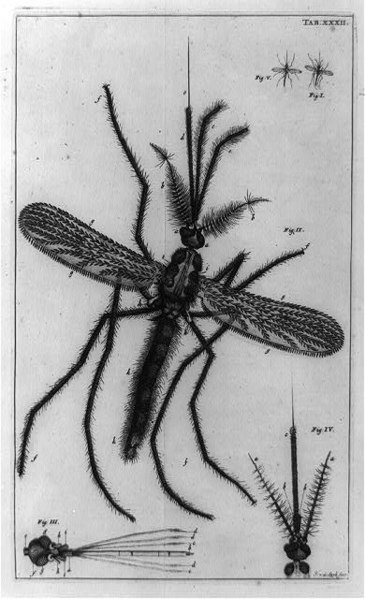
They only want light. Or at least I think that’s what they want. They cling to the ceiling and then die, in such astounding numbers I’m amazed they keep coming and that the world isn’t running out of gnats. They started slipping in through the tiny gaps around the air conditioner every night when the weather got warm. I keep a mop out so I won’t be constantly stepping on their poor little corpses. In the place I used to rent, the converted pea-soup-green trailer that plays the role of Mae’s house in my books, I had a few well-placed house spiders who lived under the lamps and took care of this problem. But I have none here.

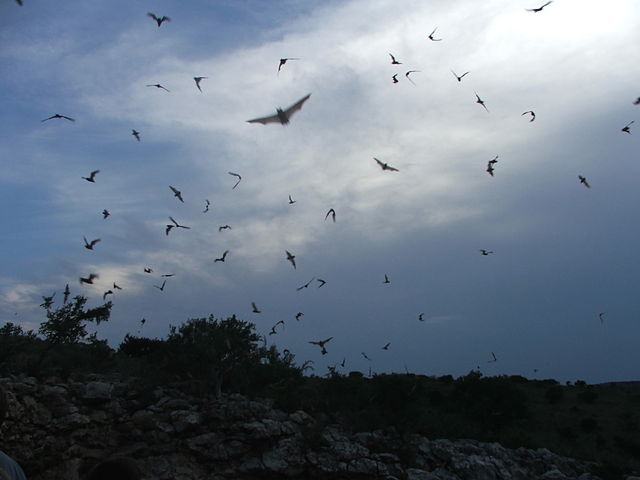
When the bats came back to their nearby caves in mid-April, the gnats vanished for a while. But when the high winds kick up, the bats stay low over the Rio Grande, their delicate bodies protected by the banks, and they don’t come into town. They don’t like wind any more than I do. So, on windy nights, the gnats once again hover around my ceiling light, walk across my computer screen, and then pepper my floor.

Sometimes I resent them, but they only want light.

My thoughts intrude like gnats sometimes, and I catch them being negative or critical, or just self-pressuring-busy with all the things I tell myself I ought to do. Behind all this seeking-something energy, there’s an impulse toward light. I mop up the gnats. Thoughts. Gnats. With gratitude for bats and spiders, and for the space between my thoughts.

Ghosts, Mediums, and Scientists: A Review of Spook by Mary Roach

Reading Spook was one of the most enjoyable pieces of research I’ve done. My fiction often involves ghosts and other forms of contact with the dead, as well as psychic phenomena. I’ve found numerous studies of mind-to-mind communication, remote viewing, precognition, etc., but this is the first time I’ve read about scientific attempts to study the afterlife. I read a couple of books on ghost-hunting and paranormal investigation; however, the author of those books is more a professional skeptic than a solid scientist.

Mary Roach explores current science on reincarnation, soul weighing, out of body experiences, and also the history of mediums and other interactions with the spirits of the dead. She’s one of the funniest writers I’ve come across. She manages to find the strangest items in the historical record—her chapter on ectoplasm, for example. The fact that it was regarded so seriously at the time it was a popular mediumistic trick is as fascinating as the methods used to produce it.

Roach participates in a training for becoming a medium; takes part in a study on creating the perception of a ghost through infrasound; goes along on reincarnation research trips in India; visits a small North Carolina town where a ghost helped a man win a lawsuit; and more. Her inquiries are serious, but she never takes herself seriously. Much of the humor comes from her ability to laugh at herself, and to notice the workings of her own mind.

Whether or not you believe in ghosts or life after death, you can enjoy and learn from the author’s journey.

Big Box Mind Walk

For a few days back to back last week, the wind was ranging from twenty-five to thirty-five miles per hour. The average human female runs six and half miles per hour, and this human female is a rather light object. Woman vs. wind? If I were to have gone for a run, it was clear who would win. But I needed to get out and move. My tiny apartment in perfect for everything except cardiovascular exercise. T or C lacks an indoor track for days like this. There’s a gym with treadmills, but I’m not a member. I like to move through space. So … off I went to walk in Walmart, the only large indoor space I could think of.

I expected this walk to be boring. I’m not a recreational shopper. In fact, I have an aversion to shopping. Normally, I run for an hour or longer, but my expectation was that I’d last twenty minutes, the minimum necessary for cardio benefits. The first few laps were almost oppressive, with all the consumer goods surrounding me, but then I got into a groove, keeping up a brisk pace, switching aisles if someone was browsing in my path. The sharp turns were fun, and the scenery began to amuse me. A packet of something called Dirt Cake. Day-of-the-Dead-themed exercise shorts with fancy, decorative skulls on one leg. A big poster for black lipstick. In April?

Once I got into the rhythm, I shifted into walking meditation of a sort as the visuals flowed in a stream of awareness, and it became like a walk through the contents of my mind. Automotive thought. Back to the sensation of moving, feet pushing and landing. Music thought. Back to breath and movement. Whoa, look at the great facial expression on that lady—can I describe it and use it for a character? Return to walking. Spacious aisle. Narrow aisle. Pivot and turn. Ah, good, people are eating veggies; look at the crowd in the produce section. Back to body and breath. Hula hoop thoughts. Return the mind to walking. Office supplies, cross-cut shredder. That’s my brain:  a cross-cut shredder. Walk. Breathe. A seven- or eight-year old girl is skating in her sneakers on the smooth cement floor of the meat section. Can I use that behavior for Mae’s stepdaughters? They would skate in a store. Resume body and breath.

After a while even those thoughts softened, and all I saw were words, signs, colors, shapes, fellow humans in the midst of their lives. The passing slices of their experience and my steps became all one flow.

I finally checked the time after I encountered a yoga student I hadn’t seen for a while, and we chatted briefly. I found I’d walked for forty surprisingly mindful minutes.


April Dryers

What? Not April showers? Not here. Statistically, it’s driest the month in my part of New Mexico, and one of the windiest. Here’s my recipe for an April day in Sierra County, if you’d like to experience one:

Ingredients:

Grit and sand, fine enough to blow around

Pollen from elm and juniper, enough to reach an 11 or so on the 12-point pollen count scale

Add creosote bush for aroma

Mix and toss into dryer, turn heat on high, and let it blow.

Decorate with cacti and various subtly flowering spiky shrubs

It’s not a bad month. In fact, if you run a wind farm or solar installation, it may well be the best month of the year, but it’s not most people’s idea of April. Some folks would call this summer. The temperatures have hit ninety a few times, well above our normal April average of 78. On the plus side, that’s hot enough that the creosote bush smells good. The smell comes from volatile oils, primarily terpene (also found in pines), limonene (found in citrus), camphor (found in pines and rosemary), methanol (wood alcohol), and 2-undecanone (don’t ask me what that is, but it’s found spices). Creosote only breathes in the morning so it won’t lose water, but the smell comes off it in the hot afternoon. It smells better after rain, but that’s not due any time soon.

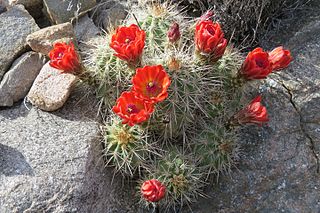
Nonetheless, things are growing. Agave plants are sending up the bizarre stalks that will eventually flower. Right now, they look like gargantuan asparagus tips. Claret cup cactus is in bloom. Green fronds are waving from the tips of mesquite branches, and a type of bush that has looked like a mass of dead black thorns all winter is covered with tiny white blossoms.

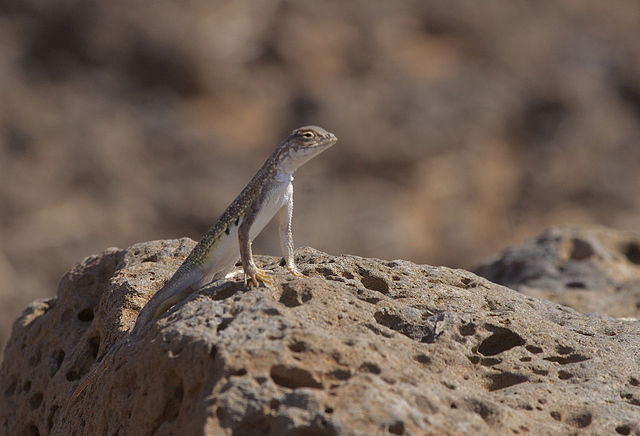
For some reason, the lizards are leaping. I’ve never noticed them doing this before. Tiny gray lizards are not only running around at their usual astounding speeds, but jumping onto rocks four or five times as high as the wee reptiles are long. It’s an impressive feat. And they have impressive feet, featuring long golden toes like little strands of straw, apparently good for clinging when they land. They seem to stop and pose so I can admire them, but they may be recovering from the leap. Springing is hard work. Pun intended.

How is spring in your part of the world?

Small Awakenings

Although I’ve made numerous changes in my life over decades of yoga and meditation practice, I’ve never felt astounded, enlightened, amazed, or shaken. I’ve processed some deep emotions and I’ve had moments of quiet clarity, but I’ve never had a dramatic spiritual experience. Instead, I’ve had aftereffects from my practice. Not flashes of divine light but little soft lights that I might miss if I weren’t paying attention.

  • Natural beauty turns off the static in my mind.
  • My pause-to-check reflex is better. I catch myself when I’m about to act or react, and I and stop, realizing I don’t have to say that, do that, or feel that.
  • My awareness of little nagging thoughts that need attention is better.
  • My awareness psychological discomfort and how it can be based on false perceptions as well as accurate perceptions is more sensitive, motivating me to think differently or let go. It’s like being aware of my body in yoga. If there’s discomfort, how can I address it to create a healthier version of the pose? Or of the thinking?

Each of these changes is barely a ripple on the surface—or under the surface—of a day, and I can credit aging with much of it. Statistically, older people are happier than young people, and though there are exceptions, we often age out of certain anxieties and into better impulse control. Life itself is a series of small awakenings.

Quick and Quirky Free Fiction

I’ve only read one of these, but I plan to download a few I’ve never heard of and have some reading adventures.

The one I’ve read, Virginia King’s Laying Ghosts, is a page-turning spooky mystery that introduces Selkie Moon, the protagonist of her series. If you like my books, I think you’ll enjoy hers. They’re also unconventional mysteries with a touch of the mystical.

Ready to read something quick and quirky? Click here.

Have fun!

Road Trip

I recently took a week and a few days to go back to Virginia and North Carolina to visit friends and collect some art I’d stored in one friend’s house. I enjoyed the reconnections with people, and the brief exposure to snow and cold and to architecture that was neither adobe nor trailer. T or C, with a population of a little over 6,000—it’s been shrinking—seems tiny next to Harrisonburg, Virginia (pop. 52,000), though it’s also considered a “small town” by some people. To me, Harrisonburg felt downright urban. So many ethnic restaurants with healthy choices, so many building over two stories tall, and so many traffic lights. (T or C has one.)

I dropped in on former colleagues, and due to snow, I was grateful that retired faculty have access to the college fitness facility. Running on an indoor track takes mental endurance, and if there hadn’t been so many students playing basketball to keep me amused, I wonder if I could have managed my usual distance. I taught a couple of yoga classes at the studio where I used to work in Harrisonburg, and it was a special and meaningful opportunity.

Part two of my road trip took me to Asheville, NC, where I found myself wondering what a trip to the mountains of North Carolina would be like for Mae Martin, my series’ protagonist.  (I was visiting the friend who inspired  the character.) Mae grew up in that area and she has connections in Asheville. What it would feel like for her to go back, after living in New Mexico? Asheville is a lot like Santa Fe and T or C in some ways, with its artists and yoga teachers and massage therapists, but in many ways it’s entirely different. The mountains are old and green. And the smaller towns beyond the city, such as the place where Mae’s grandparents lived, are another world, culturally and spiritually as well as physically, from the funky, eccentric town where she’s made a new home. (I moved her to T or C years before I made the permanent move myself.)

And what about a road trip itself as part of a story? Travel is inherently challenging. I drove through rain in the Blue Ridge on my way in, and on my way back through wind that started to peel the rubber rain-channel seal off my windshield, wind that made it hard to open the car door when I stopped for gas, wind that made big truckers struggle to open and close the doors of the truck stop. There were two wildfires on the outskirts of Amarillo and the flames and smoke mingled weirdly with the sunset. Any events in a story that I could set in weather like that would be doubly difficult for my characters, and it’s my job as a writer to make their lives difficult.

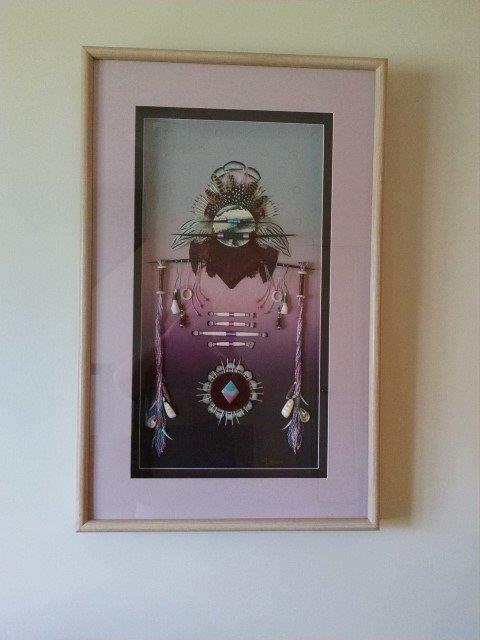
The outcome of all this? I’m glad to be home in this peculiar town with its colorful people and murals, its hot springs, and its art and music scenes. I was glad to see my T or C yoga students, to run in the desert again with the lizards and jackrabbits and roadrunners, and to go out dancing at the T or C Brewery. The art I brought back is either consigned for sale or on my walls, and I feel even more at home now with the pieces I chose to keep all around me. More complete, focused and inspired to create, with new ideas for the work in progress.

“Where’s Your Baby?”

As I charged up the last stretch of hill with a final burst of speed, I heard a shout of excitement from the playground at the end of the trail. A little boy, his dark face just visible above the stone wall, had spotted me. He must have been staring out into the landscape of cacti and junipers and sand, and been startled to see a human being—and one running, at that. I heard more happy shouts, and as I rounded the bend I saw four little heads flying along within the confines of the wall. The boy had an older sister, her hair in beaded braids that swung wildly as she ran. When I did a cooldown lap of the last little stretch, the children tracked me, and then they met me as I entered the parking lot. In an SUV parked nearby, I could see a young Hispanic woman with long hair and glasses, nursing a small baby in the back seat. Two of the kids looked like they were hers, and I wondered if the two black children were stepchildren in a blended family or if they were friends, perhaps out-of-town guests. In other words, what’s their story?

The boy who’d started the excitement of running with me was curious about me, too. I guessed him to be five at most, a handsome little guy with fine features and a runny nose. He asked me how far I ran and how often. He asked where I lived, and then followed up with questions that made me think he didn’t understand age yet.

“Where’s your mommy and daddy?”

“They passed away a long time ago.”

“Why did they pass away?”

I didn’t feel like telling a child at play about my parents’ end-of-life health problems, so I simply said, “They were very old.”

“My mommy’s still alive.”

“Of course. You’re young. That’s normal at your age, but not at my age.”

He followed me to my car as I got my water bottle. “Where’s your grandma and grandpa?”

“They passed away, too. They were even older.”

“Where’s your baby?”

“I don’t have one.”

This stumped him, and he asked again, saying everyone has a baby, and then added, “I have a baby.” He was carrying a toy in one fist, some kind of bristly green creature. Ah. His baby.

While I stretched at a picnic table, his sister, who was around eight or nine, joined us. They inquired about my age, which I gave as sixty-three. The girl told me their father is “six nine.” I asked, “Is that his height or his age?” She said, “He’s that tall and he’s that old. Do you know him?” I was sure I didn’t, if he’s really that tall. And was he really that old, with children so young? She had to be pulling my leg.

The two black kids and the Hispanic boy ran off to the swings, and the Hispanic girl, who was also about eight years old, stayed with me while I finished my stretches. Even while she’d been running and playing, she held onto a notebook with a pink cover that matched her pink sun dress. Perhaps she’s a future writer. Without my asking, she told me, “Those kids are from Arizona. They visit us every year. Usually once, but they came twice this year. The other one is my brother.” She intuited that people want to understand each other’s stories, but did not enlighten me as to whether her friends’ father really was sixty-nine years old and six-feet and nine inches tall.

It makes a better story if I’m left wondering.

Conversations and Story-Telling


My eighty-two-year old neighbor hasn’t been able to walk his dog since he fell off his bike and injured his shoulder. His dog is strong and energetic, and his balance isn’t as good as it once was. We worked out an arrangement where I hold the leash, and the three of us walk together. He’s there to give his dog commands as needed and pull occasional thorns out of her paws, and I’m there for a steady grip and good balance. One reason I offered to do this is because I knew we’d have great conversations. In an hour-long walk, we never ran out of interesting topics. With eighty-two years of engaged, thoughtful life plus a great sense of humor, my neighbor is a delightful story-teller, and I was happy to prompt him to keep going.

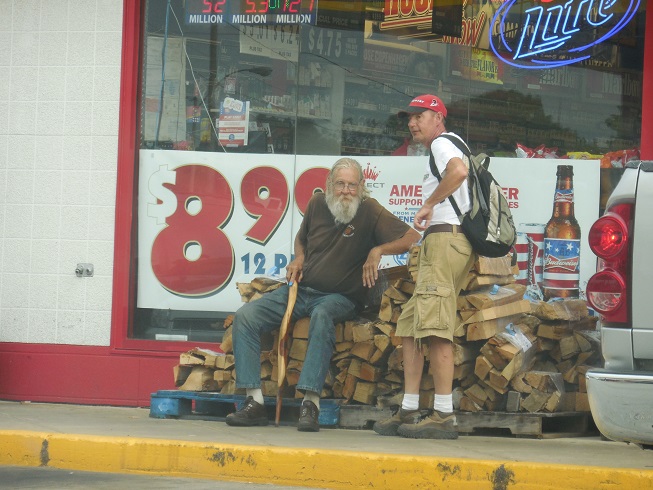
At a popular fishing spot on the curve of the Rio Grande, we ran into another gentleman of advanced years with his dog, and the men immediately struck up a conversation about fishing, dogs, and various other things. Normal T or C behavior—talking to strangers.

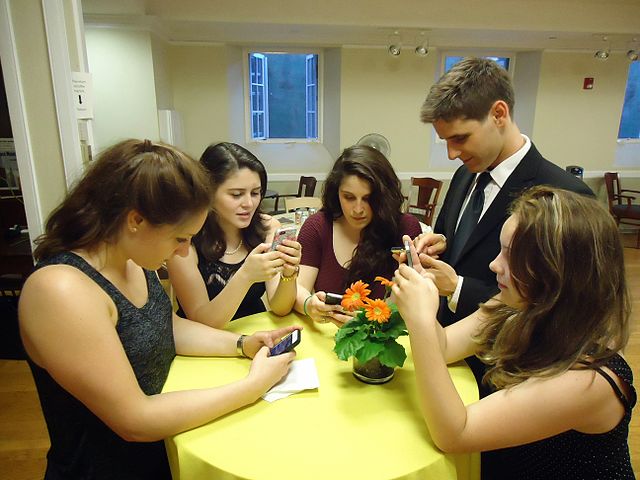
Later in the day, I went out to dinner with a friend, and when the server came to check if we were okay, since our meals hadn’t arrived yet, we’d been so busy getting caught up with each other we hadn’t noticed the kitchen was a bit slow. A young couple came in and was seated across the room from us. I had a view of them in profile, each hunched over a phone, heads bowed, making no eye contact and no conversation. They looked like a satire on smart-phone addicts. I wondered about the state of their relationship. First date and painfully shy? Together too long and bored? Or was this, to them, normal?

Maybe they’ll stay in T or C a while and put the phones down. I’ve seen local young people doing things like skateboarding the wrong way down the middle of Broadway, earbuds hanging loose and blasting music to passersby (I can use that for one of my characters—Misty Chino would do that), but so far I’ve never seen them doing the blind-to-the world phone-walk my college students so often did. I imagine the young tourists, phone-walking, bumping up against a cluster of locals yakking on the sidewalk with someone who pulled a truck over to the curb to join the conversation. And the couple makes eye contact with the strangers. They answer friendly questions and tell their stories, and go on their way, talking with each other.