Win Four Books: A gift to thank you for reading my blog

I’m honored that so many people read my reviews and reflections. Obviously, I love to write, and it’s good to know that my words reach people who share my enthusiasm for books, my love for New Mexico, and my interests in alternative healing, mindfulness, and mysterious phenomena. To thank you for following my blog, I can’t give you all a gift, but I’m having a drawing. Two of my blog readers will win the current four books in the Mae Martin Series in paperback. Here’s how:

Send an e-mail to ambfoxx@earthlink.net  or

ambfoxx@yahoo.com

with the heading Blog Follower. Let me know which blog or blogs you follow (I have four*), and I’ll enter you in the give-away. I will reply confirming your entry.

You can ask to subscribe to my new release mailing list at the same time if you want, but I will not automatically subscribe you. Fear no spam. It’s not coming.

On Monday Sept. 28th at noon I’ll close the entries and put all the names in a virtual hat and have a colleague pull two out. I will contact the winners and ask for their mailing addresses, and contact the other entrants with only the first name and last initial and general location of the winners, i.e. “Winners are Jane X in Saskatchewan and John Y in Florida.”

If you’re not yet familiar with my fiction, you can read the book descriptions on my home page https://amberfoxxmysteries.wordpress.com and also try a free sample:

https://amberfoxxmysteries.wordpress.com/free-downloads-retail-links

*The four blogs are:

https://amberfoxxmysteries.wordpress.com a blog about the mysteries of life and reviews of mysteries set in New Mexico.

https://everywhereindies.wordpress.com a blog dedicated to supporting and reviewing the work of indie authors who publish everywhere, not just Amazon. (It started as my Nook book shopping list and grew.)

http://ladiesofmystery.com a group blog with seven other women who write mysteries, dedicated to the topic of writing, from craft to inspiration, with freedom to digress as we see fit.

http://amberf.booklikes.com a book review blog covering everything I read, from yoga philosophy to cozy mysteries to literary fiction to thrillers and more.


Spider Old Woman, Part Two

A synchronicity isn’t just a coincidence. It’s one that means something to the person to whom it happens. My synchronicity story is about a Spider Old Woman story.

Quite a few years ago, I was in a relationship with a man who denied that he was keeping secrets from me, secrets that were unhealthy for our relationship, but the evidence added up and I broke off with him. A few months later he got in touch and persuaded me that I had misunderstood what was going on. I had planned to drop him from my life and move home to New Mexico, but I chose to disregard my intuition and judgment and trusted his words instead. I still moved, but we had an unexpected reunion the day before I left. After his visit, I sat on my back porch in rural Virginia gazing out into the woods, and the herd of deer I had come to know as my closest neighbors came into view. I was stunned to see an unfamiliar animal among them. At first I thought it was a horse, though it made no sense for one to be in the woods—but it was a white deer, gazing directly at me. It felt miraculous, a sign of some kind.

On my way out of town early the next day I stopped by my landlady’s antique shop to drop off the key to the house and she had a sculpture of a white deer on display in the window. The message seemed to be begging for my attention. I was sure it had to do with this man, and since the deer was so beautiful, I took it as a positive message that I’d done the right thing.

I stayed in touch with him while I lived in Santa Fe, but we didn’t see each other until another change of jobs brought me back East, this time to Northeastern North Carolina. Shortly after we had our reunion number two, I went to the Meherrin tribe’s powwow where I bought the book, Spider Woman’s Web. In it, I found the story, The Woman Who Kept Secrets. My short retelling below doesn’t do justice to it, but you can get the message—and then read the book.

A long time ago, on one of the ancient Pueblos, there was a woman who waited until all her friends had married before she would commit, and only when she was lonely did she finally agreed to marry a young man who loved her, though she didn’t love him. He was kind, and for a short whole they were happy enough, but then she became restless. Sometimes he woke at night and discovered that she was gone. One night—though she claimed he must have dreamed her absences—he decided to find out where she went. He pretended to be asleep, but once she’d gone far enough from their home, he followed her by moonlight and came to kiva outside the pueblo. (A kiva is a ceremonial underground chamber) He peered in and saw a strange ceremony going on.

Some versions of the story have a shape-shifting shaman in this scene, an act of possible witchcraft; other versions have people misusing the sacred chamber by coupling with partners other than their spouses. The man was discovered and thought he might be hurt or killed, but instead he was invited in. His wife sat beside him and assured him all was well, better than it seemed, and he fell asleep with his head in her lap. When he woke up, he was on a narrow ledge on a cliff, hungry and thirsty and alone. His wife and another man were on the far side of the canyon on another cliff. They threw roasted corn to him, but if he moved to catch it and eat it he would fall. He had to avoid snakes, too, so he held very still. He lost consciousness and woke again, this time in the home of Spider Old Woman. She gave him medicine, an ointment to rub on his wife’s shoulders, which she promised would solve the problems in their marriage.

That night as the man and his wife lay together he rubbed the ointment on her shoulders. To his surprise, she became agitated and got up and went outdoors. He followed her. She began to pace, looking wildly about, and then her body started changing. Her legs, her torso and then finally her face became those of a white deer. The deer gazed at him for a moment with tears in its eyes, and then joined a herd of other deer and ran off. He never saw her again, and he got on with his life.

In my new home in North Carolina, I encountered another white deer, this one grazing with its brown herd-mates in the field behind my house. I’m not the only person ever to see a white deer—Northeastern North Carolina has a few of them—but for me, they carried a message. I had been right the first time. I needed to send this man out of my life for good, and I did. He was the man who kept secrets. The white deer.

https://www.goodreads.com/book/show/528968.Spider_Woman_s_Web

Spider Old Woman, Part One

I can understand why a mythical wise woman who is helpful and powerful could be called Spider Old Woman. From big furry tarantulas to tiny jumping spiders who can spring eight times the length of their wee legs, I think spiders are amazing and often beautiful. I once saw a sparkling emerald-green spider, no bigger around than the little tip you press to click a ballpoint pen, sitting on a gas pump in Suffolk, Virginia. Also in the South, I’ve encountered delicate pale green spiders, even their legs the color of spring leaves. I let some rather dull-looking spiders live with me all summer in Truth or Consequences, NM, because they did such a good job with the gnats or whatever those were that used to come to the light when I was writing at night. Webs are functional for catching gnats, and they’re also works of art, especially outdoors after a rain when they’re beaded with drops of light.

As part of a get-acquainted activity in my academic division, faculty from different departments were asked to pair up and tell each other where we from, what we teach, and who we would be if we could be superheroes, and what our superpowers would be. The answers were varied, creative, and revealing. Some professors admired real humans as their superheroes. Young mothers who are also teachers and scholars wanted multi-tasking superpowers. My superhero was Spider Old Woman. My power would be, if I had one, to make people aware of the interconnectedness of all things—aware that when they touch one thread of the web of life, it truly does vibrate everything in it.

Spider Old Woman—or Spider Woman or Grandmother Spider as she’s variously known—may be familiar if you’re a fan of Southwestern mysteries, such as Anne Hillerman’s Spider Woman’s Daughter and James D. Doss’s Grandmother Spider. She’s found in the mythology of Native tribes all over the western half of North America. In New Mexico Pueblo stories, she “creates order from chaos by drawing two intersecting lines, the first from north to south, the second from east to west. It is she who creates the four seasons and adds the four elements of weather—thunder, lightning, clouds and rainbow—to the sky.” (From Spider Woman’s Web by Susan Hazen-Hammond.) I love this view of creation as connection and pattern, and the emphasis on the sacred importance of those events in the sky.

In some stories Spider Old Woman seems to be a sort of magical helper, but she’s old and wise. She doesn’t bring what we want so much as what we need. I found the book cited above at a booth at a powwow in Northeastern North Carolina. Its subtitle is Traditional Native American Tales about Women’s Power. A Spider Woman story in it bore a startling resemblance to real events in my life, and cast a new light on them in a way that changed my life story and helped me reclaim my own power. I’ll tell those stories—both mine and the traditional story—next week.

https://www.goodreads.com/book/show/528968.Spider_Woman_s_Web
https://www.goodreads.com/book/show/913105.Grandmother_Spider

https://www.goodreads.com/book/show/17349269-spider-woman-s-daughter

Waltzing to “New Mexico Rain”

In my years of being happily single I’ve never minded going places on my own—in fact, I love the freedom of going alone, and the openness to meeting new people that I have when I do this. Last summer, when Michael Hearne played at Santa Fe Bandstand, I struck up an acquaintance with a fellow Hearne fan. The music was a little late starting and we were early, so we sat together on the base of the monument in the Plaza for quite a while. The funny thing is that for as long as we talked, I couldn’t remember his name or what he did for work, only that he was from Albuquerque and loved music and dancing. We danced together for much of the evening. He switched partners occasionally, dancing with women he knew from Albuquerque, and then coming back to me. He had to catch the Rail Runner before the song, the one everyone wants to hear and dance to most of all, “New Mexico Rain.”* If this were fiction, the Cinderella-esque departure of the dancing partner whose name I’d forgotten would lead to something. It didn’t. I ended up dancing to that song with a stunningly attractive and much younger man who could lead a waltz with energy and grace.

This year, I arrived early again, and found a huge crowd waiting for Bill Hearne and Michael Hearne**. I sat on the base on the monument between two slim, fit, middle-aged women with brilliant (and definitely natural) red hair of the same length and with the same kind of rippling curls. The one on my left was local, and the one on my right was reading a tourist brochure in French, oblivious to her Santa Fe twin—who assured me they were not in any way connected. If this were fiction, the coincidence of their resemblance would go somewhere. It didn’t. I just happened to be between two oddly similar members of that particular one-percent.

I looked up and saw a tall, slender man with a youthful face and gray hair under a faded pink ball cap—the same man from Albuquerque in the same hat. He was saying to the woman with him, “I don’t see any of the regulars.” I spoke up, and he remembered me—though not my name. He introduced me to his friend, and I easily learned her name, and that she was a massage therapist visiting from North Carolina. I forgot his name and occupation again. But I did dance with him. He flowed back and forth between partners. I liked having breaks to watch the sea of dancers before being re-immersed in its waves.

When he left last August, I said, “see you next year.” He told me he’d wondered if “that lady” would be here again. All either of us could remember about each other was how we danced, with a connection that was perfectly of the moment. If this were fiction, there would be more to this story, but there isn’t. He is my Bandstand Michael Hearne concert dance partner. In its own way, that story is magical enough.

This year, we did get a chance to waltz to those lovely lines about waltzing in New Mexico rain. Maybe we’ll dance again next year. If we’re lucky, perhaps it will rain. (If this were fiction, it would.)

*“New Mexico Rain” https://www.youtube.com/watch?v=96UkbM6cII4

**New Mexico’s adopted sons—Americana with a touch of Western Swing

http://billhearne.com/wp/

http://www.michaelhearne.com/index.html

“Do You Need a Ride?” A Pedestrian Ramble

One of my favorite Edward Abbey rants in Desert Solitaire is about tourists who won’t get out their cars in a national park and who suffer the illusion that they have actually seen the place when they haven’t walked in it.

For me, walking is a way of getting to know a community and its personality. I seldom sit in waiting rooms when I could be out exploring. A place doesn’t have to be scenic to have character; even a kind of dreary character can be interesting to a writer. While waiting for oil changes at the Ford dealership in the town that inspired Cauwetska in The Calling, I explored the neighborhood behind it. Many years later when I wrote the book, I knew which house Mae and her mother would move to in the opening scene and I could see, hear and smell every step of the life-changing walk Mae takes that evening.

In my review of The Pot Thief Who Studied Pythagoras I mentioned the narrator Hubie Schuze’s reflections on the superiority of walking compared driving. The line that stuck with me from this particular scene is I saw a baby gopher—one of the many things one could not experience if driving a car. I’m trying to find the chapter for another quotation but I keep finding all his other walks in Albuquerque instead. Hubie walks in his city quite a lot.

Based on this literary precedent, I believe it can’t be remarkable to be walking in Albuquerque, surely not so odd that a complete stranger should offer me a ride—and yet someone did. I arrived early for a yoga class Tuesday and decided to walk a few not-very-scenic blocks to pass the time rather than sit. A man of about fifty to sixty, driving a nice car, rolled down his window in passing and asked if I needed a ride. New Mexico is a friendly place, where we talk to strangers all the time, but I’ve never been invited into a car. I was so stunned I just said “No,” forgetting add “thank you.” What was this man thinking? I was wearing yoga clothes, flip-flops, and a sensible sun hat, so I don’t think I looked like some middle-age hooker angling for business at five-thirty in the afternoon. I didn’t look feeble, either. When I was walking in T or C a few nights earlier, a woman I’d never met before asked me what I did to stay so fit. She was getting out of her car, and she didn’t offer me a ride. (On that same T or C walk I passed a group of people who’d been rafting on the Rio Grande. They’d just unloaded their gear and I think they’d been imbibing a little on their trip. One woman, still holding a half-empty beer bottle, hugged another, and liquid poured from the bottle to the ground. The recipient of the hug asked, in a most serious tone, “Are you peeing?” You couldn’t get a laugh like that while driving. That was as good as seeing a baby gopher.)

When I went to the corn dance at Kewa Pueblo (Santo Domingo) earlier this week, I chose to park a distance from the plaza and walk. Twice, shuttle bus drivers tried very hard to let me know I could ride. I know they were just being courteous, but I couldn’t bring myself to ride. In my work in progress, this pueblo will be one of the settings, and walking helped me to soak up details.

When I walk in Santa Fe, no one offers me a ride. The city is full of pedestrians, some of them very interesting. While I walked to the Best of Santa Fe Block Party last Saturday, I encountered young women striking dance and yoga poses on the streets. This evening in the Plaza at Bandstand, I saw a tall trim Anglo man with a white tiny goatee wearing a little round flat African hat in pink and green and orange, pink John Lennon sunglasses, an orange-and-green African print shirt and a swath of similar fabric wrapped around his waist over his bright green shorts. All the clothing looked new, clean and crisp, a carefully chosen concoction.

The best-dressed dog at Bandstand belonged to man whose lean, scruffy appearance and worn-out backpack suggested he might be homeless. He had placed a pair of sunglasses with bright orange frames on the nose of his dog, a gentle, friendly mutt. Children broke off dancing wildly to the Santa Fe Chiles Jazz Band to pet the dog, and the man was gracious, careful of the children’s well-being and his dog’s good behavior. The way he steered and guided his dog made me think perhaps the glasses were there to indicate that the dog was blind. I had to wonder about the story behind his apparent good cheer in what looked like tough circumstances. Now, while writing this, I wonder if anyone ever offers him and his dog a ride.

The Back Yard Buddha

My landlord put a Buddha on the back deck of the house I’m renting. This statue is about two feet tall at most, a slender Indian Buddha, not the jolly fat Chinese kind, and he has a seam on his right shoulder that shows where he was broken out of a mold. He’s a mass-produced Buddha.

A few weeks ago, I was sitting for meditation after my yoga practice and noticed that his hands were in dhyana mudra, which I was about to use to center my mind. (Imagine the classic thumb-to-first-finger jnana mudra joined by sliding the hands together so the tips of the thumbs and the nails of the first fingers touch.) Dhyana means concentration, the most difficult stage in yoga for many people, myself included.

His eyes are closed and he has an infinitely subtle Buddha smile, an expression that somehow conveys deep and effortless focus, immersion in what Buddhists call “lovingkindness.” As I sat with my eyes open, held the mudra and gazed at him, I felt the peace and stillness of that smile. I’ve never used any kind of spiritual or religious imagery for meditation, so I found this effect intriguing. I’m an extravert by nature, and I wondered if this mirror of true inwardness was what I needed, or if I was just borrowing serenity.

Over time I’ve started to feel my mind fall into quietude from a mere glance at the Buddha, whether he’s glowing in the moonlight or showering in a thunderstorm. I like to think that the artist who made the original put something special in that face, and understood that mudra. It makes me glad this Buddha is mass-produced. Somewhere, someone else is smiling back at him. Hundreds of people, hundreds of smiles, petals of peace in a single flower.

Embracing Darkness

On an ordinary quiet night, I took a break from writing to make a cup of herbal tea. Suddenly, I was in the dark. Tea freshly brewed, and I couldn’t even see the mug. I had to feel the doorway to get out of the kitchen. Funny how the mind works. I have to find light, I have to find light. In the living room, my laptop had gone to sleep on the coffee table, and I found it by the tiny red dot on its rim. I woke it up and used it to see my way around, searching for things I knew I didn’t have. Matches. Flashlight.

Sudden change and loss are hard to accept. I’ve been reading two books that deal with this topic: Barbara Kingsolver’s Flight Behavior and Marc Ian Barasch’s The Healing Path. The first is a novel about both ecological and personal crises; the second is nonfiction, about facing life-threatening illness. My response to the simple lack of electricity confirmed what these writers say about how humans react to an unwelcome shift in circumstances. We want normal. I kept thinking I could go into another room and turn on a light. No. There’s no power. The whole town was dark. Then maybe, I thought, I could sleep through the outage. No. There’s no fan, no air conditioning. What was I going to do in the dark with my laptop battery running low? It was 11:30 p.m. and that’s when I do my best writing.

I shut off the laptop after I’d found my Nook, which had more charge, and took it and the mug of tea outside, using the Nook as kind of dim little flashlight. I thought, I can read.

No. Not once I’d seen the stars. Then, all I wanted was the stars. Even in the desert in a town with little night glare, the removal of all manmade light was … breathtaking? No. Awe-inspiring? Too weak. Sacred.

I didn’t do anything to pass the time in the powerless night. I just lay back and looked at it. Thoughts drifted in. How long will this last? Should I pack up and go to a hotel in another city? I didn’t move. Stars. The lingering craving for electricity grew weaker and weaker.

This is it. The dark still night, afire with diamonds in its endless depths. The ordinary and normal gone. Someday my power will go off, and that will be it. Maybe it will be like the kitchen was, blind nothingness. Maybe it will be like the brilliant, hidden, undiscovered sky. All I know is that I had that sacred moment under the stars, and that I chose not to miss it.

Sparky’s is Real

In my endnotes for my books, I explain few details about settings and research. At the end of Soul Loss, I mention that the other businesses in the story are fictitious, but Sparky’s in Hatch, New Mexico is real. I got an e-mail from a reader who found that fact—quite understandably—hard to believe. Not that she thought I was lying. She was simply marveling that such a place could exist.

For those who have had a similar reaction, or have not yet read the book, here’s an update on that wonderful place from my latest visit to Sparky’s:

In the middle of a 100 degree Sunday afternoon, in a dance hall that serves no alcohol, the Desperadoes played Western swing while couples two-stepped on a dance floor framed by walls full of antique advertising signs and shelves and glass cases crammed with old piggy banks, cookie jars, radios and little robots. High on one wall, a Rajah Motor oil neon sign glowed between a couple of other neon antiques and a mounted deer head with a big hot pink butterfly perched over its right ear. An old metal diving helmet was displayed at the other end of the neon row. The bas-relief of the skeletal rider on a skeletal horse that I mention in the Sparky’s scene in Chapter Two is still there, but there’s always something new or rearranged.

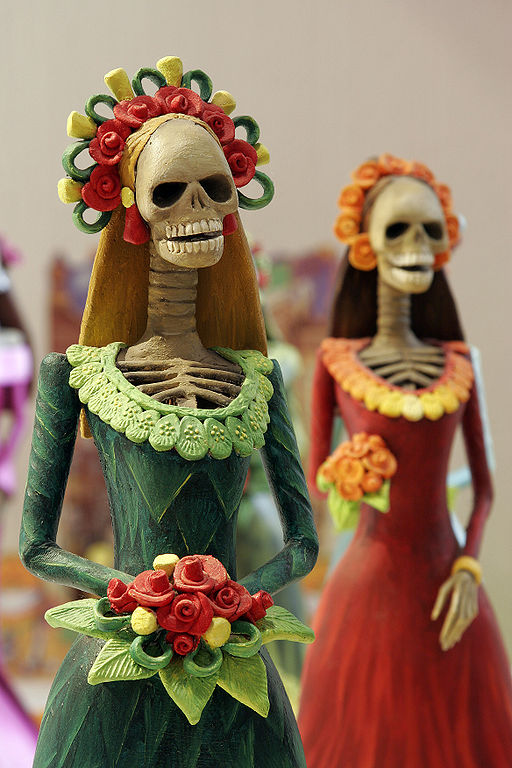
Sparky’s is a living organism of sorts. The interior has expanded to include a third room between the restaurant counter area and the dance hall, and the décor there is Sparky’s best. The skeletons who used to occupy the passage to the restrooms are once again in somewhat piratical garb, and have joined a tableau over the door of the new room along with an old wooden jukebox and a collection of Catrinas, the elegantly clad skeleton ladies of the Day of the Dead.512px-Catrinas_2

You will never run out of “whoa, I didn’t see that!” discoveries at Sparky’s. The giant advertising statues outside have new companions. On top of a monster KFC cup, a green chile wearing lipstick and a bridal veil holds hands with red chile in a top hat as they beam at each other in nuptial devotion—a match made in Hatch. Sparky the robot, his fountain espresso cup ever-flowing, gets new decoration. Sunday he was wearing goggles and some red-white-and-blue stars. Inside, more musicians have autographed the wall behind the stage, where the one thing that never changes is the sign that says, “Do one thing every day that makes you happy.” If you’ve set foot in Sparky’s, you have already done that.

Need pictures? Check out Sparky’s Facebook page.

https://www.facebook.com/pages/Sparkys-BBQ-and-Espresso/74823382942?sk=timeline

Good food and good music in the strangest-best place for both.

*****

Catrina images courtesy of Wikimedia Commons

Ten Things I Love about Truth or Consequences

Conversations. I’ve never been in a situation where anyone was at a loss for words. The line in Bullock’s grocery store, Art Hop, the pool, a drum circle by the Rio Grande at night … it doesn’t matter. People will talk to you anywhere. I met all my friends here through random conversations with strangers.

Passion Pie Café. The place has art on the walls, art on the tables, great tea and coffee, vegan date bars, a free book shelf, and plenty of the above-mentioned conversation.

Hot springs. Of course. That used to be the town’s name. A soak can restore mind and body and spirit.

A history of healing. Magnolia Elis was an important part of the town’s life as a healing destination in the middle of the twentieth century. Her capacities as a healer were reputed to be extraordinary. Her building is a historic landmark now, with her name glowing on the roof in blue neon at night.

Critters. Bats come out at dusk to hunt insects near the Rio Grande, swooping and dancing over the river and the wetlands. If I go to the right spot at the right time, they surround me. Sometimes I’ve seen them crossing the stars as I lay in a hot spring at night. If there’s been rain late in the day, tarantulas emerge from their burrow to seek mates. Lizards seem to be everywhere—scurrying from one patch of shade to the next by day, occasionally sticking to walls and windows in the evening. They look bland at first, but on closer inspection I’ve found that some are pearlescent gray with a subtle peachy glow and others have a delicate brown-and-white checkered pattern with hints of orange. There are hummingbirds, butterflies, and also few of the most impressively vile bugs I’ve ever met, such as big black ants that can bite through your socks and a few summers ago we had a bizarre inundation of skunk beetles. I don’t want them to visit again, but they were interesting.

Stars. Okay, everyone in the desert gets excited about stars. Anyone who has ever come from the humid East to the dry West has had the same dazzling discovery: there are a lot stars up there, and they are really bright.

Rain. It’s so special when it rains in the desert. A big black cloud is not threatening but promising.

Turtleback Mountain. The serene turtle draped gracefully on its crest really looks like a turtle. (I can’t see the elephant in Elephant Butte, can’t even tell which of those gray buttes is supposed to be the elephant)  The turtle is always relaxed, as if he has just done yoga and is now in an amphibian’s version of savasana. With the recent rain he’s looking a little like a chia pet as the red-brown rock fuzzes up with patches of green.

Color. Much I love adobe-brown-pink-beige Santa Fe, I like the way T or C mingles that esthetic with wilder décor (and a lot of trailers). There is a candy-cane striped law office on Main Street. Homes range from adobe-normal to pink, purple, yellow, turquoise, and covered with murals. A shop on Broadway has Lakota-style ledger art on its stucco walls. The next one is bright green with orange and blue turtles parading over the door. An old van drives around town wearing the word “whatever” on its collage-covered side.

This isn’t a rich town; in fact quite the opposite—it’s always struggling. And yet it never collapses in on itself. It’s vibrant, full of art and originality.

 Do you know and love T or C? What’s one of your favorite things about it?

Out of the Office!

I love putting that “out-of-office” automated response on my college e-mail account every summer after the three-week June session ends. It means I’m only a writer for July and half of August. I do all my fall class preparation in June, so I feel free: no pressure or to-do lists hanging over me. It’s not that I dislike my job—I enjoy my interactions with students—but I do have a tight schedule during the academic year, keeping up with two off-campus yoga teaching jobs as well my faculty job. I spent a few days in Santa Fe to celebrate my freedom, and now it feels great to settle back into in Truth or Consequences, 100 degree weather and all. When it got down in the eighties in the middle of my first night here, I went out for a soak in the hot spring under a full moon. When I woke up blissfully late, the first thing I did was write, working on the fifth Mae Martin book during breakfast. That’s my idea of the perfect start to a day.

As I always do in the summer I went out in the heat yesterday. The sign on the Bank of the Southwest said 102, but I’ve been told it’s right over a very hot spot in the hot aquifer and is usually wrong by a few degrees. Convinced it might it be only ninety-nine degrees, I walked to the river. The Rio Grande was full and broad, its waters gleaming with reflected blue and green. The bright notes of a red-winged blackbird perched in a shrub on the bank, the sweet scent of the sunbaked plants and the yellow flicker of a butterfly in front of a vista of pink-red dirt stopped me in my tracks—and stopped time. Nothing existed but the moment itself.

As I headed home, a friend driving past on his way from the pool stopped to talk in the way of small towns, cutting off his engine and rolling down his window. There was no traffic for us to interfere with, not in July, and I stood in the middle of the street for a one of those unexpectedly soul-baring conversations which are the cherished hallmark of our friendship. Later, while I was doing yoga in the shade on the back deck, watching a promising flock of dark clouds being herded in by the wind, a white butterfly against the thick blue-gray stilled me again. Stopping is good. To talk, to see, to be. At night, soft rain fell, touching my face with its cool fingers while I soaked in the hot spring. Water from above, water from below. Doubly blessed.

While I’m in T or C, my internet connection is limited to our wonderful local coffee shop, Passion Pie Café, which closes at three, or a feeble little mobile hotspot, which is sometimes so slow I’m reluctant to waste time dealing with it. This is making me cut back on my social media interactions, so I’m out of the office to Facebook and Goodreads, checking in rarely and saying little when I do. This results in more time for writing. I have no idea what impact my partial absence will have on my social networks on those sites, but it’s having a great effect on the next book.

My summers in T or  are always healing and productive. Immersion in the living world, from butterflies to old friends, is as important for my creativity as the freedom to write.