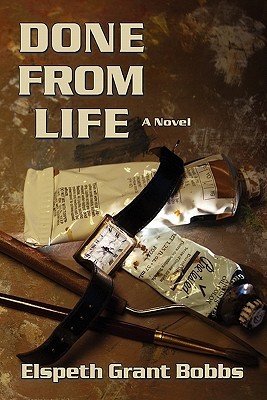
A New Mexico Mystery Review: Done From Life by Elspeth Grant Bobbs

done-from-life

Art and Murder in 1950s Santa Fe

 Rumor has it that a number of the characters in this book are based on real people who were part of the art scene in Santa Fe in the fifties. The author was part of that scene, married to an artist, but she didn’t write the book until 2011 when she was in her late eighties. Her ability to immerse her perspective in a fifties mindset without a single slip or anachronism is impressive. It makes the book fascinating and often startling, as the narrator, feisty young Mary McIntyre—Mac to most people—takes the sexism around her for granted, casually describes a fashion of the time as a “squaw dress” without the slightest sense that the word could be offensive, and tiptoes around the fact that someone is gay with what was no doubt open-mindedness and acceptance for those times. I’m not complaining about these features of the book; it’s realistic and well-done. The time period is neither romanticized nor denigrated, shown as it was in society overall, and in particular in Santa Fe (fictionalized as Villa Real, part of the city’s full name, La Villa Real de la Santa Fe de San Francisco de Asis, the Royal City of the Holy Faith of St. Francis of Assisi).

The characters are irresistibly both likeable and flawed, none of them fatally. Except, of course, one—the killer. Mac, who moved to Santa Fe for her health after spending time in a sanitarium (a true-to-life aspect of fifties New Mexico), works for the local art association. Three of its senior members, established artists, have recently died in accidents. During her illness, Mac read a lot of mystery novels to pass the time. For a lark, she and her neighbor, struggling artist Bill Thorpe, start plotting a mystery novel as if the deaths had been murders. Then, the more they think about it, the more they suspect it’s what really happened. Mac’s problem: she knows and likes all the suspects. Including Bill.

As Mac recovers her health and her looks, she basks in male attention, not hesitating to date two men at once, one of them married, taking unabashed pleasure in the situation and at the same time learning more about the murders that the police are sure were accidents.

As I read, I absorbed new information about an artist’s life and work, got a feel for a city I know and love as it was sixty-odd years ago, and enjoyed working out the puzzle in Mac’s engaging company. I suspected who had done it, but not how or why, though all the clues were well laid. So were the red herrings. Bobbs handles what is normally the worst scene in any mystery—the confession scene—with genuine originality, eliminating almost all of the clichés. At the end, Mac’s decision how to handle her knowledge is morally ambiguous, but her reasoning is clear.

A special charm of this book, for those who know Mrs. Bobbs’ contributions to Santa Fe, is that Mac’s hobby is gardening. Mrs. Bobbs’ gardens at La Querencia are legendary, making her a Santa Fe Living Treasure. The gardens, in fact, are her claim to fame, and it’s quite possible there are many people who know of her for this achievement and don’t realize she wrote a mystery.

In lieu of the usual author interview, I’ve linked to a blog post that features pictures of the author’s gardens and to a wonderful article from New Mexico Magazine that is better than anything I could have done. After reading it, I felt as if I’d spent time in Elspeth Grant Bobbs’ delightful presence. Enjoy.

I do have to point out a shortcoming in this book. I wish the copyeditor had done justice to it. Sunstone Press should have someone who is more attentive to detail do it over, fixing simple things like run-on sentences, a few unclear lines of dialog, etc. that the original editor should have corrected before publication. These oversights annoyed me considerably at first, but I became so immersed in the story that although I still noticed the problems, I ceased to be so distracted by them.
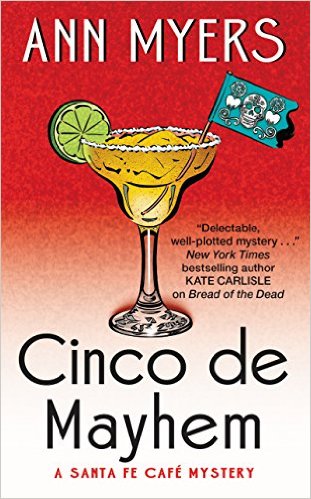

 

A New Mexico Mystery Review: Cinco de Mayhem

CincoCoverImage

The story begins with a green chile and cheese soufflé—spicy, light and airy, and at risk of sudden collapse, setting the tone for a comic culinary mystery. Rita Lafitte and her colleagues at Tres Amigas, the Santa Fe café of the series title, get involved in solving a murder again. The victim is a petty, arrogant bully, a restaurateur and food cart operator who made enemies of all the other food cart owners in the city. Not an easy death to care about except that a friend of Rita’s is being framed for it. Linda Santiago, the unlucky accused, is a wonderful, original character from the first book who doesn’t fit any mold or any of the standard roles in a comic mystery. Another complex, intriguing and believable character is the multi-faceted Don Busco, hotdog vendor and raconteur. Others are more broadly drawn and provide great comedy, especially Addie, with her delightfully eccentric fantasies of being British, and eighty-something Flori with her flirtatious ways, her sleuthing hobby and her new fascination with Sun Tzu’s Art of War. They are wildly colorful, but not to the point of being impossible. Someone just might feel free to be that odd in The City Different.

It was good to see Rita still connected to the memory of Victor from the first book in a natural flow of her personal story from one book to the next, and to watch how her budding romance develops. Her relationship with her daughter is an ongoing part of the series that adds depth and realism and of course the inevitable humor and conflict of parenting a teenager.

I got a kick out of the arrival of a flamboyant professional thief and his role in the plot. With the high rate of burglaries and thefts in Santa Fe, he may have strong future in the series. There are only 2 or 3 murders a year, but people like him have a thriving occupation.

The setting is brought to life, though only a very small portion of the city is featured. The writing is tight and polished, digressing only for the food-related tidbits that narrator Rita and culinary aficionado readers would find irresistible. With several subplots and red herrings, the plot was paced to keep to me turning the pages even after I figured out the killer’s identity. The revelation scene was the only weak point. Even though almost every mystery handles it this way, I’m not a fan of this particular genre convention and love it when authors find another option for getting closure on the crime. The final ending was satisfying, however. And of course, there are recipes for some of the foods featured in the story, including the thematic soufflé that frames the tale.

To learn more about the series, you can read my review of Bread of the Dead and my interview with Ann Myers, and check out her web site.

Book Review: One Mind by Dr. Larry Dossey

Chakra_Another

To some people, psychic events are kind of cool, fun and interesting. To others, they are troubling and to others, they are woo-woo nonsense. To a few, they are the subject of serious science.

In this book, Dr. Larry Dossey’s thesis isn’t simply that nonlocal or psi phenomena exist, but that these phenomena have spiritual, ethical and ecological implications. He provides compelling evidence from research and a vast collection of illustrative stories to show that shared knowledge and perception over a distance are not only possible but common. People who are not normally psychic have this connection with loved ones at times of intense need. Psi connections occur with twins, with pets and owners, with doctors who know when patients need them, and are even shown to take place between minds and machines in experiments with random event generators. Dossey calls this capacity to share past, present and future in our consciousness the One Mind, and notes that love is a factor that enables it.

It’s not the only factor. Mere helpfulness will suffice. Some gifted individuals can bring their psychic ability into action on purpose, finding shipwrecks that were previously undetected by other means or locating stolen property.

Our society is afflicted by the illusion of separateness, fueled by rage, fear and negativity. Dossey persuasively builds his argument that individuals are woven into a web of being through consciousness that is not confined to the brain and body or to one place and time. In the final chapter, he quotes Vaclav Havel on transcendence, wrapping up the journey through the various forms of evidence with this reminder that we not only can transcend the boundaries of ego and self-vs.-other thinking, but that we must.

A review can’t do justice to the contents of this book. It is constructed so that ideas build upon ideas, scientifically and philosophically, and it is also entertaining, like a conversation with widely-read, witty and irreverent expert. If you liked the review, you’ll like the book even better.

Larry Dossey’s web site: http://larrydosseymd.com


Image: Chakra by Ranjithsiji

A New Mexico Mystery Review: The Clovis Incident

Clovis_frt

Until I read this book, all I knew about Clovis was that it was home to the Norm Petty recording studio, where Buddy Holly recorded his hits. It’s not one of New Mexico’s more famous places and seems unlikely ever to be one. This makes the premise of the book immediately appealing. Freelance PR pro Sasha Solomon is trying to get a gig promoting flat, unimposing Clovis as tourist destination.

She was doing PR for a health care company that included alternative therapies in it coverage, and in true Albuquerque/Santa Fe area style, she tried out so many shamans and other mind-body-spirit healers she had a kind of psychic meltdown, making her mental boundaries so porous she now hallucinates under stress. She’s been fired, and she needs the Clovis job.

The story gets more and more eccentrically New Mexican as Sasha looks into alien abductions as part of her PR plans to promote alien-seeking tourism in Clovis, (Her visit to alien-centric Roswell is a small but delightful part of the book.) Alien abductions also figure in a murder investigation, as do Sasha’s strange visions, when the body of a Singaporean military officer is found on a friend’s land.

The less colorful aspects of life in Clovis, from the military base to the farms and ranches, are portrayed with respect and realism in the framework of a humorous mystery. In a crucial scene set in the midst of a large-scale dairy farm, suspense and comedy run neck in neck.

Author Pari Noskin captures characters brilliantly, whether they are major players or walk-ons. Sasha is an original creation, likeable but far from sweet. Detective LaSalle grew on me. The longer Sasha had to deal with him, the more he was revealed in the slow, natural way strangers get to know each other.

Underlying themes include mother-daughter relationships, friendships, rural life, and romance in middle age, tied together through the mystery and laced with an inside look at the PR business. The mystery is multi-layered with so much entertainment that I sometimes forgot to try to solve it. I know a book is working when I respond to it as a story rather than a plot. It turns out that I did suspect the real culprit, but I never felt that the author had made it too easy to figure out.

Noskin turns some off-beat phrases, with a style unlike any other. Aside from Sasha’s appalling habit of taking shots of whipped cream straight from the can, I thoroughly enjoyed every page.

*****

My interview with the author will be posted in the next week to ten days. Meanwhile, you can buy the book and enjoy an unconventional trip to Clovis.

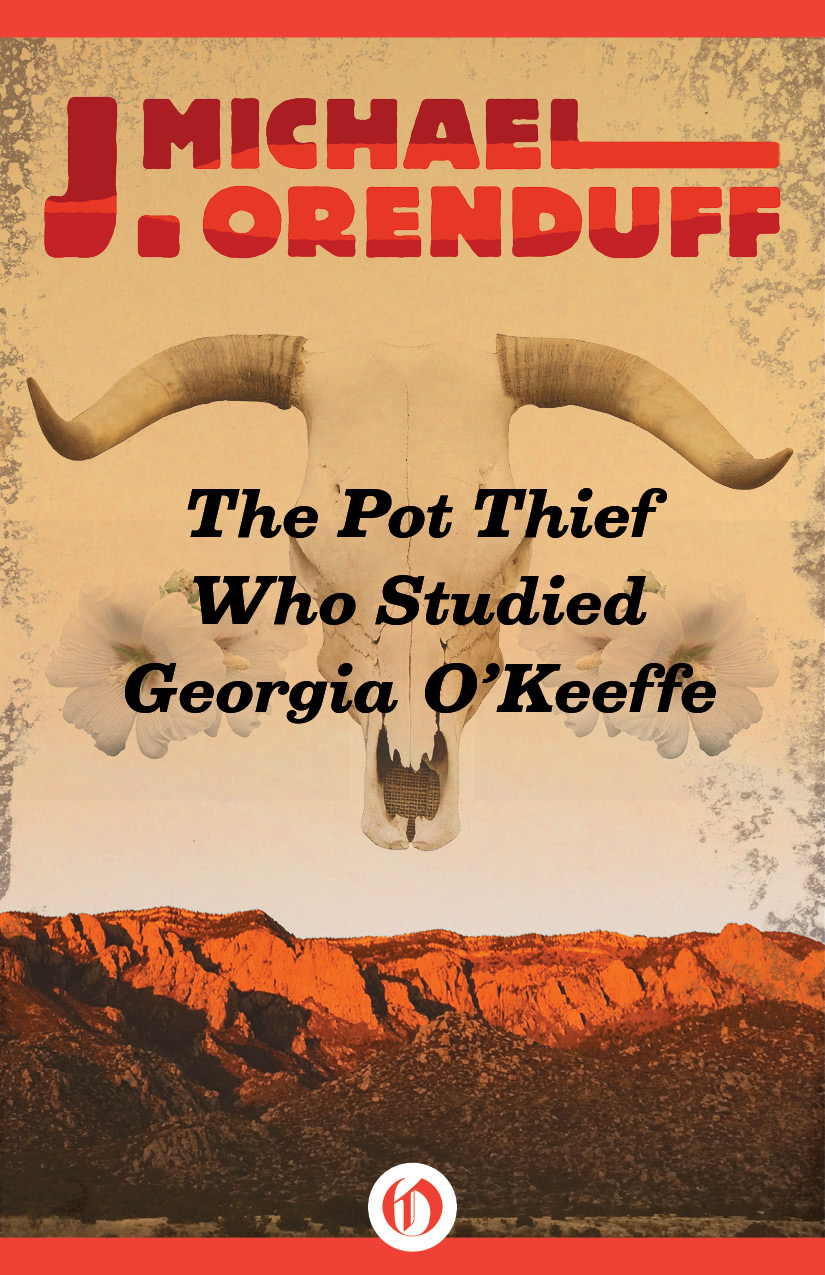
A New Mexico Mystery Review: The Pot Thief Who Studied Georgia O’Keefe

O'Keeffe cover 3

This is not an interstate kind of a story; it’s a back road drive with a raconteur at the wheel. There’s a wonderful pot in a remote place, and it takes a bit of a hike and some excavation to find it. Brush off another layer, and there it is, an intact marvel of original workmanship. The old pots which the narrator, Hubie Schuze, admires were made by hand, not on a wheel, and their shape shows it. Not perfect—and not meant to be. That’s part of their character. This book is not shaped like a standard mystery novel, either. Don’t expect it to be. Just ride the back road. Hubie knows where he’s going (though you may wonder about that at times).

The prologue takes off like a rocket. Then, during the first few chapters, new readers may go through what I’ll call “orientation to Hubie,” getting used to the flow of his entertaining and often educational ramblings on topics historical, artistic, culinary, and unclassifiable. (Established fans of the series already enjoy this as much as solving the mysteries.) If you’re new to the Pot Thief and decide to start here, don’t worry, keep reading. Once Hubie gets out in the desert to illegally “rescue” an ancient pot, the story, his character, the setting and his deep reverence for the artifacts he finds and sells come together into a lively, colorful tale that’s both a clever mystery caper and a sweet, delightfully off-beat love story. There’s a lot of wordplay, for fans of that type of wit. However, the humor I liked most in this book was that which came authentically from characters and situations, and there’s plenty of it. Hubie’s sincere and awkward attempt to put his girlfriend at ease in a delicate situation is hilarious, all the more so because it comes from his heart. A sudden turn of events near the end is so perfectly timed and phrased for comic effect, I think my neighbors heard me laugh when I read it.

The New Mexico landscape and locations—from Albuquerque to Truth or Consequences to the vast emptiness of the White Sands Missile Range—are portrayed well. Hubie’s idiosyncratic meanderings are part of the New Mexico feel of the book. I can easily see him in the mini-park in the median in Truth or Consequences across from Black Cat Books and Rio Bravo Fine Art. I can’t decide if he would get on my nerves or amuse me if I sat with him—probably both—but he fits perfectly. (There seem to be a lot of smart, eccentric, single, middle-aged men in T or C.) Orenduff has created a unique character in Hubie, and his own style of mystery—intelligent, non-violent, and funny, with the murder aspect secondary to other puzzles. The red herrings are effective, the clues are laid well, the solution is surprising, and the end is satisfying.

If you haven’t yet discovered the earlier books in the series and want to start at the beginning, the titles, in order, are:

The Pot Thief Who Studied Pythagoras

The Pot Thief Who Studied Ptolemy

The Pot Thief Who Studied Escoffier

The Pot Thief Who Studied Einstein

The Pot Thief Who Studied D.H. Lawrence

The Pot Thief Who Studied Billy the Kid

The Pot Thief Who Studied Georgia O’Keefe (release date: Jan. 26, 2016)

 Next week I’ll have an interview with the author, J. Michael Orenduff.