Knowledge and Perception

During the month of August, there were so many events scrolling through the electronic sign over the entrance to Elephant Butte Lake State Park that someone decided to remove the time-temperature-and-welcome from the cycle of reminders and announcements. Once I got used to not seeing those numbers when I rounded a high point on the trail with a view of the sign, I realized how absurdly attached I’d gotten to noting exactly how many minutes it had taken  me to reach that spot and whether the temperature had gone up a degree. I enjoyed my runs more without this information snagging my mind.  Now that there’s less going in in September, “Welcome to Elephant Butte Lake State Park 1:36 p.m. 87 degrees” is back. It still takes me exactly twenty-four minutes to reach the point where I can see it, and I can tell how warm it is without looking. What is it about numbers and measurement? Or even the desire to know something just because it’s there to be known?

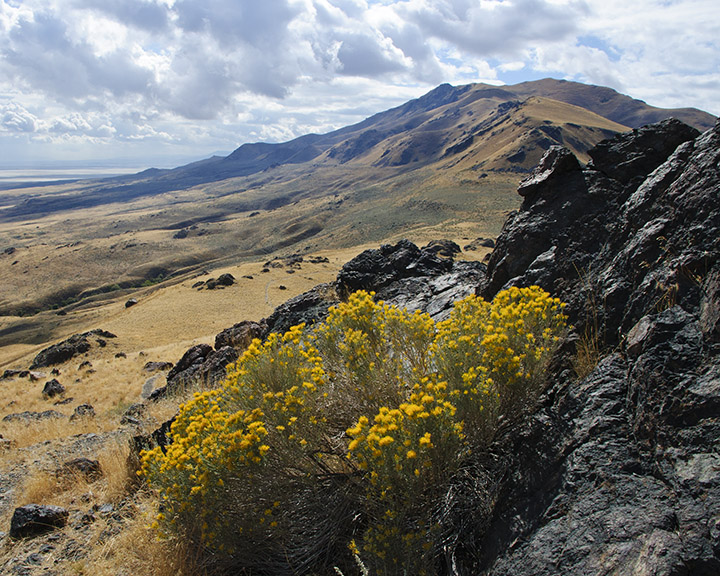
I don’t have anything against knowledge. Practical knowledge enhances life, and useless learning is fun.  I spied a large, almost squirrel-sized, New Mexico whiptail today. She did one pushup and disappeared under a bush. My useless knowledge informs me that she was a she because they all are—our state reptile is an all-female species.  Trying to identify a delicate purple flower I admired, I searched online in vain, but I learned that among New Mexico wildflowers there are plants called Water Wally, Hairy Five Eyes, Bastard Toadflax, Blue Dicks, Redwhisker Clammyweed, and Bonker Hedgehog. (The last one is a small cactus.) I still don’t know the name of the purple flower. I think its bright yellow companion is snakeweed, but it may be chamisa. Chamisa’s botanical name is Ericameria nauseosa, which makes me want to create an unpleasant character named Erica Maria in some future book. This plant, or its purple friend, smells wonderful, not nauseosa, and that perception is a greater joy than the satisfaction of acquiring a fact such as its name. Globes of yellow blossoms on green stems and taller stalks with tiny purple blooms glow against the pale brown sand, and a rare whiff of floral sweetness surprises me as I run past. At exactly the same speed whether or not I measure myself.

*****

Enjoyed this post? You may also like Small Awakenings: Reflections on Mindful Living.

Disappearing Words Come Back—Overnight

This short story appeared on my blog between sunset and sunrise on the autumn equinox last year, and is showing up and disappearing again this year, here and in my newsletter*. Last year, I explained its disappearance the day after. This year, I’m sharing the explanation again, but in advance. I’ve put it on a download link that expires.

Why does the story vanish?

When I was a teenager, I read a newspaper column about a myth related to the autumn equinox. After all these years, I can still see the kitchen table where I was sitting and see which side of which page the column was on. I remember that it was about a Germanic pagan goddess of second chances who opened a path that was only visible on the night of the autumn equinox, a path seekers could take to redo a mistake or regret in their pasts. I made an effort remember her name and wrote it down, although I was confused as to whether it was Llobrodga or Llobrogda. Having had a short story published in a teen magazine, I already thought of myself as a writer, and I knew I would have to create a story about this myth someday. An image of the goddess’s twilight path of golden leaves stayed with me. When I finally wrote the story decades later, she didn’t exist. I looked up everything I could think of about goddesses of second chances and pagan mythology and the autumn equinox and found nothing. I can’t explain this. But I hope you enjoy A Night in Betsy Gap.

The title came about a few years ago during a training session for professors who were teaching a first-year seminar class. One of the presenters was named Betsy, and she didn’t use all her allotted time, so someone referred to the open space in our schedule as the Betsy Gap. I said it sounded like some place out near Naked Creek (a real town in that part of Virginia). The name Betsy Gap stuck with me as perfect for an obscure place where a traveler could get stuck. Then I saw a prompt for a short fiction contest in which the theme was crossing a line, and it had to include the word six-pack and another which I’ve forgotten. The idea for a short story about Edie had been brewing in the back of my mind for a while, since her only role in the Mae Martin series is in Hubert’s past. I was surprised when Will Baca showed up in the story, but this other-world experience prepares him for the big changes he goes through about ten months later in Ghost Sickness. (Not that he remembers.)

When you read the short story, you’ll know something Mae and Hubert won’t know until book seven, since Edie cut off contact with everyone she knew in Cauwetska and Tylerton, intentionally making herself hard to find. Her fate won’t show up in the series until the work currently in progress comes out. But in the September before the events in Ghost Sickness, she spent a night in Betsy Gap.

* If you subscribe to my newsletter, pardon the repetition. For the most part, my blog followers and newsletter subscribers don’t overlap, and neither does the content they read.

*****

The Calling, book one in the Mae Martin series, is free on all e-book retail sites through the end of September.

Brain Wash

Wednesday was an insanely busy day. I moved back into my place over the Labor Day weekend. The bad neighbor is gone! But I’ve had a lot of catching up on my life to do. The last thing I felt like doing was laundry. It’s the one aspect of retiring and downsizing that’s been unsatisfactory, because I have no room in my otherwise perfect apartment for laundry machines. I’ve adapted to the laundromat as well as I can. I bring books and magazines and read outside, I take walks, or sometimes I bring my exercise tubing and work out, but I still don’t like it. On this super-busy day, the laundromat was also busy, full of people doing noisy things on their phones, and there were noisy activities outside too. I read, but it wasn’t peaceful. I ran an errand while my clothes were in the dryer. More busyness. When I got back, one of the dryers hadn’t started when I thought it had, so I had to restart it and wait longer.

Normally, I do a meditation practice with mudras late at night, to clear the day away and cleanse my energy. I did it there, in the laundromat. The only other remaining customer had gone outdoors. I didn’t care if she came back in and saw the mudras, though. This is T or C, after all. People here talk with strangers freely, and she’d already shared something pretty personal in our short conversation. I was free to be myself.

All the churning and spinning of machines echoed my state of mind. Then, five minutes of mudras in mountain pose in front of that misbehaving dryer changed everything. The washing was done. Inside me.


*****

Enjoyed this post? You may also like Small Awakenings: Reflections on Mindful Living.
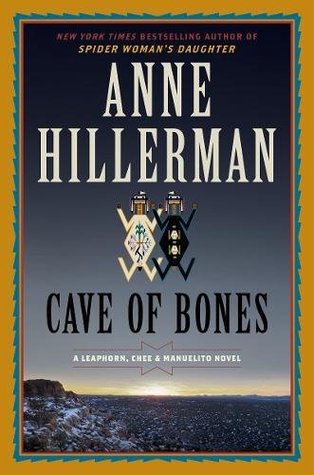
A New Mexico Mystery Review: Cave of Bones by Anne Hillerman

I mean this as praise when I say this book reads more like a slice of life than a standard mystery novel. Anne Hillerman sustains suspense while avoiding the familiar ruts of the genre. I liked the fact that there was no “dead body by chapter three,” one of the conventions of mysteries. And since the book doesn’t start with a murder or the discovery of a dead body, the mystery gets its impetus from figuring out what happened and why. Not from figuring out who killed someone. Navajo police offer Bernie Manuelito shows courage and persistence as she becomes involved in several related problems: the puzzling disappearance of a man who worked for a program helping youth through wilderness experiences, a tribal council member’s demands that the program’s accounts be investigated, and the possible looting of ancient grave sites. Bernie’s husband, Jim Chee, is also looking into the fate of a missing man.

I was every bit as compelled to keep turning the pages as I would have been in a more conventional mystery, maybe more so, because I couldn’t guess where the story was going. I was curious about many people’s motives and deeply concerned about whether or not the missing men would be found. I wanted to know why they vanished and what might have become of them. Both of them became real and likeable while entirely offstage, as shown through the eyes of those who knew them—including one’s cranky mother-in-law and another’s disgruntled, critical coworker as well as those who loved them.

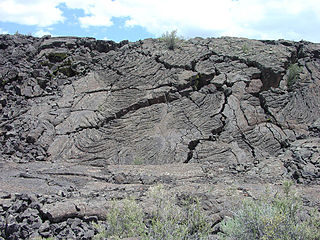
As always, I enjoyed the fullness of the story, the family life, and the friendships that make Bernie a whole person. The settings, from the Malpais lava lands  to the Institute of American Indian Art in Santa Fe, are vivid. The land itself is a powerful part of the story.

There’s no closing cliché, for which I am grateful. I hope it isn’t a spoiler to congratulate Hillerman on not having her protagonist held at gunpoint by a killer as a way of wrapping up the final questions. Instead, she provides a more original drama that triggers the key revelations, and also more a realistic conclusion.

I thought I caught a timeline glitch relating to some seeds in a drawer, but I might have been reading too fast and missed something. Otherwise, polished and intriguing.

Un-poisoned

At the time of my writing this, my Bad Neighbor, the smoker, squatter, and apparent drug dealer (based on traffic in and out of the apartment he’s occupying) hasn’t left yet, despite the two eviction notices. It’s going take a court case. And since he won’t move out, I have—temporarily. There’s no safe level of second-hand smoke, and ventilation isn’t enough to get rid of it. The physical impact of the toxicity—headaches, sinus pain and congestion, light-headedness, and difficulty concentrating—was obvious. I didn’t fully realize the mental effect until I escaped. When your body is being poisoned, it’s hard to clear your head.

My landlord found me a place to stay until the problem is resolved. I am so grateful for this escape, and am amazed at how different I feel. I’m in, of all places, The Red Pelican. If you read Death Omen, I expect you remember it well—it’s so eccentrically beautiful. I’m in the room I gave to Kate and Bernadette in that book, and I don’t think I described it quite right, though I got the general ambience of Red Pelican rooms with their Asian art and bright colors.  Some of them have purple walls and red trim, but my room has red floors and white walls and a wonderful collection of Japanese prints. Three festive porcelain Buddhas fling their arms up in delight on the shelf of the transom over the bedroom door. A huge sequined dragon festoons the bedroom wall.

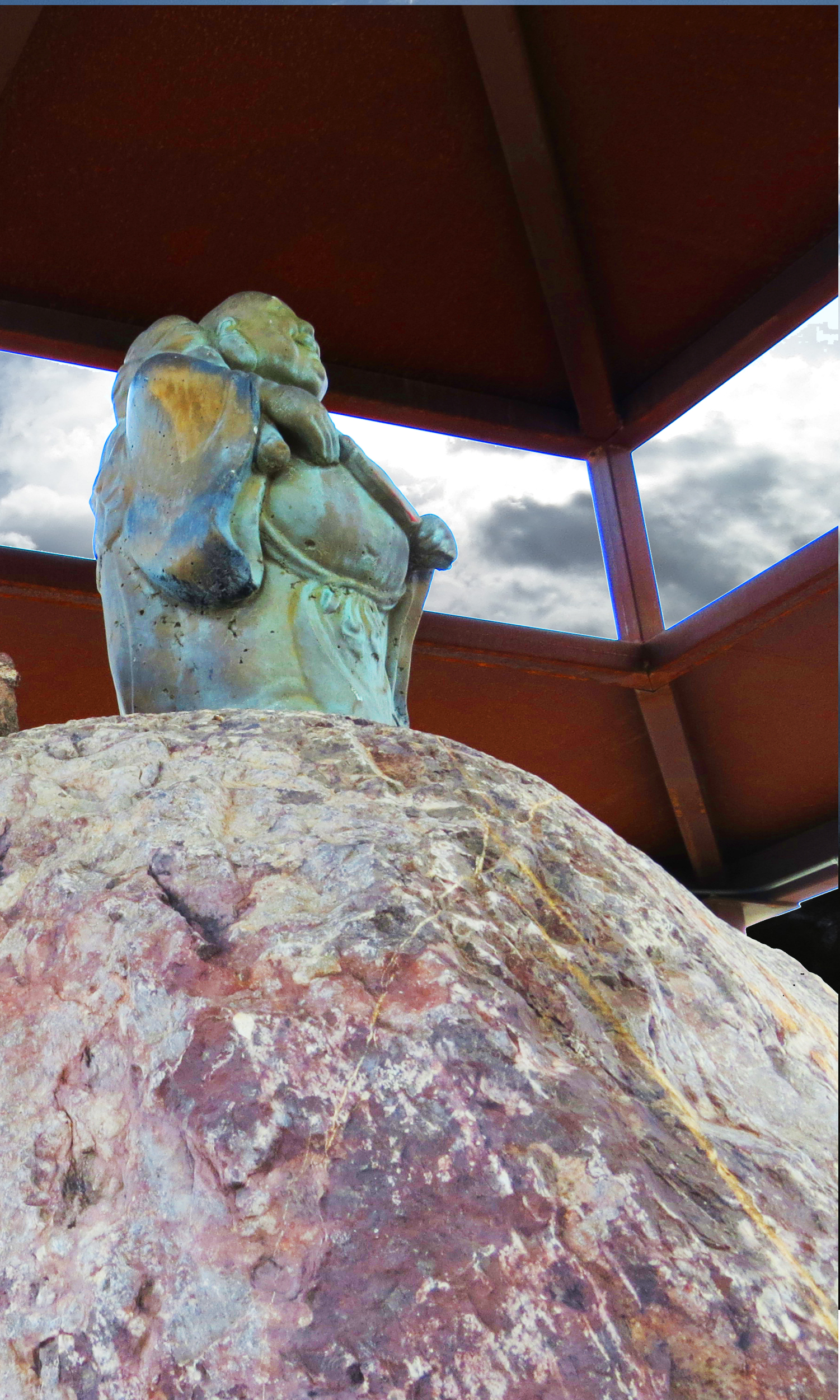
And then there’s the courtyard, with the enormous rock framed by four benches and sheltered by a three-tiered pagoda roof, with gaps open to the sky between each tier. On the rock is perched a Buddha, a radiantly wise, alive-in-the-moment being, a happy traveler with a small sack slung over one shoulder and a fan resting against his round belly. Though I always felt drawn to him, I never knew what his props meant, so I looked them up. The fan is a wish-giving fan, while the sack is said to contain various things, depending on the legend. Treasure. Candy for children. The troubles of the world. The Hotei—or Laughing Buddha—with the fan and the sack is a wandering monk who takes away unhappiness.

On my first night free of being poisoned, a magnificent, long-overdue downpour arrived and stayed for hours. When it lightened to drizzle late at night, I went out into the courtyard, my steps on the gravel the only sound in the world. I visited all the deities and Fu dogs around the perimeter, circled my favorite Hotei on his rock, and then gazed up at him and at the moon through the shredded remains of the storm.

Cleansing. Wholeness. Fresh air. Stillness. Safety. We have no idea how toxic our world, our lives, our minds, our interactions—anything—has become, until we step away from it and breathe.

*****

Thanks again to Donna Catterick for the picture of the traveling Buddha in the Red Pelican courtyard.

Another Reason to Read the Classics

In my work in progress, the seventh Mae Martin mystery, Mae’s ex mother-in-law is running for office again in North Carolina. I didn’t become a campaign volunteer to do research, especially since I’m door-knocking in New Mexico, but I’ve gathered a few good stories which may have a future in this book or another. FYI: Though this post does involve a political campaign, it’s non-partisan. If you suffer from political burnout, relax. I don’t even mention names or parties.

Today’s story:

In a pleasant neighborhood of one-story stucco and adobe houses with a view of the open desert beyond, I walked up to the second-to-last house on my canvassing list. On the street where the incumbent representative in our NM house district lives, I was volunteering for the opposing candidate. I’ll call them Incumbent and Challenger. Incumbent’s neighbors tended to support her, even if they were members of my party and not hers, and even though Challenger might better represent their views. They like Incumbent. That’s local politics. In another neighborhood a few weeks earlier, I met a woman who had never heard of Challenger, but said, “Is she running against Incumbent?” I said yes. The woman replied vehemently, “Then she’s got my vote.” It was obviously personal. She added, “Am I awful?” I smiled and said we were happy to have her vote.

Back to today’s second-to-last house. I’d been through a thunderstorm earlier, was now walking in heat and sun, and was ready to wrap things up. A black pick-up truck with Harley-Davidson bumper stickers pulled into the driveway just as I approached. A man with a long shaggy white beard sat at the wheel.

“Hi,” I began my perky canvasser bit. “Are you Mr. X?”

He was. And my list of voters to contact said he was a member of my party. I went on with my introduction, telling him who I was and that I was volunteering for Challenger. I asked, as I always do, if he had heard of her. People are often unfamiliar with a new name at the bottom of the ticket.

“I don’t vote. All politicians are liars.” Still sitting in his truck with the door open, he nodded meaningfully toward Incumbent’s house. The politician her other neighbors liked so much they’d vote for her even when they generally disagreed with her party.

Not sure how to handle his blanket aversion, I offered him Challenger’s flyer. “In case you should decide to vote, you can read about what she stands for.”

He actually read it, right then and there. “Hm. Social work.” He’d noticed her career field. “I studied social work in Colorado.” He told me what jobs he’d had, working with youth and then with drug users, and then informed me that “My wife, who is not a citizen, made me vote in 2016. But that’s the only time I’ve voted in decades.”

“That’s a powerful woman, if she could get you to vote when you’re so turned off by it.”

“She is. A powerful woman.” But, he told me, he’d moved to New Mexico alone because his wife didn’t understand why he had to have his motorcycle.

His way of getting involved in the community wasn’t political, he continued, but rather volunteering at the new animal shelter. “I don’t have any animals.” With a half-smile, he inclined his head toward the pair of dogs barking behind his fence.

“We all have our ways of trying to make the world a better place. You’ll take care of the animals, and I’ll knock on doors for Challenger.”

I was about to say goodbye and wish him a good day when he got out of his truck, revealing long skinny legs in shorts and knee-high black socks. “Let me show the motorcycle. So you’ll understand.”

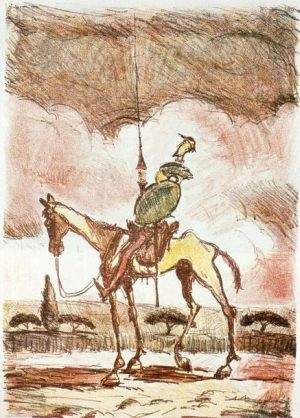
There was a black Harley in the driveway. Apparently this was not The Motorcycle. He opened the garage and revealed a bigger bike with ivory fenders. It looked like a vintage machine, and I sincerely admired it. He said, “That’s Rocinante,” then paused. “You know who that is?”

“Don Quixote’s horse.”

Mr. X beamed. “Not many people know that. I’m gonna vote for Challenger. She’s got good people working for her.”

I felt as if I’d just won Jeopardy as well as Incumbent’s neighbor’s vote.

Small Awakenings: Reflections on Mindful Living

Even commonplace events can have depth and meaning, if we take time to notice. Power outages. Desert rain. Bats in flight. A stranger singing in a park.

In this collection of essays, Amber Foxx—a former college professor, now a mystery writer and yoga instructor—blends her insights as a teacher with her love of words to chronicle moments of beauty and deep attention.

Join her on a reflective journey though the small awakenings mindfulness brings into everyday life.

Barnes and Noble        Amazon           iTunes Bookstore         Kobo

paperback:  Direct Sale   Amazon

Eight plus Eight Equals Awareness

The dread of being stuck with an inconsiderate neighbor plagued me while I ran, as my mind rehearsed all the ways the problem could get worse and all the steps I might have to take to get it resolved. After all, there was only one good scenario: him moving out. But the bad ones seemed endless, and my mind seemed compelled to explore all of them, including having to move to get away from him. For me, his worst disruption of our previously serene little community in our building has been smoking (and stinking up my apartment!) although smokers are required to go off the property, not even in the courtyard, to light up. Worry clings to the mind in pursuit of a solution, even if there’s none possible at the time. Granted, this can be a preparation for coping, but I don’t go out in nature to worry, so I started counting the negative thoughts. Once I notice a pattern, it’s an effective way to interrupt it and make a particular worry into a practice rather than a torment. It came back eight times in four miles. With each return, I was no further along in solving the problem, but I was more aware of clinging to it and could let it go more quickly, to return to awareness of my movement and my surroundings. After all, if I can focus that intently on a negative, I apparently have the capacity to focus equally on something else if I chose to do so.

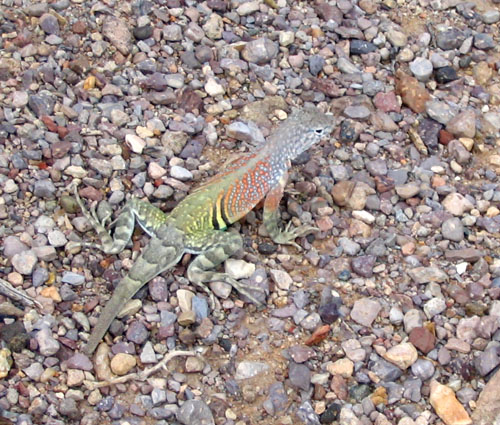
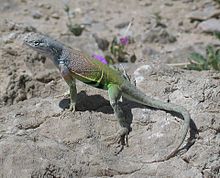
It was the day after a big rain, a cool eighty-two degrees, and that brought out the lizards. I saw eight greater earless lizards, evenly distributed along the trail, one about every half mile, and I paused to admire each of them. Their sleek gray heads and necks. Their glowing orange sides with diagonal black stripes. Their orange upper arms and radiant blue-green forearms. Their green hind legs and tail that seem lit from inside like a stained glass lamp. (The pictures don’t do justice to their true colors.) Most of them posed or did push-ups, as if showing off their jewel-like skins. Normally, I feel lucky to see just one, so this was an extraordinary bounty.

When I got home, my landlord let me know he was giving the smoker a thirty-day notice to vacate the premises. I wish the guy would leave sooner, but the point is, I hadn’t needed to keep thinking about it. I’m glad I was able to pop the worry bubble often enough to enjoy the weather and the lizards.


Mae Martin Mysteries Books 1-3 Boxed Set

The Calling

A missing father. A mother with a secret. A professor who might be a shaman—or a fraud. As Mae discovers her gift of “the sight,” she overturns her own life and the lives of those around her.

Shaman’s Blues

A gifted musician disappears. A questionable seer vanishes, to Santa Fe or another dimension. Finding two missing people proves easier for Mae than learning the truth about either—or getting one of them, once found, to go away again.

Snake Face

Musician Jamie Ellerbee needs Mae’s psychic aid. His tour is being trailed by bad luck, an anonymous fan, and a strange new friend—who may not be a friend after all.

 No murder, just mystery. Every life hides a secret, and love is the deepest mystery of all.

Three full-length e-books for $5.99.

Amazon   Barnes and Noble   Kobo   iTunes Bookstore

Change

The bats have relocated. It’s an unwelcome change for their fans, but it was inevitable. They couldn’t stay in a man-made structure forever.

The old warehouse where they resided has been sold and cleaned out, and repairs are in progress. The building was crumbling, and the bats, delicate and magical as they are, made it stink. The man working on the place said the bats were welcome to back if they wanted to for now, but of course they don’t want to. He had the doors wide open and daylight was pouring in. The building is going to be converted into several apartments. As one of my neighbors said, even bats have the sense not to like developers.

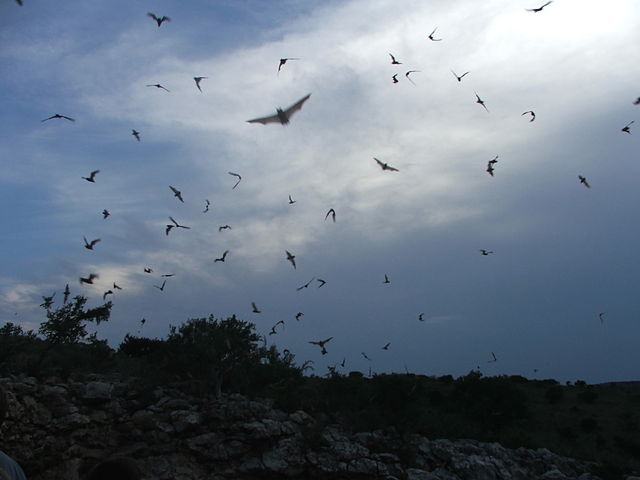
Years ago, the bats lived in the Methodist church, also known as the pink church. Then, after a fly-out, the church had wire mesh installed over the vents so the bats couldn’t come back in. They moved to the warehouse. Now they’ve moved again. Bat lovers in the T or C hot springs historic district have been watching the sky at sunset. Our little relatives are still around, though in smaller numbers, and we don’t know where they live now. We’ve checked various possible new bat homes. The Baptist Church. No bats. The ice house, an empty building between Rio Bravo Fine Art and the community youth club. No bats. Though I miss the clouds of them in the evening sky, I hope for the bat colony’s sake that they have moved to a nice private cave on protected land where they can stay for generations.

Several evenings ago, I took a sunset walk, and a few bats hunted bugs over the streets. I counted seven bats fluttering over the river and the wetlands, but I couldn’t stand by the water and be immersed in them. And gnats are gathering on my ceiling again, though only by the dozens, not swarming the way they do when the bats are entirely out of town.

A speckled and striped gecko, no more than an inch long, with a rosy patch on its tiny head, was attempting to sneak into my apartment when I got home from running today. I was tempted to allow it to move in. It was cute and it would eat gnats. But I caught it, admired it, and carried it across the courtyard to a rocky area under a tree. Better for all of us, in the long run.