Yoga with Cats

I had watered the plants before I did my practice in the sun, and the one-eyed tom cat slipped under the fence and lapped at the puddle where I’d dragged the hose across the flagstones to water the pomegranates. Part of his tail was missing as well as one of his eyes. I was surprised to see him stay so long. Strangely, he wasn’t timid like he used to be. While I did my yoga practice, paying close attention to my alignment, to my breath, to my presence in the moment, he came closer, stood nearby, and meowed relentlessly. I realized that he, like other cats I’ve known, wanted to be part of this.

I once taught at a yoga studio that had resident cats. During my personal practice there, the one named Shakti would participate in any pose in which she could place herself with a gentle leap onto my body. Without ever using her claws, she would get on the thigh of my front leg in warrior one or on my back while I was in child’s pose, a warm breathing sandbag. When I was in a pose in which she couldn’t participate, she would meow pitifully until she could make contact with me again. (She inspired the scene in Death Omen where Gasser joins Jamie in yoga.)

Another cat with whom I did yoga belonged to my landlords next door when I rented a little house out in the country in Bertie County, North Carolina. (For people who like trivia about my books, the place I rented is Yolanda’s house in Shadow Family, the old one-room schoolhouse.) Fluffy, a long-haired calico, used to come to the porch for yoga. I think cats are drawn to the positive energy, to a human who is serene and grounded and stretching.

One-eyed Tom kept looking at me with his one eye. I tried not to look at the other, thinking, what happened? Don’t your people take care of you? The neighbors had been feeding him, but had they taken him to the vet, done anything for him? I wanted so much to pet him, but I’d read about a man in England who got some horrible rare disease from petting an unfamiliar cat on the street, and after that I vowed that I would stop petting the friendly, half-feral cats that roam T or C.

One-eyed Tom stared. He mewed and coiled to jump up on the chair that I was using as a prop. But I moved just enough to discourage him. He stuck around, though. When I finished my practice, he settled down in the cat loaf position in the sun and did his savasana while I did mine.

I looked at him more closely when I sat up. His face didn’t have the big tom cat look anymore, and his injured eye was no longer leaking and oozing. It was just gone. I think he’s been to the vet finally, and that his people who feed him tamed him enough to care of him. I owed him an apology. Should he try again, I’ll let him join more fully in my yoga.

 

“A few more breaths.”

The yoga teacher I studied with for over twenty years, the man who taught me most of what I understand about yoga—the skills of teaching, the physical and spiritual practice—died Oct. 21, 2024. He’d been ill for a while, and his wife said he died peacefully.

I honor his life and work by teaching and also by practicing. By remembering not just what he taught but how he taught: with respect, humor, knowledge, and insight, with attention to every person in the room—the real room or the Zoom room—guiding students to be their most conscious selves. I used to commute all the way to Albuquerque to take his classes. The studio where he taught closed in 2020, and I continued to study with him online.

When his cancer was diagnosed, I knew I wouldn’t see him again. He was my teacher, not my social friend, a reserved and private person. I understood not to pressure to see him, not to intrude. I’ve been studying with his wife, also a thoughtful and caring teacher in the same tradition. As he grew more ill in hospice care, she asked me to take over her Zoom class so she could be with him. I wrote to her about his influence on me, and she shared my words with him. He changed my life.Today, I did my yoga practice outdoors, with his teaching in mind as I always do. “Yoga is a manual for being human,” he once said. He challenged us to practice with attention to the moment, deeply awake. Sustaining a difficult asana, he gave clear permission to exit the pose at any time, while inquiring of yourself why you needed to stop. He often ended a long-held pose with “a few more breaths” to get us through it, then saying “And when you’re done, you’re done.”

Namaste, my teacher. My spirit honors your spirit.

Inspired by Learning

Every two years, I have to renew all my certifications as a fitness professional. I enjoy the classes, including the tests, and feel refreshed as an instructor. I also take weekly classes with a yoga teacher whose skill I aspire to emulating. There’s no required continuing ed for writers, though. I could go years without learning anything new, if I wanted. But since I don’t know everything and can forget to apply what I do know, I took a class on revision and self-editing.

It made me look at my work in progress with fresh eyes and gave me an improved sequence for my revision tasks as well as new tools for analyzing problems in a book. It’s more challenging than analyzing movement but equally fascinating.

I’m now so excited about working on the next Mae Martin mystery, I had a hard time making myself pause to write a blog post. Recent encounters and experiences have made me think “blog post.” Bluebirds in the desert. Daytime coyote songs. A new gallery’s grand opening with dance performances accompanied by gongs and didgeridoo—it was so T or C.

But … I have to work on the book!

*****

If you’re new to following me, you may have missed some of my older posts. Small Awakenings is a collection of reflective essays from this blog.

Novelty

I take requests at the beginning of every yoga class. The senior students in Gentle Yoga ask for “the same as last week.” It’s become a running joke, because the class is the same in some ways every week, but it’s also different. They become more capable and aware, so the same asana sequence is a new experience even though familiar. I also introduce novelty on purpose. Not enough to be confusing, but enough to make all of us engage more mindfully. I’m a better teacher when I challenge myself to instruct the basics in varied ways.

During this heat wave, I’ve been waking up ninety minutes earlier than I had been previously. I’d been writing late into the night and early morning, but that meant running in the hottest part of the day. I tolerate heat well, but I’ve drawn the line at a hundred and four. (I used to think ninety-nine was the max I should endure, but then I realized a hundred didn’t feel any different.) Anyway, the point of this story is: the change was not only instantaneous and easy, but it changed my perception.

I began perceiving annoying tasks I’d put off as being easier, and I got around to them. I managed my time better with less attraction to time-wasters. This was not a conscious, will-power based change, but a side effect. I made one alteration because running is important to me, and the other changes followed, as if I’d cleaned the filter on my brain, allowing it to operate more efficiently.

I plan to add something new to Gentle Yoga tomorrow. One new asana. One small yet significant change.

The Pause

When I catch myself pushing on and on, from one task to the next, I’ve intuitively begun to pause in between and do nothing. A few silent seconds of breathing and gazing at whatever’s in front of me changes everything. Then I carry on with greater equanimity and mindfulness.

Teaching yoga, I bring students back to a neutral pose between more challenging ones,  revisiting tadasana between warrior poses or dandasana between seated twists. In stillness and symmetry, we can feel the aftereffects of the previous asana.

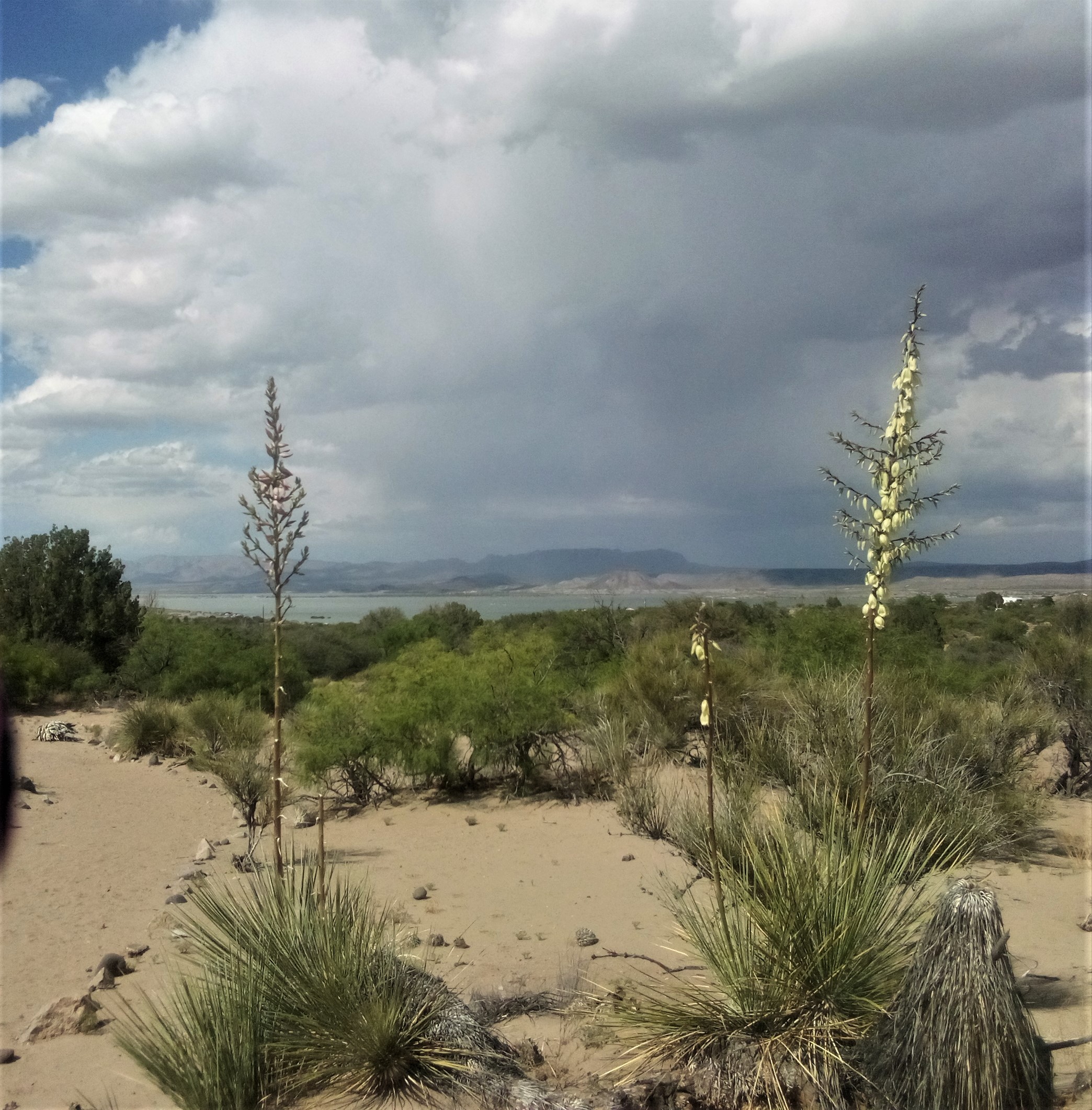
Pausing my run for a sip of water at the top of a hill, I discovered the clouds in the north were no longer distant but moving in and thundering, bringing the imminent blessing of rain to the desert. A multitude of yuccas’ spikes of bell-like blossoms stood out, green-white against the blue-gray sky.

The space between each breath, neither inhalation nor exhalation; the space between each thought, neither this thought nor that; the airborne space between each running step; the pause between lightning and thunder; the line breaks in poems, the rests in music; the dark sky between the stars, the blue sky between the clouds. Sacred space.

One Perfect Day

Spring in New Mexico is pretty rough. The humidity feels like it’s below zero and wind averages twenty miles per hour, day after day. Some days are windier, and things fly around that were never meant to fly, along with a lot of dust and sand. It started early this year, in mid-February, cutting off a good two weeks of our beautiful, gentle winter.

Suddenly, a winter day appeared in March. Fifty-nine degrees. No wind. When I started my run, there was hint of petrichor in the air, the scent of rain. None fell, but it was a sweet moment. The clouds parted, the sun beamed warmth between them, and spring beauty I tend to overlook when distracted by enduring the wind emerged to my attention. Small green plants pushing up in the desert despite lack of rain. Quail and doves and roadrunners calling out to their kind, and quail darting across the trail. A little beige ground squirrel running at full speed, its tail flying out behind it.

Every step and every breath was pure delight. Neither hot nor cold. No strain, no suffering. Just bliss and beauty. The touch of the sun brought pleasure with no “in spite of.”

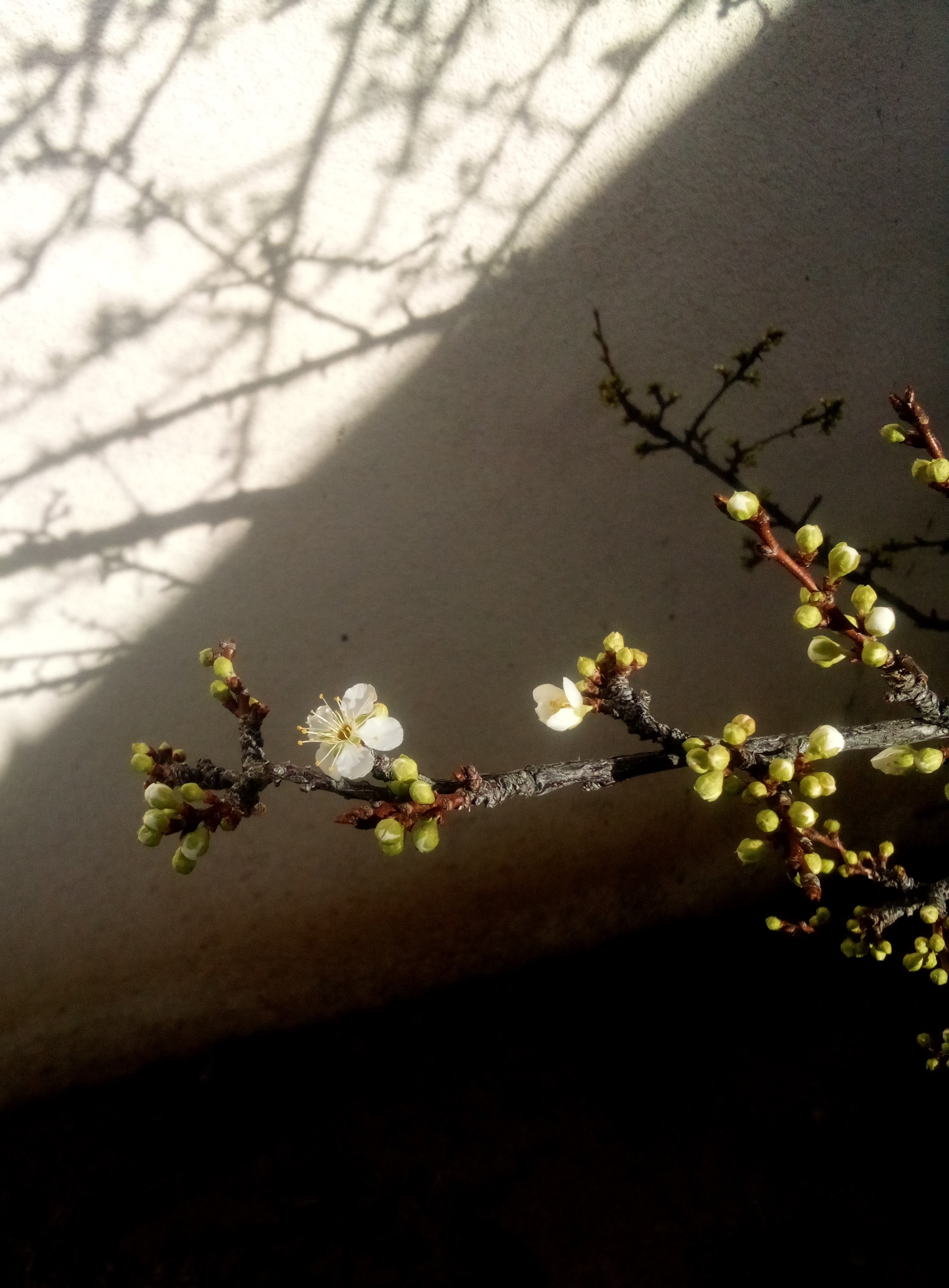
Then I did my plant care chores as no chore at all, watering fruit trees and garden plants for neighbors who are often away. The plum tree was in full bloom. Bees buzzed in it and in the blossoms of the cottonwood trees. Spring-like pleasure without the stress of normal spring. The wind was due back the next day, and knowing this, I basked in every second. One perfect day.

Can I cherish every day the same way?

Listening and Light

Listening silences my inner noise. Running on a winter afternoon, I hear my feet. The sound- textures change from hard slapping on dried-mud clay to near-inaudible thudding on soft dust and sand to crunching on gravel and pebbles. A crow caws in flight. A flock of doves rises from the desert brush with alarm calls as fluttery as the rush of their wings. Hikers converse in amiable tones, too distant for me to make out their words. Rather, I receive their voices as part of the music, harmonizing with the cheep of a solitary bird, the hum of something mechanical at the New Mexico Veterans’ Home on the hill above the trails, and the crow of a rooster somewhere across the Rio Grande.

Listening seems to sharpen my vision, enhancing my inner stillness and conscious presence. The light behind cacti brings out gold in the thorns on tall green prickly pears and red in the thorns on little purple pancake cacti. Their flat purple pads soak up the light. A female desert cardinal is little more than silhouette in a mesquite tree. Each pebble stands out like a sculpture. Each crevice in the now-dry rain-cut earth is wrinkled with deep shadows.

Thoughts slip in, but I let them go and come back to listening and light.


The Spiral

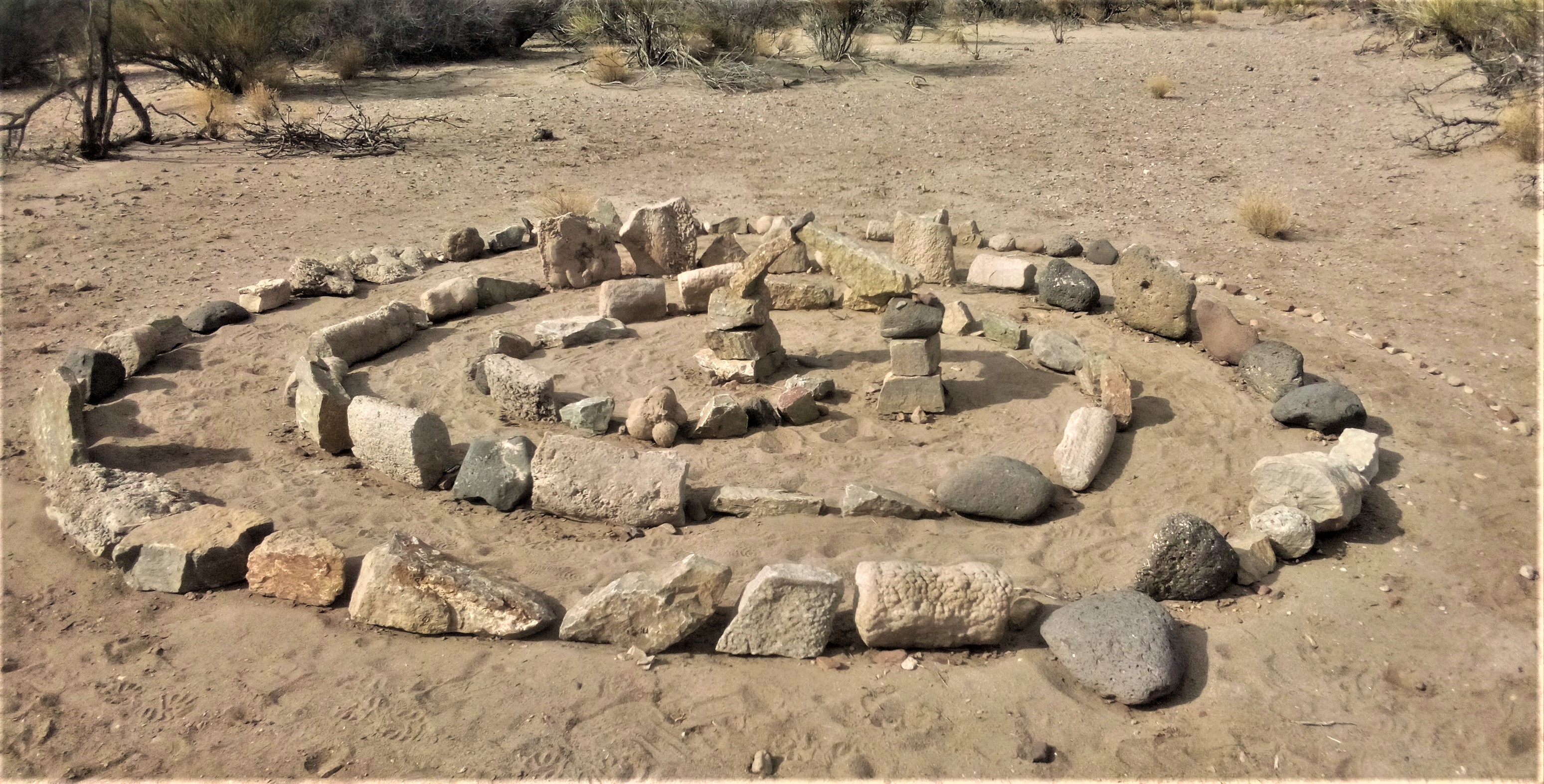
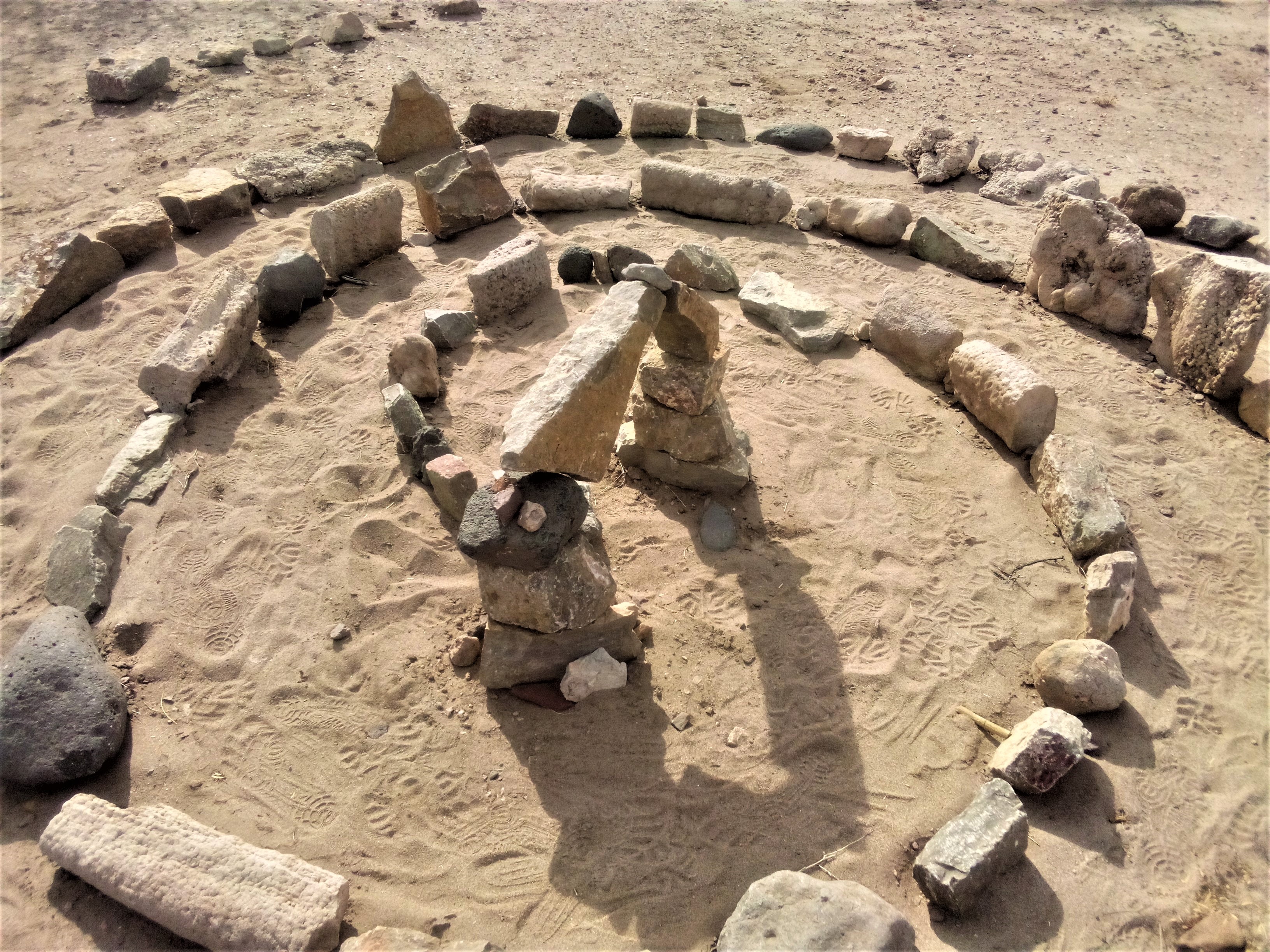
Someone rearranged the collapsed mini-Stonehenge at Elephant Butte Lake into a spiral. Each rock seemed mindfully chosen for its shape, its size, and its colors in relation to the other rocks. At the end of the spiral was a kind of temple, an arch of precisely balanced stones, and then a little offering of green juniper, old wood, and pebbles that reminded me of the flower arrangement at a tea ceremony. Simple, natural, inviting of contemplation.
When I walk the spiral, I am aware of other footprints, someone else’s slow, reverent steps arriving, stopping, and returning outward. I see the bubbles and tubes of the lava rocks, hear my steps on the sand. And nothing else. I arrive at the center and arrive at silence. I return outward, past the smaller and smaller stones tapering out into open space.

The arch fell. The offering blew away. I arranged the remains in a stable position. And walked the spiral again.

Whoo!

About once every two years, I encounter another runner on the trail. Mostly there are dog-walkers in the fall and winter, and no other humans in the spring and summer. Last week, the rare runner approached, and he didn’t just say hi and pass, he grinned and whooped.

He wasn’t a kid—there was gray in his beard. I guessed he was visiting from some snowy place. He wore a tank top while I wore long sleeves and gloves. Escaping to the sun and the desert, he had to be in a state of pure delight. We passed again on the next lap of the loop—at almost exactly the same spot, going in opposite directions at equal speed. He whooped again, raising his hand in a high-five. “Good job!” My cheering section. “You too,” I said.

His exuberance got me thinking about joy. About letting go into the moment. Not taking for granted this experience I have four times a week that was such an exhilarating treat for him. And he celebrated our mutual awesomeness as senior runners still at it. As I ran on, I slipped into my inner “whoo!” zone.

I’ve done it since even without his cheers. Yesterday, I spent two laps mentally fussing with my volunteer work’s to-do list and was about to stop early to deal with it. But then my inner whooper turned around and ran for another half hour, dumping the to-dos and choosing freedom. Then I went back to town and dealt with it all. Today after I taught my outdoor yoga class, I watered the plants (that’s how I pay rent for my “studio”) and instead of going home to get on with the endless list, I gave in to the urge to do my own practice before I even rolled up the hose. I’d only had time for a short warm-up before class. This long, spontaneous practice under the brilliant blue sky was bliss. More om than whoo, but a good bit of both.

Darkness Underestimated

Dark humor. Dark moods. Dark and stormy nights. As a night person, I feel that darkness is underestimated. There’s soothing, sacred darkness. Darkness that makes us see.

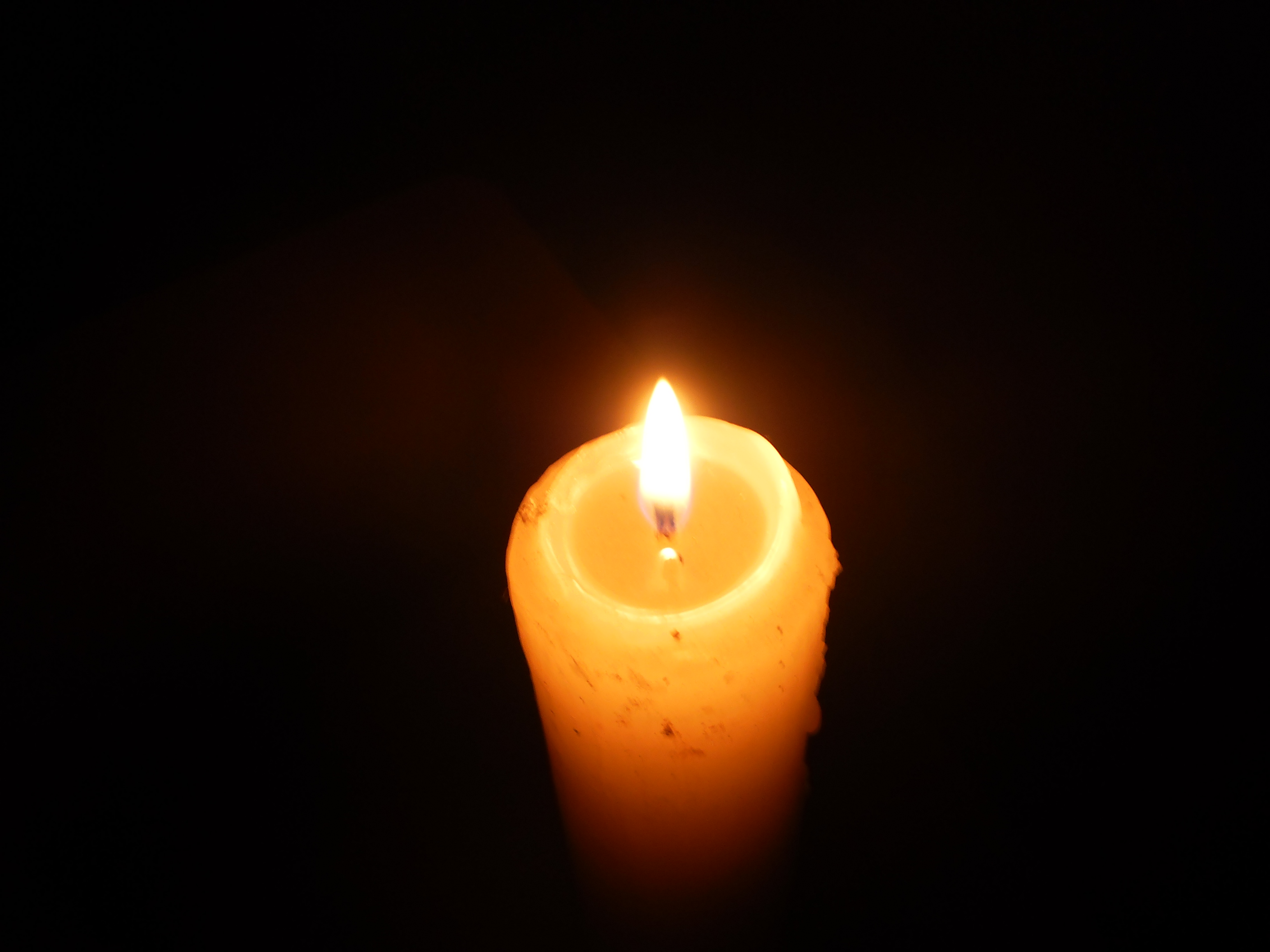
This week, we had one of those brief, random power outages that strikes Truth or Consequences a few times a year. No light from anything but the night sky crept through my windows. The neighborhood was perfectly silent. I found my one candle and a small LED flashlight. My old flip phone made a good flashlight, too. The lack of brightness was peaceful. I had to move slowly, paying attention. With less stimulation, my mind eased into a softer place.  A shower by candlelight was calming. When I turned on my new smartphone to call in the outage (in case hundreds of other people hadn’t already done so), the light was glaring and disagreeable. I was glad to turn it off.

Darkness shone a light.