Reversals

The obstacle isn’t necessarily in your path; perhaps it is your path. I took a New Year’s yoga class in which the teacher used this theme. We can’t always remove our obstacles. Sometimes we learn to work with them and learn from them.

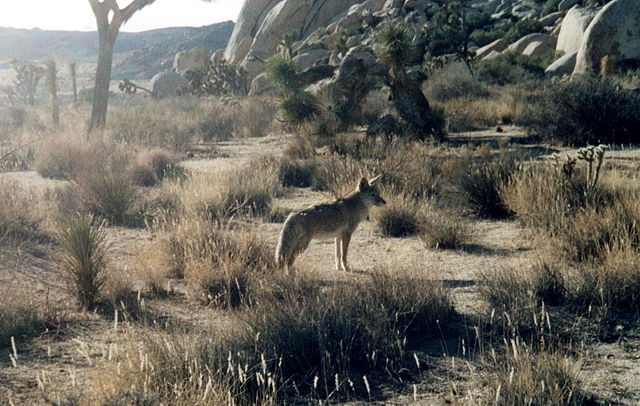
During my run a few days back, I heard coyotes singing.  Then they started yipping and growling, as if there was some kind of scuffle going on. They weren’t far ahead of me, and I remembered that a friend had once been followed by a pack of coyotes when she was hiking alone. Though coyotes almost never attack humans, running past this pack, whatever they were doing, seemed like a bad idea. Maybe there were just two—it’s coyote mating season—but maybe it was a fight with an outsider to their territory.  The noise stopped, and through the gaps between shrubs, I spied them trotting silently toward the section of the trail I was headed for. When in the presence of predators, I told myself, don’t act like prey. I turned around.

Danger is exciting on the page, but even the smallest danger doesn’t appeal to me in real life. Reversals, however, are interesting in both cases. I saw the landscape from a different perspective, since I usually go up the long hill rather than down. The same place can look quite new from the other side. And I ran further, since I had to retrace my steps.

That evening, my work in progress was so stuck it was putting me to sleep. Not a good sign.  I wasn’t sure how to fix it, but I told myself I was going to push through and not go out dancing that night, though there was a musician I would have enjoyed hearing at the Brewery, and I can walk there in five minutes or less. Still stuck, I gave in and went. My favorite dancing partner was there, and an acquaintance who is a mystery fan. I danced a few songs with one, talked story structure with the other, and then headed home, ready to write.

The problem lay in being too linear, telling the story step by step. I need reversals, a surprise, and something as energizing for the reader as a wild dance with a strong partner.

Retreat

As a professor, I welcomed the holidays as time off. After the busyness of the fall the semester, what I wanted and needed most was a chance to go inward. When people would ask me, “What are you doing for Thanksgiving?” I’d answer “As little as possible,” and then explain that I used the day as a retreat. I gave the same answer for Christmas. My family long ago stopped buying gifts and switched to supporting each other’s favorite charities. I love visiting them, but not in the winter. That’s not the time to go to Maine. Spring or summer visits are our tradition, not holidays.

My personal tradition of using the major holidays as retreat days carries on in retirement. I’m normally busy, outgoing, and social, not at all the stereotype of the introverted writer, so I still need such days. Aside from walking to the yoga studio to teach a class on Thursday evening (yes, a couple of people chose to come), I didn’t go out. I did my own yoga and meditation practices, and I finished the first draft of a book. Perfect.

The only hard part of this is explaining it to people who think it’s sad or weird, when I’m actually happy not “doing” the holidays. When I do explain, I find quite a few people who like the idea, but others still seem to think it’s a bit pathological. We have Scrooge and the Grinch, after all, among our seasonal archetypes. One Thanksgiving in Virginia, some well-meaning neighbors anonymously left a huge aluminum pan full of turkey and stuffing on my doorstep, not knowing me well enough to realize I’m a vegetarian. I guess they saw that I didn’t go out and felt sorry for me. I never knew which neighbors did it. I wish they had known my day of inwardness wasn’t lonely or depressing, but liberating. Soul-nourishing.

I have friends who do the big family gatherings, and that nourishes their souls. I heard the community pot luck at the brewery was packed, and I imagine it was fun for everyone who went and gave them what they needed from the day, also.

Black Friday passed, and I didn’t shop. However, I hope my friends in T or C who run stores had good sales, and that those who did shop supported small businesses and found meaningful gifts.

My neighbor across the street put up her Christmas decorations before Thanksgiving. Though she intended to make herself wait, she couldn’t resist. She had creative fun, and the display is quite entertaining. (The pink flamingo is wearing a holiday bow.) I don’t own any ornaments and like it that way.

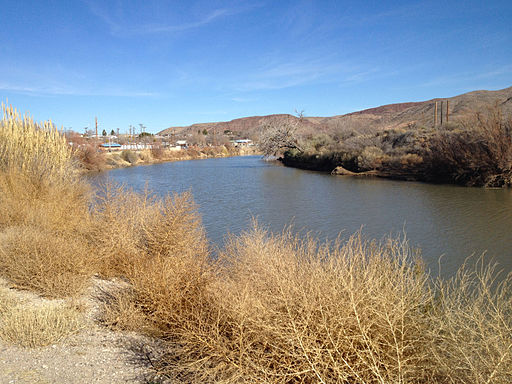
Today, I walked to the river, hoping to see water birds. The cormorants or coots—I still don’t know for sure what they are—have returned, and they were making their odd noises, peeping and croaking as they fished. On the opposite bank, where I’ve never seen any humans before, a man in a plaid shirt and denim shorts sat in a small, sunny clearing, perfectly still. Fishing or contemplating? I couldn’t tell. The sky was New Mexico Blue over Turtleback Mountain, and a blue heron perched on a for sale sign on a piece of land I hope no one ever buys, even though one of my yoga students is the realtor. The man on the bank moved just enough that I could see his fishing line catch the light as a fish stirred his meditation into new awareness, the present moment tugging on his hook.

His attire on a fifty-five degree day made me suspect he was a snowbird, one of the Mainers and Canadians who escape to T or C and think even our cool days are warm. If so, he has escaped to a town without a mall. What better place to spend the season? It was good bird day. Heron, cormorants (or coots), and snowbird.


Outdoor Yoga and Bushy Neurons

I’m still exploring Hare Brain Tortoise Mind at a tortoise pace, and I came across this concept in it: Animals that live in highly stimulating environments grow bushier neurons in their brains. That is, the neurons develop more dendrites, make more connections with their neighbors, and become capable of new and varied patterns of interaction. They can get out of a rut.

I think of T or C as a bushy neuron kind of place. A friend who visited from Virginia tried to explain what she found so remarkable about it. She said I’d described it well in my books, and yet those descriptions hadn’t captured a certain aspect of its vibe, something she struggled name or explain. Then she finally realized what it was. “There’s no pattern.”

While she was here, she mentioned how odd it was to look down an alley and see not only a dirt alley with dumpsters, but also an explosion of murals—not graffiti, but murals. The town kept surprising her. And it can still surprise me.

She’s right; there’s no pattern, unless the two blue-and-purple houses on my block constitute a pattern. But one has a moon goddess on it and the other has a Kokopelli. On the same block are trailers and the stucco-and-stick-fence gated wall of a spa that will never be built. For some reason, someone bought the lot quite a few years back and began construction, although you can’t build anything that size in this location. It’s a nice wall, though.

Doing some volunteer work that takes me all over town, I recently discovered a section of Juniper Street I never knew existed. The street has three disconnected parts, and I’d only known about two of them. This third part is around a hidden curve. From there it suddenly drops down, becoming so steep no one could ever ride bike up it and so narrow you’d hate to meet another car on it. On one side is a great wall of wind-and-water-sculpted red dirt and on the other side, two residential streets, one with little houses, and below that, one with super-bright crayon-colored trailers. When I’ve looked down at the town from the water tower hill, I couldn’t figure out where the street with those trailers was and how one got to it. That third leg of Juniper was hidden by the wall of dirt.

In other neighborhoods, I’ve food an orange-and-blue building, stone buildings, a yellow house with Lady of Guadeloupe murals, little hidden cottages behind other houses, magical gardens, art gardens, hoarder yards, collapsing houses, yards with so much trash in them I worried how people could live that way, serene little adobe apartments with winding paths and desert gardens, and many of these coexist on the same streets. No pattern. The appeal of T or C to artists and musicians makes sense. It’s not neat, cute, or pretty, but it makes your neurons bushy.

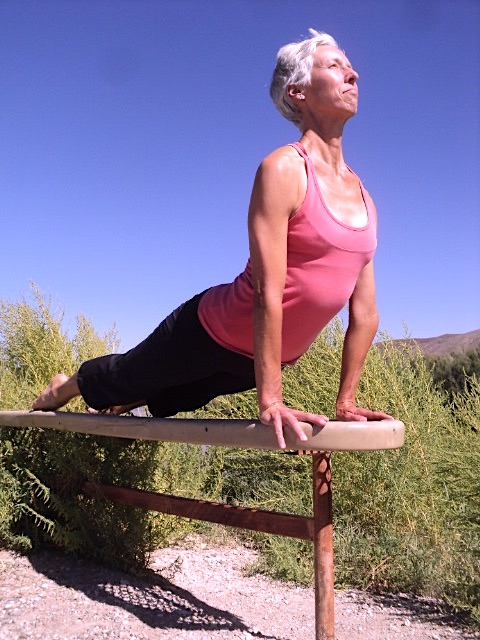
The recent exposure to so many new off-beat places seems to have broken my habitual perceptual patterns. I discovered a perfect spot for outdoor yoga in the courtyard outside my apartment that I never noticed as such, though the small square of bricks was always there. Smooth and flat, partly shaded, it faces the autumn-yellow fig tree and a tall purple aster. Yoga feels more spiritual under the open sky with nature around me, even if it’s nature in the courtyard. And the shapes of the fig tree and the flowers reminded me what the novelty was doing for my neurons.

*****

Read more of Amber Foxx’s essays on this blog and in the collection Small Awakenings: Reflections on Mindful Living.


Small Awakenings

Although I’ve made numerous changes in my life over decades of yoga and meditation practice, I’ve never felt astounded, enlightened, amazed, or shaken. I’ve processed some deep emotions and I’ve had moments of quiet clarity, but I’ve never had a dramatic spiritual experience. Instead, I’ve had aftereffects from my practice. Not flashes of divine light but little soft lights that I might miss if I weren’t paying attention.

  • Natural beauty turns off the static in my mind.
  • My pause-to-check reflex is better. I catch myself when I’m about to act or react, and I and stop, realizing I don’t have to say that, do that, or feel that.
  • My awareness of little nagging thoughts that need attention is better.
  • My awareness psychological discomfort and how it can be based on false perceptions as well as accurate perceptions is more sensitive, motivating me to think differently or let go. It’s like being aware of my body in yoga. If there’s discomfort, how can I address it to create a healthier version of the pose? Or of the thinking?

Each of these changes is barely a ripple on the surface—or under the surface—of a day, and I can credit aging with much of it. Statistically, older people are happier than young people, and though there are exceptions, we often age out of certain anxieties and into better impulse control. Life itself is a series of small awakenings.

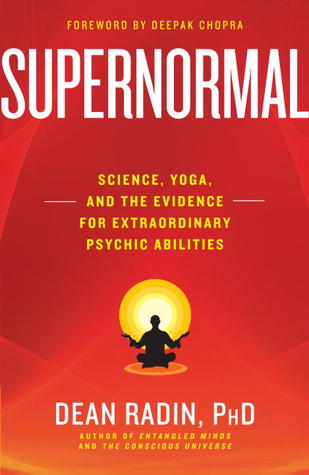
Review: Supernormal by Dean Radin

Some people approach the topic of psychic phenomena from a standpoint of immoveable conviction. There are those who believe psi events happen, and no science or statistics would convince them otherwise. On the other side are those who believe such things do not happen, and no evidence from even the best quality research could convince them otherwise. It’s like politics. Minds seldom change. But that doesn’t mean they never do. Science progresses through study and replication and further studies, and the word “proof” is seldom used outside of mathematics. This book should interest readers who would like to assess the evidence with an open mind.

Having said that, I think it may be useful to preface this review with the author’s credentials, taken from http://www.deanradin.com/NewWeb/bio.html:

“Dean Radin, PhD, is Chief Scientist at the Institute of Noetic Sciences (IONS). Before joining the research staff at IONS in 2001, he held appointments at AT&T Bell Labs, Princeton University, University of Edinburgh, and SRI International. He is author or coauthor of over 250 technical and popular articles, three dozen book chapters, and three books including the award-winning The Conscious Universe (HarperOne, 1997), Entangled Minds (Simon & Schuster, 2006), and the 2014 Silver Nautilus Book Award winner, Supernormal (Random House).”

The author works hard to make statistical analysis and research methodology accessible to a reader without a background in those fields. Having spent the last ten years of my academic career helping first-year college students learn to comprehend the language of scholarly journals, I have mixed feelings about this “translation.” Would it have been better to teach his readers the terminology, or was paraphrasing it the right choice? I don’t know. Sometimes he tries too hard to funny, like a professor who attempts to lighten up his lectures with strained jokes, but that’s a minor issue. Overall, I found the book well-structured and thoroughly researched. (384 sources are listed in the back, exceeding the number of pages in the book.)

Supernormal is primarily about how scientists study psychic abilities, not about spectacular events, so anyone wanting to read amazing, colorful anecdotes won’t find them here. It’s not essentially about yoga, either, though it will have more meaning to a reader who has studied yoga philosophy, and Radin has some good quotations on that subject. In yoga, the siddhis are not, as I understand it, as important as simply achieving awareness and quieting the cravings and cluttered noise of the mind. The siddhis can happen, but they are not the purpose or goal of practicing yoga. Nonetheless, in Radin’s research and in studies by other scientists, subjects with a regular meditation practice performed significantly better in experiments testing clairvoyance, precognition, and other psi abilities, so there appears to be a correlation between meditation and being psychic. An impressive number of well-designed studies support this. (My own experience fits the pattern. When I began yoga and meditation at age twelve, I began to have precognitive intuitions and dreams.)

I’d recommend this book to a reader who wants to get “down in the weeds” in the labs where these studies are done and examine the designs, the methods, and the analyses without going to the original scholarly journals. It’s a solid summary of what’s been found so far. The questions raised about the nature of reality and the nature of mind and consciousness are intriguing. How did the future find a crack into my dream and appear in perfect detail? Some of Radin’s studies address the emotional aspect of psychic material. He set up one study using long-term couples with one partner who was ill as subjects, and included the emotional bond and loving intentions as part of the design. Why does this matter? As with any other sense, we may be constantly filtering out irrelevant information and focusing on what is salient. It’s only when we dream that a friend is about to die or hear a voice warning us of something dire for a loved one that we let the psi phenomena take central focus. Otherwise, our psychic sense’s input can be ignored as background noise, the way unimportant input from our hearing often is. Perhaps if we learned to tune into this sense and trusted that it was real, we might act with more awareness and wisdom.

Much of what happens in psi is small—a sense that something is about to happen, or that one is being stared at—so we pay no attention. Radin studies all of these phenomena in minute detail, even documenting patterns of brain activity. I could go on, but that would be a spoiler, if there can be such a thing in science.

Radin almost pulls the rug out from under himself when he drifts off into a page or two of speculation on unrelated phenomena such as UFOs and crop circles that the skeptics and debunkers (some who rail against his studies) have actually already done good job explaining. Even though he doesn’t say he believes in these things, and uses them as a take-off point for ruminations about reality, they have no natural connection with psi ability and probably don’t belong in in a book on that subject. (I suspect that editors sometimes don’t tell famous authors—whether they are novelists or established scientists—to “kill your darlings.”) Nonetheless, as a yoga teacher, a long-time consumer of the scholarly literature on psi research, an individual who has occasional psychic experiences, and of course as the author of a mystery series featuring a psychic, I found this to be a worthwhile read.

 

Uninterrupted

I’m reading a pre-publication review copy of a book on fascial anatomy and updated, science-based stretching techniques for athletes. (Don’t worry, I’m not going to review it here, but I am glad this publisher still wants a former professor as a reviewer.) Part of the pleasure in reading it today is that I could keep going for two and half hours, fascinated and intellectually refreshed. While I was working, that much unbroken time to read a book in my field was rare. Days were chopped up by e-mails and appointments and of course classes. Time was always tailgating me with papers to grade and endless pop-up tasks to organize.

 After reading for as long as I felt like reading today, I applied concepts from the book to my yoga practice, intrigued by the way the authors’ research lines up with things I’ve heard some of my teachers say and that I have discovered through exploration. The undulating wave of the breath moves through each stretch. You should experience no pain in stretching. Don’t exit a stretch by tightening the region of the body you just lengthened. Effective stretching releases connective tissue, fascia, not just muscles.

 I have all the time I need to study the charts and try out the techniques before integrating new skills into my yoga teaching—when I get around to setting up a teaching schedule. I’ll finish the review before it’s due. This spaciousness plus engagement is something I hadn’t experienced at work for years, probably not since the advent of email. In my windowless office, I used to read books like this in ten- and fifteen-minute spurts when I could grab the time, or read a page while the computer woke up. Today I read in sunlight with a view of flowering trees. Uninterrupted.


Centering and Balancing

Moving and retiring is a positive disruption and it’s one that I chose. Still, I’m prone to wishing I could just get the tedious parts over with. There is no “over with.” It’s all part of my life, unique moments I am consciously living. I’m more effective when I’m present to a process, whether it’s cleaning out my desk, selling off my furniture, or going to one last department meeting. Not only more effective, but happier. Slowing down, I can get more out of each step of this change and put more into it. Be more attuned to the people around me. An attitude of rushing doesn’t speed things up. An attitude of spaciousness eases the pressure. It will all get done. It’s like yoga. Set up the pose with attention, be aware of the pose, sustain the pose, exit mindfully.

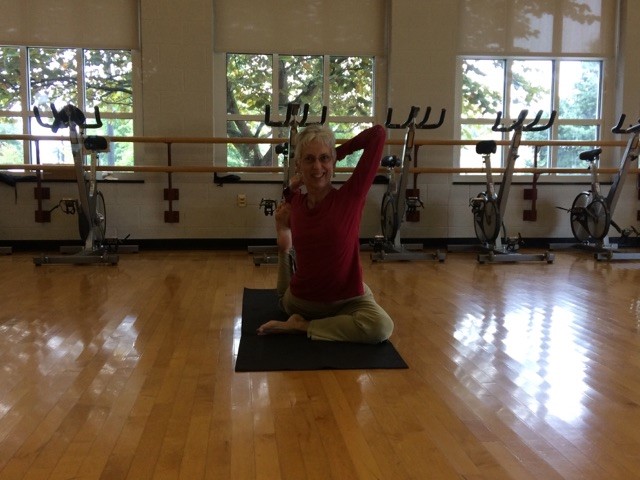
Note: the pictures were taken in the exercise studio on campus where I did my most important work: teaching yoga. At my retirement party, that’s what everyone was talking about. Yoga.

Ahimsa and Santosha

Though a few of my fictional characters do practice yoga, this week it’s Amber the yoga teacher and college professor more than the novelist who’s talking.

The Sanskrit word ahimsa is usually translated as “non-harming.” It’s one of the principles of yoga philosophy, one of the yamas, which means abstentions or restraints. Ideally, we’re aware of it in our asana practice and also as we take our yoga with us into our lives. Ahimsa applies to self and others, to all life forms, not only to humans. Thinking unkind and hostile thoughts, saying destructive things, or doing harmful actions are all contrary to the principle of ahimsa.

When I teach, I remind students to stay in a pain-free range of motion and to come out of a pose completely when fatigued rather hang in their joints and possibly injure themselves. But then I’ll look around and see students succumbing to the competitive urge to do what a stronger or more flexible classmate can do. Santosha needed! This is one of the niyamas, the observances to be practiced without restraint. It means contentment. One does not fight reality but takes an attitude of receptive awareness. Objecting to reality with complaints and harsh judgment doesn’t change it. Change can occur, however, from this basis in contentment. Approaching one’s own body and one’s own character from santosha seems to go with having a sense of humor that is kind and open.

I do my best to integrate yoga philosophy into my teaching without giving a formal lecture. However, it’s incredibly hard to teach Americans not to hurt themselves, and when I instruct other kinds of physical activity it’s even harder. There’s no expectation of spirituality or stress reduction in a strength-training class, but of self-improvement, and for some reason, we seem to think we’re better people if we push ourselves beyond healthy limits. I’ve met young men who take pre-workout pills with so much caffeine they could cause a heart attack in order to force their exhausted bodies to work harder, when what they really need is eight hours of sleep a night. I think Americans subscribe to a pervasive cultural delusion that it’s virtuous to go without sleep or heroic to work sixty hours or more a week, and that a great athlete will sacrifice the long-term well-being of his or her body for the sport and for the team. I wish no one had ever come up with the phrase, “no pain, no gain.”

Well-rested, relaxed people get more done in less time. They fight less. Comprehend more. Pay attention and remember better. Procrastinate less. Have more energy. If we all slowed down and allowed our nervous systems to stop buzzing, what would happen? If we valued our health as a nation and as a culture, rather than seeing it as expendable in the pursuit of other goals, what would happen? How would employers treat workers? How would we treat ourselves?

Turn it off. Turn it all off.

One of my yoga teachers in New Mexico often mentions the importance of quieting the nervous system. He doesn’t use music in his classes. I teach in places where music is expected, so I use unobtrusive, meditative music, but it’s still background sound, another level of stimulus.

Readers of this blog may have noticed I like to contemplate the effects of power outages. Today there was a brief one at the fitness center at my college. Normally, there are a few fluorescent lights in the group exercise studio that never go off, though I turn off the ones I can. These perma-lights were finally gone. So was the steady blowing of the air conditioning. Its presence has been ceaseless, so I never knew how harsh and persistent it was until it stopped. With plenty of natural light through the windows of a room that had been chilled a little too cool for yoga, the outage was wonderful. The quality of my voice softened. The clarity of my thoughts sharpened. My teaching became more precise, more aware, and I felt a matching shift in the students’ energy. When I stopped talking, there was nothing to be heard at all. Except, perhaps, each student heard his or her own breath.

Overstimulation has a subtle yet pervasive effect. Sometimes I wonder if it’s addictive. There are people who say they have to sleep with a TV on or have one running at all times when they’re home—“for the noise.” That would drive me crazy. I write in as much silence as possible and do my personal yoga practice in silence, too, either outdoors with only the sounds of birds and insects and occasional neighbors’ voices, or indoors in a quiet room. I’ve praised perfect silence in nature before, but today was the first time I’ve experienced the benefits of deep silence in my teaching.

Yoga doesn’t require stimuli that keep our minds bouncing and nerves buzzing. Yes, we can learn to do it in the midst of a barrage of sounds, but when we can choose to be free of them, it’s even better. The yoga sutras begin with a definition of yoga that can be translated as “Yoga is the stilling of the fluctuations of the mind.”


Recompressing

Half-way between New Mexico and Virginia, my tire pressure goes down. It happens every year. Nothing is wrong with the tires. It’s just that I go to mechanics in Santa Fe and they make sure the pressure is normal for that altitude, and then I descend to the lowlands.

When I unpack in Virginia, I always find that my shampoo bottle and other plastic containers have collapsed inward, folding in around the empty spaces inside them. When I run, I feel the heaviness of the air—the dampness as well as the low altitude. It’s hard work, like plowing through used teabags. Talk about coming down!

It’s time to recompress. I’ll readapt to the climate, to the busyness of the academic year, and to the green campus, so conventional and normal. I’m in the transitional phase, now though. I miss the colors and textures of the desert, the people in T or C, the eccentric personality of the town itself, the spaciousness of my life there and all the open space around it—so delightfully situated in the middle of nowhere. The challenge now is stay spacious inside when my surroundings aren’t, and as external demands become like the air, an unseen weight leaning on me. I did yoga on my back deck today, and two tiny bees sat peacefully on my shoulder through several poses. I was grateful to have this practice of active mindfulness. It left me feeling whole and bright. My outer life has to recompress, but my soul doesn’t.