Interview with author Amber Foxx

Nancy Adams's avatarSaints and Trees

Please welcome guest Amber Foxx to this week’s Saints and Trees. Amber writes the mystery series featuring healer and psychic Mae Martin. Amber’s professional training and academic studies in various fields of complementary and alternative medicine, as well as her personal experience and travels, bring authenticity to her work. She divides her time between the Southeast and the Southwest, but Truth or Consequences, New Mexico is HOME.

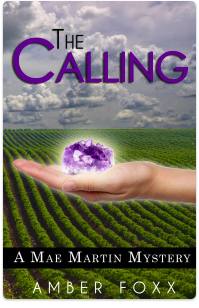
No murders, just mysteries. Love is a mystery. Every person is a mystery. Every life hides a secret. The first Mae Martin psychic mystery Published December, 2013 No murders, just mysteries.
Love is a mystery. Every person is a mystery. Every life hides a secret.
The first Mae Martin psychic mystery
Published December, 2013

It is my great pleasure to interview Amber today:

SAT: THE CALLING, the first book in your Mae Martin series, is such an original and fresh story. What sparked the idea for the series? Did it start with the character of Mae or something else?

 AF: The idea started in several different ways. The part of me…

View original post 2,860 more words

Shaman’s Blues Released!

                                            Shaman’s Blues

                           The second Mae Martin psychic mystery

Mystery crosses between the worlds and romance gets turned upside down in Santa Fe, the City Different.

Mae Martin gets a double-edged going-away gift from her job as a psychic and
healer: beautiful music by a man who’s gone missing, and a request to find him.

When she arrives in her new home in New Mexico, aiming to start life over as she comes to terms with her second divorce, she faces a new challenge in the use of her gift. Her new neighbors are under the influence of an apparently fake psychic who runs the health food restaurant where they work. When Mae questions the skills of the peculiar restaurateur, the woman disappears—either to Santa Fe, or another dimension. The restaurant’s manager asks Mae to discover which it is.

Finding two missing people proves easier than finding out the truth about either of them, or getting one of them, once found, to go away again.

Seeing a Ghost

Once in a while, writing paranormal mysteries, I need to introduce a character who is no longer alive. In Shaman’s Blues, Mae has no concept of ghosts at first, but Jamie, an anthropologist’s son, assures her that every culture has them.

Ghosts fascinate us, even when we don’t believe in them. People sign up for ghost tours of historic districts, and some choose the option to get the presumably haunted room at a B&B. Part of the attraction in ghost stories is the curious pleasure of safely experienced negative emotions. There is something frightening about an encounter with the dead, and most ghosts are said to have fallen into the place between worlds through tragedy. By seeking out ghosts, we can dip into terror and sadness for a quick swim and come back out, invigorated by the plunge.

It’s different for the ghost. Stuck in the crack between two worlds, attached to earthly life yet incapable of living it, looking, perhaps, for one particular soul, the ghost must be frustrated, bewildered and lonely. No wonder they behave badly sometimes. It can’t be much of an afterlife.

I say that lightly, but at the moment that I met a ghost, I was scared to the bone. It was quite some time ago, but I can still feel her when I think about her.

The cold is what made her frightening.

I was a college student on Christmas break visiting my sister and her husband, and my boyfriend and I stayed in the attic bedroom of their old house. In the dark before dawn the alarm went off, and my boyfriend got up to go to work. We spoke briefly, kissed goodbye, and he left. Wide awake, I stayed in bed under a heap of quilts and blankets, hoping I could go back to sleep. Our shared body heat had made cozy nest of the bed and I didn’t want to get up early on my vacation.

I snuggled the blankets around me, and was suddenly chilled. I wasn’t alone. A woman’s head and shoulders floated on the far side of the room. She stared at me, her face stern and judgmental over a high collared dress, her hair pulled back in a severe tight bun. I was terrified, not by her apparent resentment, but by the deep, unnatural chill. At the same time, I thought her features were like the country comedian Minnie Pearl.  I’ve cited Stephen King’s Danse Macabre in a book review before, and it fits here: comedy and horror go hand in hand. I pulled the blanket over my head until the cold went away.

Prior to that, I didn’t believe in ghosts. I’m not sure I do now, either, but it’s like what anthropologist Michael Harner says about shamans not believing in spirits. They don’t have to. They know.

When I Read Poetry


I love reading insightful discussions of the meaning of a poem. Since my favorite bloggers were on a poetry theme this week, I decided to take on the challenge. It was much harder than I imagined.

When I read poetry I am so struck by the power in the words, and the images speak to me so directly that I am stumped when it comes to saying what it means in other words. I can say why the verse speaks to me, but I have to discuss it as a direct experience.

Among the many reasons I never tire of Yeats is the subtlety of the meter and rhyme. The flow is so natural, nothing feels forced to fit. My favorites beg to be said aloud. The rhythm is the feeling as much as the words are.

Yeats’s Crazy Jane poems feature an aged woman who defies convention, argues with the Bishop, and has a deep spiritual life—on her own terms. She had a wild, passionate youth without concern for propriety—many lovers,  only one of whom she loved—and she also loves God. The woman in the cycle A Woman Young and Old is not identified as Crazy Jane, yet I think of her as the voice of those poems. The stories and attitude are the same. Carnal and mystical within one breath.

Sharing  some lines of Crazy Jane, so perfect I need say nothing more.

Crazy Jane and Jack the Journeyman


I know although when looks meet

I tremble to the bone,

The more I leave the door unlatched

The sooner love is gone,

For love is but a skein unwound

Between the dark and dawn.


A lonely ghost the ghost is

That to God shall come;

I—love’s skein upon the ground,

My body in the tomb—

Shall leap into the light lost

In my mother’s womb.


But were I left to lie alone

In an empty bed,

The skein so bound us ghost to ghost

When he turned his head

Passing on the road that night,

Mine must walk when dead.


On Yeats’s Psychic Wife


I became enamored of the poems of WB Yeats when I was nineteen and still love to read them. I can recite some by heart (The Fascination of What’s Difficult, which I learned while I was working as a theater choreographer, includes the line “My curse on plays …”) A college boyfriend won me by being able to recite Lapis Lazuli (in a little Greek bar that inspired the one in Snake Face.) I created a dance cycle for the Crazy Jane poems, and also a solo dance for When You are Old. While I was reading the poet’s autobiography, I discussed his interests in mysticism and Irish mythology with a friend who was an English professor. She was quite sure Yeats’s wife George (yes, a woman named George) faked being psychic because it was the only way to win his heart away from Maude Gonne. His other passions, Irish patriotism and theater, lived in her, and she was beautiful, so the only way to compete was to communicate with a spirit world that announced itself by the smell of roses. I don’t know if it’s true or not but her hypothesis would make a good story.

Energy Healing: A Personal Story


After I read Afterwards You’re a Genius I was curious about the work described there, and looked for a graduate of the Barbara Brennan school.  The healing was unlike anything else I’ve ever experienced. My mind stayed clear the whole time. I didn’t have to work to focus it. No drifting, worrying or fantasizing, no urge to sleep. I had complex visual imagery along the lines of what I later read in descriptions of the early stages of an ayahuasca journey—geometric lines and vivid colors. It was all abstract, but vivid and intense. I’m not an artist, and the visual creativity amazed me. The other strange thing was the flood of laughter. The healer touched my left arm or hand, I can’t remember, and tapped some deep well of humor.  My earliest memory is laughter. It was like finding my true self. She who laughs. The next day I had no more tolerance for the man in my life. He was long overdue for the break-up, and I did it. I told him exactly what I thought and felt, and confronted all his lies. At first I was swamped with the anger I hadn’t let myself feel, and then dancing with the utter joy of being free of him. I felt that the energy healing freed me from an unhealthy niceness. The healer said she saw suitcases around me. I wasn’t living with him to move out, but I did end up moving across the country a few months later.

Psychic Science

Nadia's_Psychic_Readings_01After I taught a stress management workshop as part of one of my college courses, a young man came up and asked me if I knew anything about being psychic. (He must have been psychic to think to ask me.) He had recently started having precognitive dreams and wanted to learn more. These are some resources I recommended to him. If you read my books, you may also be curious.

I list references in the back of The Calling, including some of the articles and web sites used in the course Bernadette and Charlie teach. In the scene where Mae and Hubert read the about PEAR lab studies, I tried to give readers a sense of the solid scientific support there is for remote viewing and also remote influencing of what should be random events. (PEAR stands for Princeton Engineering Anomalies research.) The articles from the PEAR lab, and the ones on affecting the output of random event generators (REG) are a little dry, as scholarly articles can be, but the site can give you a summary of the work done there.

For more accessible reading on the subject, I suggest Rupert Sheldrake’s book The Sense of Being Stared At. The title refers to one of the topics he has studied in depth. Yes, we do feel it when we are being stared at.

A fun yet solid book exploring energy healing and the power of the mind to influence events is Afterwards You’re a Genius by Chip Brown. (Published in 1998, it’s now out of print, but used copies are available on Amazon.)Brown enrolls in an energy healing course, and fills in the science around the story through research and interviews. The title is a quote from Dean Radin, a scientist who studies such things as the ability of human intentions to influence REG machines and robots. When you start studying wacky stuff, you’re a wacko, but afterwards, you’re a genius.

I found a trove of fascinating stories on the web site The Archives of Scientists’ Transcendent Experiences. Scientists may not like to admit that a mystical or psychic event happened to them. This site served as a safe community for those who had such a story to share. It is currently inactive—no new posts—but readable.

The journal Explore is wonderful. I recommend subscribing if you are seriously interested in healing studies. I encourage you to sample the brilliant editorials of its editor Larry Dossey.

When he was editor at Alternative Therapies in Health and Medicine, the peer-reviewed journal I cite often in The Calling, I used to look forward to his editorials as the highlight of the journal. He unites science, poetry, and wit with a unique voice. He can integrate the most unlikely images into a coherent, thought-provoking essay.

I also recommend Dossey’s book the Power of Premonition.


Image from Wikimedia Commons, courtesy of Bohemian Baltimore

Breaking the Genre Barrier

I’ve claimed genres because Amazon and Goodreads and other web sites require it, but I am a genre-blender. I once described my genre as “platypus.” The platypus looks like a mammal, a bird, and a reptile, blended into one animal. I write with elements of general fiction, mystery, romance, suspense and paranormal, but I don’t fit in any genre. I use the “paranormal” category, so readers who are interested in a mystical element to their mysteries can find me. I use the mystery category because my protagonist, a psychic, looks into the whereabouts of a missing people or animals, or why strange spiritual phenomena have occurred, or what secrets people are hiding. The mystery in my books is not always related to crime or death, though sometimes it is.  So far, none of the books are about murder. I simply wasn’t drawn to writing about murder.

Many years ago I read a mystery in which the central puzzle to be solved related to an art heist. It was non-violent. I loved it, and never forgot the concept of the murder-less mystery, even though I have long since forgotten the author and the title. Another murder-less example is the Number One Ladies’ Detective Agency series. Precious Ramotswe is a private detective investigating such things as workplace thefts, infidelities, missing heirs, etc. There are plenty of mysteries in real life that do not involve killing someone. People are very strange, and often dishonest. I knew a man who kept it secret from his “wife” that they were not legally married, so he could honestly tell his mistress that he wasn’t married, since she would have broken off with him if he was. (I will not tell you how he did it. I may yet use it in a book.)

When it comes to paranormal fiction, I don’t care for anything with vampires or werewolves or other such creatures. I like books where the mystical kind of mysterious steps into the ordinary. Linda Hogan’s Power and Mean Spirit are two of the best books I’ve ever read. She crosses the bridge into the spiritual realm through ordinary reality in a way that makes the extraordinary somehow more believable. Her books are general fiction, or literary fiction, although they have a strong supernatural element. I don’t claim to write like Hogan, but this is the kind of “paranormal” that appeals to me as reader. I’ve had a number of psychic experiences, and have researched various elements of the mystical experience, and alternative healing, and found that this is an area full of mystery in its other sense—the inexplicable.

My characters, not the genre, seem to be the element that draws readers in. I may have to make that my brand.

                             READ OUTSIDE THE BOX WITH AMBER FOXX

The Mae Martin Psychic Mysteries

Paranormal fiction for people who don’t like paranormal fiction.

And for those who do.

No murder, just mystery.

Love is a mystery. Every person is a mystery.

Somewhere in every life there is a secret.

“Are You Psychic?”

(This is revised and recycled from a previous post on my Facebook author page, for those who don’t read me on Facebook.)

Am I psychic? Yes, but I can’t do what Mae can do. I have history of precognitive dreams, some that predicted major events such a relative’s death or illness, or a major change in my workplace, and others that foresaw peculiar and unlikely but utterly trivial events. I have no idea why this happens, but it’s happened forty or fifty times. I stopped counting. I’ve only been able to harness this ability intentionally, to see something for a friend, once, and the dream took months to come true. I would not make a good psychic in a novel. I plan to have a character with a more focused and useful version of this talent in a later book. Ezra Yahnaki, the thirteen year old grandson of Mescalero Apache medicine woman Bessie Yahnaki, will be introduced in book five of the series.

The idea for Mae’s gift was planted a number of years ago when a neighbor invited me for dinner. She had a friend visiting from out of town. This visitor could hold something you owned, and pick information about you and your life. I didn’t know what to expect, but I asked her to find out what I most needed to know. She turned away from the dinner table, holding my eyeglasses, and was quiet for about five minutes. When she faced me again, she said she’d seen an elderly woman in a bed, and sensed that this woman was very sad. My mother was in a nursing home suffering from multi-infarct dementia. In this condition a person remembers the past well, and the personality is intact, but the events since the series of mini-strokes are lost. She had no short-term memory. It was distressing for her to be lost in the present and yet be intellectually sharp and know who she was in the past. My mother died shortly after this. I based Mae’s gift on this woman’s ability to see the present at a distance through touch, and added the ability to see the past.