I had to share this wonderful image of Truth or Consequences. There’s a scene in Ghost Sickness that takes place right here, on this sidewalk in front of Passion Pie Café. And I wanted readers who haven’t been to T or C to get a glimpse of my town. I highly recommend the photography blog this came from, Always Backroads.
Category: Behind the Stories: Inspirations and Encounters
From the Shadow Side of My Bookshelf
That’s the side I never look at. The side scarcely touched by my superficial housework. Where the dust is.
This week, I stuck the duster behind the books, though I didn’t bother to pull them out, and I encountered a slender volume that had shifted into the shadow side. I’ve always believed that if a book literally, physically jumps out at me, I may need to read it. This one had ducked back and hidden from me. I pulled it out. It was Jungian psychologist Robert Bly’s A Little Book on the Human Shadow. I’m Jungian enough to appreciate synchronicity. 
I opened it at random and found a chapter that’s an interview with Bly and his editor William Booth. It starts with Booth asking Bly how some ordinary person, a hypothetical woman in a small town in Minnesota without access to a Jungian therapist, might find her shadow. (The shadow, by the way, isn’t necessarily the bad side of the mind, it’s the unacknowledged side, the aspects of ourselves that we have, in Bly’s imagery, stuffed into a bag we carry around on our backs.) In his answer, Bly suggests that this hypothetical ordinary person look where her attention is drawn. Does she tend to think too much about a member of her community that she sees as sexually loose and immoral? Does she find herself obsessing on a member of her PTA who she thinks is fake and dishonest? If these other two women dominate her attention, her shadow may be calling her to look at her own sexuality and at her own level of sincerity and honesty.
In essence, Bly says, to find your shadow, look at what you hate.
That’s different from what you disagree with. It’s quite possible—more so face to face than in social media conversations—to disagree without hatred. I find it valuable to talk with people with whom I disagree so we can stay in a constructive relationship. But I hate yappy dogs that won’t shut up. I’m an extravert, a talker, and I’m persistent as heck. Maybe I need to acknowledge my inner yappy dog. The other day during my outdoor yoga practice between the tennis courts and the college president’s house, the president’s dog objected to my presence exactly at the time I was ready to practice savasana. Deep relaxation. Quietness. What could I do? I focused on the spaces between the barks. Maybe I can do this with my own yapping thoughts. My tendency to object to things.
Back to the book. Bly chose Abraham Lincoln as an example of a well-known person who seemed to have incorporated rather than rejected his shadow. I agree. One thing I admire about Lincoln is how he handled anger. He would write his “hot” letter to the person he was angry with, then put it in a desk drawer. A few days later or whenever he felt calmer and could think more clearly, he would communicate rationally with the individual, never sending the angry letter. He felt anger and expressed it, but processed its meaning rather than lashing out. That’s my reason he seems integrated. Bly gives the illustration of Lincoln’s sense of humor, his ability to laugh at himself and not take offense.
A woman meeting Lincoln on a train told him that he was the ugliest man she had ever set eyes on. Lincoln asked her, “What do you suggest I do about it?” She said, “You could stay home.” He liked her answer and enjoyed telling the story.
The shadow, once explored, might be a source of lightness, or of strength, peace, or beauty.
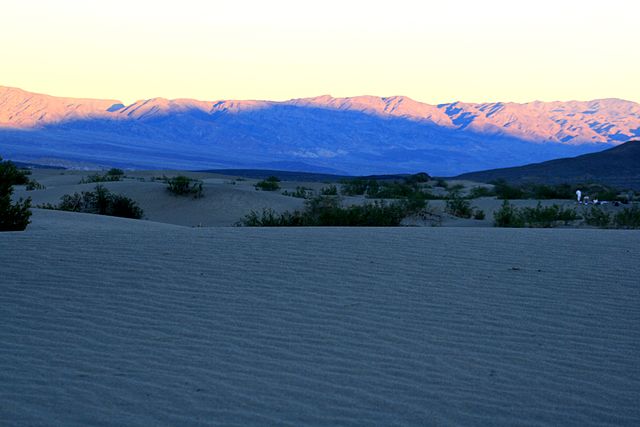
Image: Shadow of a dune in Death Valley by Brocken Inaglory
Dialogue and Discomfort
This isn’t about writing dialogue in fiction, although it’s related in a way. In fiction, an author has to sustain conflict. In real life, we have to resolve it. Keeping the drama up can be engaging for readers, but it can be destructive when people actually need to hear each other. Contrived and exaggerated conflict is the meat of reality TV, but that’s not reality. And we’re not on TV.
My college, like many across the country, has a Dialogue Club. Students are trained to facilitate conversations on difficult topics. These conversations give students a method for expressing their experiences, opinions and feelings without attacking, blaming or accusing. The participants learn to listen without arguing back. The purpose is not to persuade anyone, but simply to understand each other.
I had already planned a Dialogue Club activity in my freshman seminar this week, and the timing was right. We talked about the topics my students had chosen in advance: Black Lives Matter, and athletes who kneel during the national anthem. And then, once we had practiced our skills in civil discourse, I asked if they would be willing to share their thoughts on the election in the same way. They did. It was amazing. My class found this dialogue process valuable enough that they want to do it every week. This is so promising, I’ve volunteered to part of an upcoming campus-wide dialogue about the election results.
The origin of dialogue clubs, to my knowledge, is with a group of women in Massachusetts who had pro-life and pro-choice views and were tired of the anger and even violence that had arisen in disagreements about abortion rights. Their purpose was to hear each other, and they found that there were not just two sides. If there were ten people in the room, there might be ten sides to the issue. Venting to our like-minded friends is a relief, of course, and we all need to do that. But then, we need to move out of our comfort zones, our echo chambers. Reducing our stress often begins with raising it—by doing what makes us uncomfortable. Getting involved in anything controversial (in a role other than audience) can make most people uncomfortable, unless they are the type that thrives on conflict. The rest of us need to be as engaged, or even more so, than the people who enjoy being angry.
Dialogue clubs have been used not only on college campuses. They have been effective working through national conflicts, in places like Rwanda. Talk doesn’t replace action, of course. What it does is do is give people the courage to become part of the public conversation, the first step toward peaceful, constructive action.
Working Together, Washington, Wisdom and Walnuts
This week my college’s entire faculty and the president and the provost got together and discussed a major change in the academic calendar, a change which some support and some oppose, and we worked toward a compromise. Though we didn’t solve the problem yet, we agreed to keep talking. If we didn’t keep cooperating and communicating constructively, the institution would cease to function and it would fail the needs of those we serve, the students.
A few days ago, I finished reading an eight hundred page biography of George Washington, which I reviewed at length on my Booklikes blog. Washington was flawed, as all of us are, leaders and unknowns alike. He was successful because he listened and took time to think.
Here are two of my favorite quotations from his letters (also quoted in my review):
In this one, he was writing to his adopted grandson: “Where there is no occasion for expressing an opinion, it is best to be silent, for there is nothing more certain than it is at all times more easy to make enemies than friends.”
The following is an excerpt from a letter Washington wrote to a Jewish congregation in Philadelphia. Note that the word “demean” back then related to one’s demeanor and didn’t have its modern meaning of debasing. It meant comport or behave. “All possess alike liberty of conscience and immunity of citizenship. It is now no more that tolerance is spoken of, as if it was by the indulgence of one class of people that another enjoyed the exercise of their inherent natural rights. For happily, the government of the United States, which gives bigotry no sanction, requires only that they who live under its protection should demean themselves as good citizens.” He found religious tolerance to be too weak a concept, too condescending toward religious minorities.
Between two classes today, I took an outdoor yoga break. My route out the side of my building passes under a walnut tree and then across a lawn beside the tennis courts. Earlier in the fall, it was hard to tell a walnut in the grass from a tennis ball. A closer look at the bright yellow-green spheres revealed either the smooth texture of a walnut pod or the fuzzy skin of a tennis ball. Now the walnuts are yellow, resembling golden delicious apples, and some have softened open or been punctured by squirrels for the nut inside. The tennis balls, of course, are still firm and green. I place them on the wall of the court or toss them inside, in case they can be used again. Once they’ve been hit past the fence and left there, though, I wonder if they can serve any purpose in the game, or if these wild shots can’t be reclaimed by either the tennis players or the earth.
Curiosity and Openness
The boy braked his bicycle on the bridge over the creek and stood straddling the frame. “What are you doing here?”
As I adjusted out of the mildly altered consciousness that comes from a long, peaceful run, I continued stretching my calf muscles, listening to the stream’s soft burbling, the autumn trees rustling, and studied my interrogator. He was about ten years old, with a stocky build, short hair and wire-rimmed glasses. His question wasn’t unfriendly—not as if he owned the park, but more of an inquiry into what other people came here for.
“I just ran four miles,” I said, “and now I’m stretching my legs.”
“Four miles?” His eyebrows shot up. “I can’t even run one.”
“It took me a while to build up to four. I didn’t run that far when I first started running.”
The boy asked what it felt like to run four miles and I said it was beautiful, being outdoors and quiet, moving through nature. It’s hard to describe the spirituality of running and I didn’t do a very good job of it. He said it must be a good workout. I agreed. He rode around a little while I finished stretching, and then pedaled beside me as I walked through the parking lot toward my neighborhood.
“What was it like the first time you ran?” he asked.
I told him a shortened version of the story that follows.
I’d been visiting the Apache reservation in Mescalero, New Mexico. A friend informed me that there would be a five-K and 10-K race the next morning, then looked me in the eyes and said “See you there.”
He and his girlfriend would be running, but I could tell he didn’t mean I would be there to cheer them on. He meant I would be running. I took the challenge and ran the five-K. At the time, I lived at sea level in the Tidewater region of Virginia, and Mescalero is 7,500 feet above that. Being an aerobics teacher, I was in good shape, but until that day I wasn’t a runner. I struggled uphill at that altitude, but the singer for the Navajo Nation Dancers kept cheering me on. His group had come for the powwow, and we had met briefly and chatted while waiting for the race to start. He couldn’t remember my name, only where I was from, so he shouted, “Go, Virginia! You can do it!”
I came in second for my age group, and I was hooked. Not on racing, but on the Apache concept of spiritual running. This race was not just any race, but a community event to promote health and traditional culture, timed to go with the four-day Dances of the Mountain Gods and the girls’ coming of age ceremony. My friend who convinced me to run had told me about spiritual running when we first met, and before the race started I got to know a number of other people who ran for cultural reasons. That was almost twenty years ago. and I never lost my love for running.
The boy in the park listened to the short version of this story attentively. We chatted a little longer. He concluded that he would still prefer bicycling and then pumped his way up the steep hill, wishing me a good day and saying, “See ya.”
There was a synchronicity to this encounter. Back in 1998, I made friends with the man who got me to run that first race by striking up a conversation with a stranger. I was stuck in an airport due to a delayed flight, and as I walked to pass the time, I noticed him sitting cross-legged on the floor rather than in a chair in one of the gate areas, and was intrigued by the writing on his T-shirt. It read: All Apache Nations Run Against Substance Abuse. I was doing research in graduate school about using traditional culture to combat modern health problems in Native communities. The idea of people running all the way from the various Apache nations, from Oklahoma and Arizona and New Mexico, to gather at one chosen reservation, was inspiring. We talked a while, and he invited me to visit Mescalero later that year and put me in touch with a medicine woman who could help with my research.
On subsequent trips, I ran the five-K several more times. At the time, I was thinking about writing an
academic paper, not fiction, but years later these races, the powwows, and the ceremonies inspired many of the scenes in Ghost Sickness. By the time I wrote the book, I had a lot of experiences to draw from.
My new young acquaintance’s friendly curiosity makes me think he has what it takes to be a writer. He has his own view—prefers biking to running—but he wanted to know what I thought and felt as a runner, and not because he planned to start running. He simply wanted to know. That’s a writers’ mind, or an actor’s or a psychologist’s. He asks: What’s it like to be someone who is not like me?
Fragmentation and Focus
I’m a guest today on Lois Winston’s blog, talking about trying to focus despite fragmented time. If you share that frustration, you’re not alone. Stop by the blog and let me know how you handle it.
At the end of that post, I mention a 99 cent sale. The Calling is discounted on all retailers through October 28th.
Overfill Alarm
Taking my freshman seminar students for a mindful walking meditation excursion, I noticed things I’d never seen before. Most striking was a college van parked near the softball field, overgrown with vines. How fast did they take it over? Had the van been forgotten?
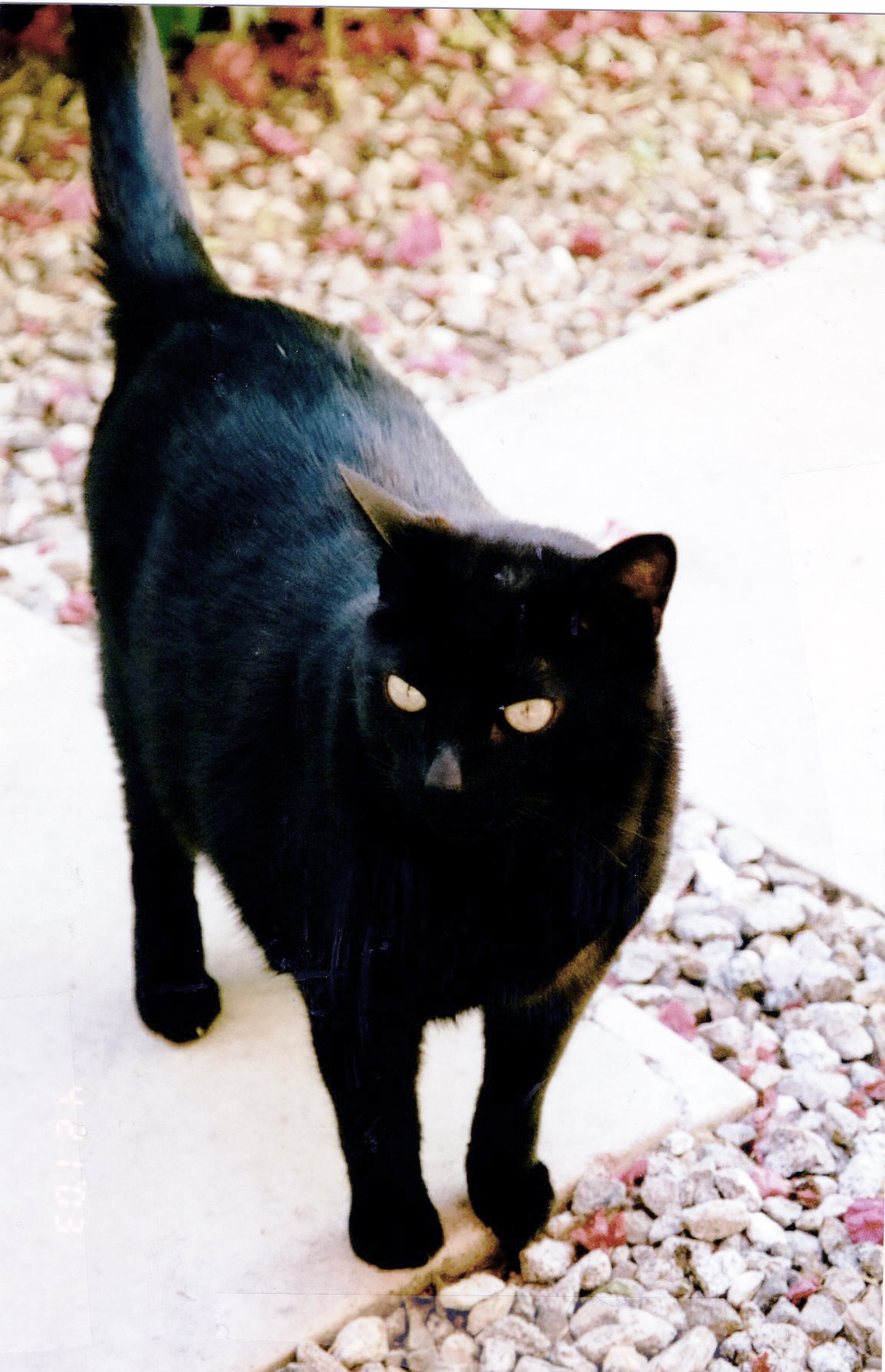
As always on such walks, I noticed the sounds: wind in leaves, the nearby river rolling softly over rocks, birds and crickets singing, and our footsteps. When we reached the park I was aiming for, one of my students found a friendly black cat and held him up. Part of the mindful condition is that we don’t talk or use phones for forty minutes. Her smile communicated all that was needed, and several of us gathered around her to pet the cat. Mindfully. Feeling the catness of the cat.
I watched carp in a lily pond, ducks on the river, and then crossed under a bridge to another part of the park. There, I saw a flock of birds reflected in gray water that was busy with a swarm of water-walking bugs, a moment of earth-sky-water symmetry that put my mind on pause. Pure perception uncluttered by the noise of thought.
A thin old tuxedo cat with a red collar trailed several students into a gazebo. He seemed to want human company, but unlike the black cat, he found no one to pay attention to him. When I went to pet him, the girls sitting in the gazebo were on their phones. Surrounded by nature’s beauty, free to enjoy silence, with a cat who wanted affection sitting at their feet, they were sucked into tiny screens.
On our return to campus, I stopped in front of another thing I’d never noticed before: a big yellow sign on the maintenance building that says OVERFILL ALARM. The class gathered in silence and looked at it. It was finally time to talk.
Does your brain have an overfill alarm? Do you override it and keep putting more in? What are the signs that it’s about to go off?
*****
Picture of black cat, Felix, courtesy of his owner, mystery author Sally Carpenter.
A Little of Everything
Today I’m a guest on fellow mystery writer Jim Jackson’s blog, answering ten questions about writing and reading. I had fun with this, and hope you will, too. Once you get to his blog, you can also find interviews with many other writers, including some of my favorites like DV Berkom. These Q&A posts could be great way to discover some new writers as well as get to know those whose work you enjoy.
Happy Tuesday.
What is Pleasant to Live Through …
… seldom makes a good story. I was reminded of this as I searched for something interesting to say in an e-mail to a friend. I wanted to stay in touch and to hear from him, but my sane, steady, enjoyable life provided little material. Hello. I’m happy. My students are great this semester. My yoga classes are going well. I’m reading good books and I’m writing. In conversation, a lot could flow from any of this, but in writing, not much.
A few years ago, I was talking with a new acquaintance at a faculty holiday party, and he mentioned that he was reading The Lord of The Rings for the first time. I had read it my freshman year in high school. Yet, when he mentioned the passage that stood out most strongly for him, it was one that I’d often thought of in the decades since reading it. Tolkien sums up the passage a long and pleasant time for the travelers in his story in one or two lines, then adds that things that are agreeable to live through are often dull to tell about, but things that are hard or even terrible to live through make marvelous tales. Authors tend to feel affection for their characters, and yet to make good stories, we have to put them through challenges. No life would remain pleasant if it didn’t require us to do something difficult. And that’s where the story is—growth through pain or danger.
At the last meeting of my book club, each us got the others caught up on her summer. One person was getting divorced, another had seen a friend through a major crisis, and another had taken her peace studies students to Hiroshima, a place that literally went through hell to become what it now is, a city dedicated to peace. And I … had been on vacation. Needless to say, the most compelling narrative wasn’t mine.
I had tons of fun, but my friends had more questions about a medical weirdness that took place shortly before I left for New Mexico. Because what makes a better story? “I went on vacation and it was great,” or “I had a posterior vitreal detachment?” They were fascinated by the phenomenon of having the gel in my eyeball partially detach and getting flashes of light and a giant floater in one eye. “How big is it? Like, the size of blueberry? Is it always there? Do you have to have surgery?” (Smaller than a blueberry, in case you care, and no, and no.) Ah, we humans. We love icky, scary stuff, and you can’t get much ickier than eyeballs.
I thought the divorce story was amazing, a much better story. Not for the conflict but for the grace. The couple who are parting ways took a long-planned backpacking trip together even though they had decided they would end their marriage. I’ve talked to each of them about it and they’re glad they had this final adventure together.
It’s their story, so I won’t tell any more of it here, but I can see in it the qualities that make the best stories. In a way, it ties in with the peace studies story and the helping-a-friend-in-crisis story. It had value and purpose, and took strength and courage. It made them grow and change. And in its difficulty shines its beauty.
Turn it off. Turn it all off.
One of my yoga teachers in New Mexico often mentions the importance of quieting the nervous system. He doesn’t use music in his classes. I teach in places where music is expected, so I use unobtrusive, meditative music, but it’s still background sound, another level of stimulus.
Readers of this blog may have noticed I like to contemplate the effects of power outages. Today there was a brief one at the fitness center at my college. Normally, there are a few fluorescent lights in the group exercise studio that never go off, though I turn off the ones I can. These perma-lights were finally gone. So was the steady blowing of the air conditioning. Its presence has been ceaseless, so I never knew how harsh and persistent it was until it stopped. With plenty of natural light through the windows of a room that had been chilled a little too cool for yoga, the outage was wonderful. The quality of my voice softened. The clarity of my thoughts sharpened. My teaching became more precise, more aware, and I felt a matching shift in the students’ energy. When I stopped talking, there was nothing to be heard at all. Except, perhaps, each student heard his or her own breath.
Overstimulation has a subtle yet pervasive effect. Sometimes I wonder if it’s addictive. There are people who say they have to sleep with a TV on or have one running at all times when they’re home—“for the noise.” That would drive me crazy. I write in as much silence as possible and do my personal yoga practice in silence, too, either outdoors with only the sounds of birds and insects and occasional neighbors’ voices, or indoors in a quiet room. I’ve praised perfect silence in nature before, but today was the first time I’ve experienced the benefits of deep silence in my teaching.
Yoga doesn’t require stimuli that keep our minds bouncing and nerves buzzing. Yes, we can learn to do it in the midst of a barrage of sounds, but when we can choose to be free of them, it’s even better. The yoga sutras begin with a definition of yoga that can be translated as “Yoga is the stilling of the fluctuations of the mind.”