A New Mexico Mystery Review: The Painter

While this is a novel about crime at one level, a nerve-stretching, page-turning suspense story, it’s also the story of a man’s soul, his deepest loves, his darkest corners, his inner light, his passions, and his art. Heller gets inside the process of Jim Stegner’s whole being. When you read this book, you, feel as if you are Jim. You wade into his favorite fishing streams with him, experience his blinding rages with him, fall into the flow of creative inspiration with him, and feel every twist and turn in the road with him, as he navigates his grief over his teenaged daughter’s death, his fame, and his conflict with a dangerous man whose family doesn’t forgive or forget. Ever.

Jim is no saint, but he stands up for the weak, and he does it with fists. When he sees a man beating a horse, Jim fights with him in front of witnesses, breaks the man’s nose and liberates the horse. And so begins Jim’s trip to hell. There are stops in brief but intense heavens of love, painting and fishing, but this time Jim’s inner demons have pulled in some real ones, and they won’t leave him alone.

The landscape of northern New Mexico and southern Colorado is so alive as seen through this painter and fisherman’s eyes that it’s virtually a character in the book. The people in Jim’s life—his model Sofia, his friends, his oft-remembered late daughter, the police who question him—are vivid and multi-dimensional, and even the passing minor characters are so finely portrayed they seem to have lives beyond the story. The scenes revolving around art in Santa Fe are drawn from life: the wealthy collectors, the galleries, and the lionizing of the famous man. As scandal and suspicion grow around Jim, so does the value of his art. The confluence of the public pressure for pictures and interviews with the inner pressure from his emotions and the sense of being hunted like prey come together in an explosive and unexpected conclusion.

For an interview with the author about this book, go to

http://www.peterheller.net/media/peter-in-the-media/

and click on the video for The Painter. The story behind the book is as fascinating as the book itself.

About the artist who inspired the author to create Jim Stegner:

Article

Images

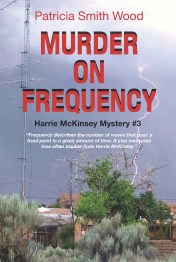
A New Mexico Mystery Review: Murder on Frequency by Patricia Smith Wood

murder-on-frequency

A New Mexico man long missing and presumed dead seems to have come back to broadcast on ham radio, only to fade out as if something terrible has happened to him.

Patricia Smith Wood has crafted another tight puzzle of a mystery in this third in the Harrie McKinsey series, once again blending multiple mystery genres—a touch of cozy, a touch of police procedural, and now a touch of the PI story as well. Amateur sleuths Harrie and Ginger, the Albuquerque police department, and the FBI come together on a complex case with help from a new character, private investigator Bernie Thomas, a former member of the APD. His role as a liaison between the professionals and the amateurs is an effective device. The amateurs take some risks, and they use their brains and their ability to gain trust and talk with people, but they don’t do what’s better done by the pros.

Harrie and Ginger, who are studying to become amateur radio operators, are naturally and believably drawn into investigating the apparent broadcast from the missing Alan Whitney. I like a mystery that gives me glimpse into a hobby or occupation I previously knew little about, and this book provides a fascinating exploration of amateur radio without ever losing the pace. Wood slips the exposition into the energetic dialog as part of a page-turning plot.

 Much of the detective works, realistically, takes place through interviews, asking the right people the right questions, and through research and the use of creative intelligence to understand the clues. Most of the violence takes place offstage, though there are suspenseful scenes in which danger threatens characters the reader comes to care about. While this isn’t in the category of a humorous mystery, there is humor in the characters’ banter, and one of the criminals was an incredibly amusing diversion. He’s a bit like someone who walked out of a 1940s black-and-white movie in a way, and yet also wholly original.

 Wood is the master of the chapter-ending hook that makes you want to keep going. Surprises kept coming around the corner right to the very end. If you like to challenge your brain to solve a mystery, Patricia Smith Wood is an author you’ll come back to again and again.

To read more about this author, see my interview with her and my reviews of her first two books, The Easter Egg Murder and Murder on Sagebrush Lane


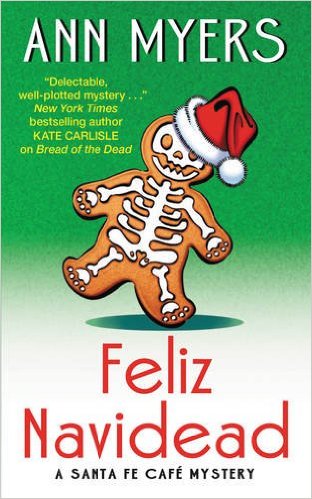
A New Mexico Mystery Review: Feliz Navidead

feliznavidead-cover

This third installment in the Santa Fe Café mystery series is tightly plotted, funny, and as full of local color and eccentric characters as the others. Ann Myers does a great job with the flow of the series—neither too much nor too little backstory. It’s a delicate balance that not all series authors have mastered. A new reader could pick this up and not be lost, and someone who has followed the series can enjoy it without any sense of interruption.

Protagonist Rita Lafitte’s rather conventional mother is visiting her in the City Different, encountering Rita’s eccentric friends and colleagues, hot chiles, devils in a Christmas pageant, and of course, Rita’s odd luck—if one can call it that—of running into murder scenes. There is some dark humor in the choice to set a murder in the middle of Christmas festivities, but it works. There’s also plenty of light humor, character-based and authentic.

The mystery revolves in part around the process of repatriating an old family collection of Native artifacts to their tribes. The conflicts in the wealthy heiress’s family—which includes Rita’s ultra-Santa-Fe-spacey-spiritual neighbor Dalia—and between the experts hired to help with the collection lead down some twisting paths, while several intriguing side plots make for more suspects and more motives. I was right in step with Rita in trying to solve the mystery, which to me means it was set up well.

Rita and café owner Flori’s amateur sleuthing is written to effectively make the reader suspend disbelief, an important aspect of this genre of mystery. Their interaction with Rita’s ex, Manny, who is so often the cop on the case when she’s investigating on her own, is well done. Manny isn’t all bad, and neither is his police work. He comes across as a competent if sometimes annoying officer, and a caring father as well as the kind of man you wouldn’t want for a husband. Celia, Rita’s artistic teenaged daughter, gets involved in the sleuthing this time, a fun change of pace. I love the relationships in this series, so it was great to meet another member of Rita’s family with her mother’s visit. It was also good to see how her romance with criminal defense lawyer Jake Strong develops. Jake’s character is given more depth and flair in this story. I got to know him better and therefore liked him better.

One thing I especially enjoyed about this book is that it gets outside of the downtown area into some other neighborhoods of Santa Fe, while still giving a view of holiday events around the Plaza and Canyon Road. (I expect it will make quite a few readers want to schedule a Christmas vacation there.) The diverse characters include one of Flori’s old schoolmates—another peculiar octogenarian—and her grandson. To avoid spoilers, I will say no more about them, but they were my favorite new additions to the cast of this series. And Flori’s latest weird hobby is her best yet. As always, there are recipes for some of the foods that are served up during the course of the story. I enjoyed the plot so much I tended to forget the culinary theme, but readers who love to cook will not. (Actually, the fact that I hate to cook and still enjoy these books so much says a lot.)

Other books in the series include Bread of the Dead and Cinco de Mayhem. Click on the titles to see my reviews, and on the author’s name for my interview with Ann Myers.


A New Mexico Mystery Review: The Pot Thief Who Studied Einstein

tptwseMy delight in reading the Pot Thief books never fades. As I dive into each story, I find something cozy and familiar and yet full of surprises, a quality much like pot thief Hubie Schuze’s happy hour conversations over margaritas with his friend Susannah.

This book has the best opening I’ve read in years. It sets the tone, revealing Hubie’s sense of humor, while introducing the instigating event for the mystery immediately. “I was trying to remember if I’d ever been blindfolded before. I didn’t think I had, but the cloth over my eyes felt vaguely familiar, almost nostalgic. I couldn’t imagine why. The only images I could connect with blindfolds were kidnappings.”

 Hubie is brought in this mysterious way to appraise a pot collection. In that collection, he finds something that shouldn’t be there. And the appraisal fee gets sneaked out of his pocket on the return trip. The lengths he goes to in order to get it back are clever (and illegal) and get him into trouble for something he didn’t do: kill the pot collector. An unexpected new romance results from his attempts to sort out his situation.

Orenduff does something I’ve seen one other author do successfully (Martyn V. Halm, in his Amsterdam Assassin thriller series, which in all other ways is as different from the Pot Thief series as it could be, though just as good). He inserts interludes. These are short chapters which tell a story within the story, about a personal aspect of the main character’s life. These interludes are few, well-crafted and beautiful, revealing details about life in New Mexico and showing Hubie’s appreciation of old friends and of the place he lives. They aren’t unnecessary, though it may sound as if they are. The nature of these books is such that this is the pace. This is the personality. There is suspense, but it’s suspense from the point of view of a man who has some amusing opinions that he freely shares, and who savors the taste of life, from traditional New Mexican cooking and Gruet champagne, to friendships, the scenery on Sandia peak, and the unexpected companionship of a funny-looking dog.

As always, the story is full of fascinating information about what Hubie is studying. The book he’s reading on Einstein and quantum physics plays a key role in the plot and in his thinking, as he struggles to understand the uncertainty principle and figure out who really killed the pot collector.

If you haven’t started this series yet, begin at the beginning and make friends with Hubie in The Pot Thief Who Studied Pythagoras.

I’ve also reviewed the most recent book in the series, The Pot Thief Who Studied Georgia O’Keefe, and had the pleasure of interviewing the author, J. Michael Orenduff.


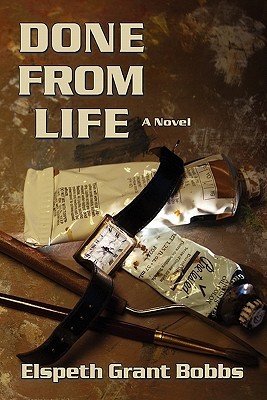
A New Mexico Mystery Review: Done From Life by Elspeth Grant Bobbs

done-from-life

Art and Murder in 1950s Santa Fe

 Rumor has it that a number of the characters in this book are based on real people who were part of the art scene in Santa Fe in the fifties. The author was part of that scene, married to an artist, but she didn’t write the book until 2011 when she was in her late eighties. Her ability to immerse her perspective in a fifties mindset without a single slip or anachronism is impressive. It makes the book fascinating and often startling, as the narrator, feisty young Mary McIntyre—Mac to most people—takes the sexism around her for granted, casually describes a fashion of the time as a “squaw dress” without the slightest sense that the word could be offensive, and tiptoes around the fact that someone is gay with what was no doubt open-mindedness and acceptance for those times. I’m not complaining about these features of the book; it’s realistic and well-done. The time period is neither romanticized nor denigrated, shown as it was in society overall, and in particular in Santa Fe (fictionalized as Villa Real, part of the city’s full name, La Villa Real de la Santa Fe de San Francisco de Asis, the Royal City of the Holy Faith of St. Francis of Assisi).

The characters are irresistibly both likeable and flawed, none of them fatally. Except, of course, one—the killer. Mac, who moved to Santa Fe for her health after spending time in a sanitarium (a true-to-life aspect of fifties New Mexico), works for the local art association. Three of its senior members, established artists, have recently died in accidents. During her illness, Mac read a lot of mystery novels to pass the time. For a lark, she and her neighbor, struggling artist Bill Thorpe, start plotting a mystery novel as if the deaths had been murders. Then, the more they think about it, the more they suspect it’s what really happened. Mac’s problem: she knows and likes all the suspects. Including Bill.

As Mac recovers her health and her looks, she basks in male attention, not hesitating to date two men at once, one of them married, taking unabashed pleasure in the situation and at the same time learning more about the murders that the police are sure were accidents.

As I read, I absorbed new information about an artist’s life and work, got a feel for a city I know and love as it was sixty-odd years ago, and enjoyed working out the puzzle in Mac’s engaging company. I suspected who had done it, but not how or why, though all the clues were well laid. So were the red herrings. Bobbs handles what is normally the worst scene in any mystery—the confession scene—with genuine originality, eliminating almost all of the clichés. At the end, Mac’s decision how to handle her knowledge is morally ambiguous, but her reasoning is clear.

A special charm of this book, for those who know Mrs. Bobbs’ contributions to Santa Fe, is that Mac’s hobby is gardening. Mrs. Bobbs’ gardens at La Querencia are legendary, making her a Santa Fe Living Treasure. The gardens, in fact, are her claim to fame, and it’s quite possible there are many people who know of her for this achievement and don’t realize she wrote a mystery.

In lieu of the usual author interview, I’ve linked to a blog post that features pictures of the author’s gardens and to a wonderful article from New Mexico Magazine that is better than anything I could have done. After reading it, I felt as if I’d spent time in Elspeth Grant Bobbs’ delightful presence. Enjoy.

I do have to point out a shortcoming in this book. I wish the copyeditor had done justice to it. Sunstone Press should have someone who is more attentive to detail do it over, fixing simple things like run-on sentences, a few unclear lines of dialog, etc. that the original editor should have corrected before publication. These oversights annoyed me considerably at first, but I became so immersed in the story that although I still noticed the problems, I ceased to be so distracted by them.


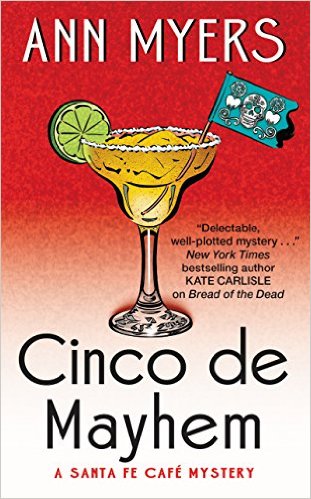
A New Mexico Mystery Review: Cinco de Mayhem

CincoCoverImage

The story begins with a green chile and cheese soufflé—spicy, light and airy, and at risk of sudden collapse, setting the tone for a comic culinary mystery. Rita Lafitte and her colleagues at Tres Amigas, the Santa Fe café of the series title, get involved in solving a murder again. The victim is a petty, arrogant bully, a restaurateur and food cart operator who made enemies of all the other food cart owners in the city. Not an easy death to care about except that a friend of Rita’s is being framed for it. Linda Santiago, the unlucky accused, is a wonderful, original character from the first book who doesn’t fit any mold or any of the standard roles in a comic mystery. Another complex, intriguing and believable character is the multi-faceted Don Busco, hotdog vendor and raconteur. Others are more broadly drawn and provide great comedy, especially Addie, with her delightfully eccentric fantasies of being British, and eighty-something Flori with her flirtatious ways, her sleuthing hobby and her new fascination with Sun Tzu’s Art of War. They are wildly colorful, but not to the point of being impossible. Someone just might feel free to be that odd in The City Different.

It was good to see Rita still connected to the memory of Victor from the first book in a natural flow of her personal story from one book to the next, and to watch how her budding romance develops. Her relationship with her daughter is an ongoing part of the series that adds depth and realism and of course the inevitable humor and conflict of parenting a teenager.

I got a kick out of the arrival of a flamboyant professional thief and his role in the plot. With the high rate of burglaries and thefts in Santa Fe, he may have strong future in the series. There are only 2 or 3 murders a year, but people like him have a thriving occupation.

The setting is brought to life, though only a very small portion of the city is featured. The writing is tight and polished, digressing only for the food-related tidbits that narrator Rita and culinary aficionado readers would find irresistible. With several subplots and red herrings, the plot was paced to keep to me turning the pages even after I figured out the killer’s identity. The revelation scene was the only weak point. Even though almost every mystery handles it this way, I’m not a fan of this particular genre convention and love it when authors find another option for getting closure on the crime. The final ending was satisfying, however. And of course, there are recipes for some of the foods featured in the story, including the thematic soufflé that frames the tale.

To learn more about the series, you can read my review of Bread of the Dead and my interview with Ann Myers, and check out her web site.

A New Mexico Mystery Author Interview: Pari Noskin

Clovis_frtRecently I reviewed The Clovis Incident, the first Saha Solomon mystery, and today I’m happy to have the author, for an interview. Pari Noskin (aka Pari Noskin Taichert) garnered two Agatha Award nominations for her first mystery series originally from the University of New Mexico Press. Like her New Mexico heroine, Sasha Solomon, Noskin is a multi-year veteran in the PR industry. Her first three books are: The Clovis Incident, The Belen Hitch and The Socorro Blast. She is also founder of the Anthony-nominated blog, Murderati.com, and a national award-winning freelance features writer. In her new series, featuring television personality and psychic Darnda Jones, Pari leaves the comforts of the familiar and explores what it means to be truly connected to the natural world, to understand other creatures’ perspectives. That’s because Darnda is much more interested in communicating with non-humans than most people she knows. Don’t worry, Pari isn’t anti-social. She enjoys hearing from her readers whenever they take the time to send her a line!

*****

AF: I noticed in your notes at the end of the The Clovis Incident that many people in Clovis helped you witthe book. What it was like bringing this idea to them? Any favorite stories from your research?

PN: People ranged from amused to moderately concerned. One of the things that really has struck me through writing the first three Sasha books and working on the fourth is that my ideas about PR and marketing, of the places about which I write, often mirror what city councils and local tourism departments are already discussing. This was true a bit in Clovis; some people really wanted to cash in on the UFO angle. It has been even more striking with my subsequent books.

A favorite research story? Hmm. I learned a lot during the writing of this first book in the series. One important thing was that it takes time and knowing the right people to get at the kinds of information I wanted. I was fortunate enough to speak with some city leaders and influencers who were quite frank with me. I don’t know if they liked the final product, however. It seems to be much more popular with people who have either lived in and moved away from Clovis or live close by but not in the city itself. That said, it has sold very well there.

AF: I know nothing about the PR field so I found Sasha’s work fun to read about. She comes across as a creative risk-taker, someone who enjoys the gamble of bidding for a free-lance job over the security of something steady. Has your PR experience helped you as an author in addition to making it Sasha’s profession?

PN: My PR experience spans well over 30 years and it has been tremendously helpful in my professional and writing life. PR forces one to always consider the perspective of the audience. I don’t write to audience, per se, but I think about how my words and stories’ structure affect the end product… the telling of the tale.

I did work as a freelancer for several years. It was a great experience in forcing organization and nurturing a continual moxie when it came to thinking about projects — how to get them done and what angles would be most effective.

AF: I have a partially-formed urge to visit Clovis after reading this book, though I’m not sure why. If I follow up on it, what would you recommend?

PN: I don’t know if I’d recommend going there nowadays. One challenge in writing about local restaurants and other businesses is that things change. Life rolls on. The Clovis Incident was published long enough ago that I suspect there are far more changes than constants in that city. Roswell has changed quite a bit too.

AF: The next books in the series feature Socorro and Belen. What made you choose these locations? And Clovis?

PN: This may sound strange, but I write about places that have an identifiable personality and human center: a there there!  I can tell pretty quickly if a town or area will yield the kind of spirit and flair that will intrigue me and make a great location for a story. I also always start with a much deeper theme than what many readers ever perceive — with a big question that I want to explore. Some people never realize what I’m doing because they focus on the humor and the speed of the story. Other’s “get it.”

Belen with its artistic center and great aspirations for tourism made me look at questions around “What is art?” “Who has the right to define it?” And Socorro, with NM Tech there, was a fabulous place to explore the themes of interpersonal as well as national prejudice and intolerance …

I always fall in love with the places about which I write, too.

AF: What is your favorite place in New Mexico and why?

PN: Not fair. I love many places here. I’m a native through and through—born and raised in NM—and I know there are so many locations to discover. You know what my favorite place (characteristic) is in NM? It’s the space … the ability to drive for just a few minutes outside of ABQ or any other town and be in the middle of all of this glorious, stunning, gorgeous land. I love the colors of this often parched land, the hues of yellows, browns, pinks, reds, blues … I love that we can be right next to ancient history without expending much effort: the ruins of old pueblos, Tres Piedras’ petroglyphs, old towns, plazas, wonderful old cemeteries.

Driving around NM, I always wonder about the people who passed before. When I see a solitary road going off into the distance, I wonder who might live there, what life would be like in the middle of this possibility in a basically harsh environment. I find all of New Mexico, especially outside the cities, incredibly inspiring and intriguing.

AF: This is off the wall, but then the whole book is (in a good way). Do you speak Cantonese? I may have taken more interest in this than some readers, but I studied Mandarin for a year and had no idea how different it was from Cantonese until I read the scenes in which Sasha brushes off her language skills. From this and from the way you blended Buddhist beliefs about the dead into the story, I got the impression you were well-acquainted with Asian cultures. What’s your background in this area?

PN: That’s a fun question. Thanks for asking. I earned my undergraduate degree at the University of Michigan in Asian Studies and lived in Hong Kong for almost a year as a college student. Asian philosophy has interested me for decades; it also helps that my mother collected Asian antiques so I grew up learning about these cultures. Also, I’ve always been interested in other languages as windows into the way other cultures think and perceive the world. I’ve studied seven so far.

AF: In The Clovis Incident, Sasha meets some apparently sane, coherent, functional people (as well as some who are more on the fringes) who claim to have encountered aliens. Tell me about your sources for this material.

PN: All of the characters came straight out of my odd imagination. I study people and so some did remind me of folks I met along the way. But I made every single one of them up — from cell to cerebellum.

AF: When you start a book, do you know how it ends? What’s your creative process like?

I never know the ending. I really admire people who outline and know where their writing is going. I’ve tried. Believe me, I’ve tried. But I have to just jump in and start writing and see where the story and characters take me. It’s not a very efficient way to write and I end up throwing away a lot of words and concepts — far too many — but no other way works for me. I love the process of discovery and am grateful that I enjoy editing too.

AF: What are you currently working on?

PN: I’m actively working on the second book in my Darnda Jones series. The first one, Stung, is available electronically and will be, eventually, in print. Darnda was born in the Sasha series and I liked her so much I wanted to know her better. She is a psychic/telepath who works as a professional “pest controller” and has a television show doing just that. What makes her especially interesting is that she cares far more for insects, animals and most plants — and for the natural world and health of our planet — than she does for most human beings. She’s a deep and wonderful character. I really wish I knew someone like her.

Does it say something weird that I’ve actually created one of my own best friends?

Also, I’m part of a writers’ collaborative now, Book View Café, and we serve as a publishing house for each other. All of us are multi-published, so the quality of all of our work is very high. I like the independence of this model — rather than more traditional models — and the fact that I can write what I want rather than what might be expected. I’m also working on the next Sasha book. It is located in Las Cruces, NM and explores the chile pepper industry and organic vs big agriculture.

AF: Thanks for being my guest. I look forward to discovering Darnda.

*****

Follow Pari Noksin on Goodreads  and on Facebook .


A New Mexico Mystery Review: The Clovis Incident

Clovis_frt

Until I read this book, all I knew about Clovis was that it was home to the Norm Petty recording studio, where Buddy Holly recorded his hits. It’s not one of New Mexico’s more famous places and seems unlikely ever to be one. This makes the premise of the book immediately appealing. Freelance PR pro Sasha Solomon is trying to get a gig promoting flat, unimposing Clovis as tourist destination.

She was doing PR for a health care company that included alternative therapies in it coverage, and in true Albuquerque/Santa Fe area style, she tried out so many shamans and other mind-body-spirit healers she had a kind of psychic meltdown, making her mental boundaries so porous she now hallucinates under stress. She’s been fired, and she needs the Clovis job.

The story gets more and more eccentrically New Mexican as Sasha looks into alien abductions as part of her PR plans to promote alien-seeking tourism in Clovis, (Her visit to alien-centric Roswell is a small but delightful part of the book.) Alien abductions also figure in a murder investigation, as do Sasha’s strange visions, when the body of a Singaporean military officer is found on a friend’s land.

The less colorful aspects of life in Clovis, from the military base to the farms and ranches, are portrayed with respect and realism in the framework of a humorous mystery. In a crucial scene set in the midst of a large-scale dairy farm, suspense and comedy run neck in neck.

Author Pari Noskin captures characters brilliantly, whether they are major players or walk-ons. Sasha is an original creation, likeable but far from sweet. Detective LaSalle grew on me. The longer Sasha had to deal with him, the more he was revealed in the slow, natural way strangers get to know each other.

Underlying themes include mother-daughter relationships, friendships, rural life, and romance in middle age, tied together through the mystery and laced with an inside look at the PR business. The mystery is multi-layered with so much entertainment that I sometimes forgot to try to solve it. I know a book is working when I respond to it as a story rather than a plot. It turns out that I did suspect the real culprit, but I never felt that the author had made it too easy to figure out.

Noskin turns some off-beat phrases, with a style unlike any other. Aside from Sasha’s appalling habit of taking shots of whipped cream straight from the can, I thoroughly enjoyed every page.

*****

My interview with the author will be posted in the next week to ten days. Meanwhile, you can buy the book and enjoy an unconventional trip to Clovis.

A New Mexico Mystery Author Interview: J. Michael Orenduff

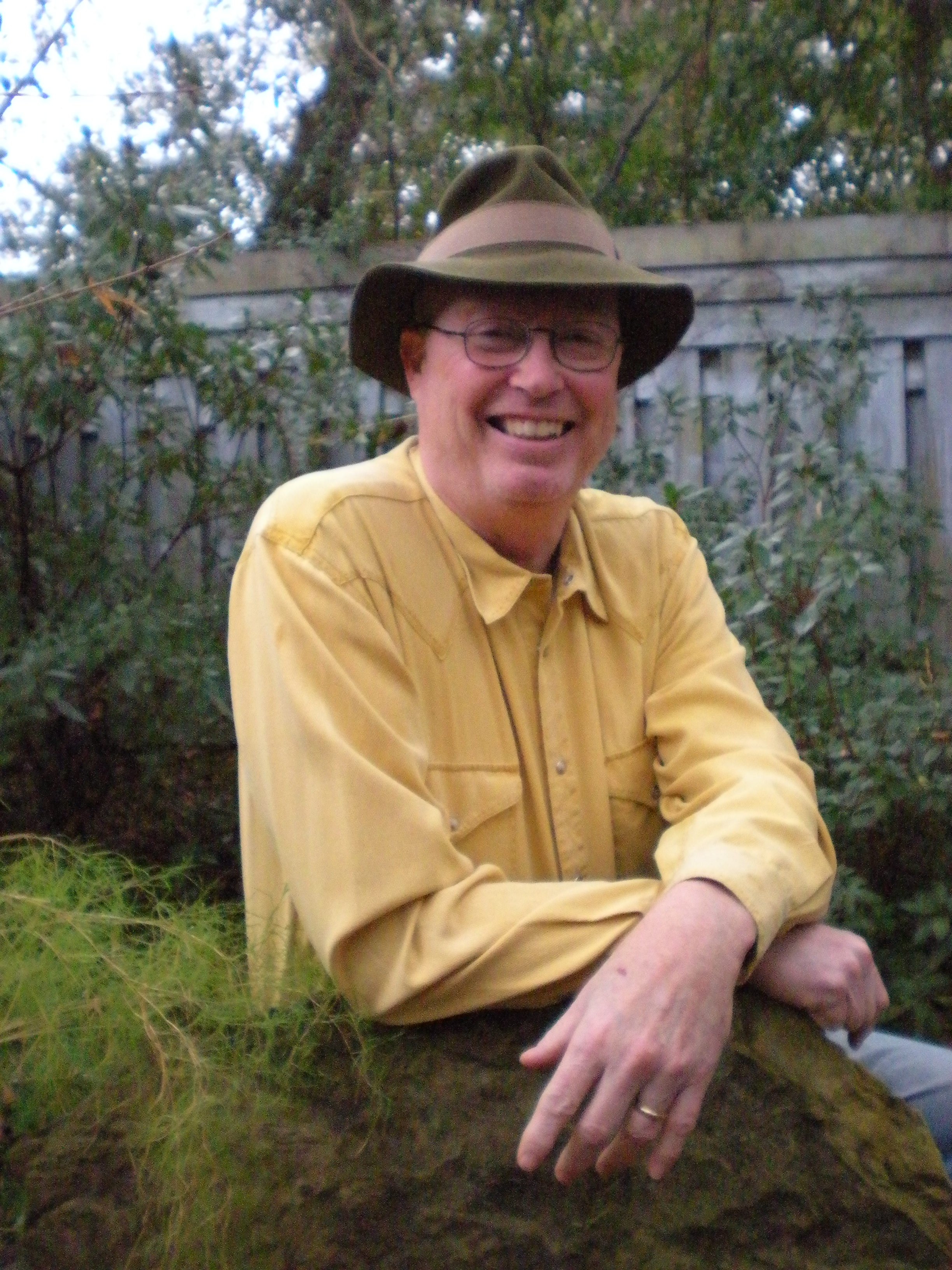
author 1.53mbO'Keeffe cover 3

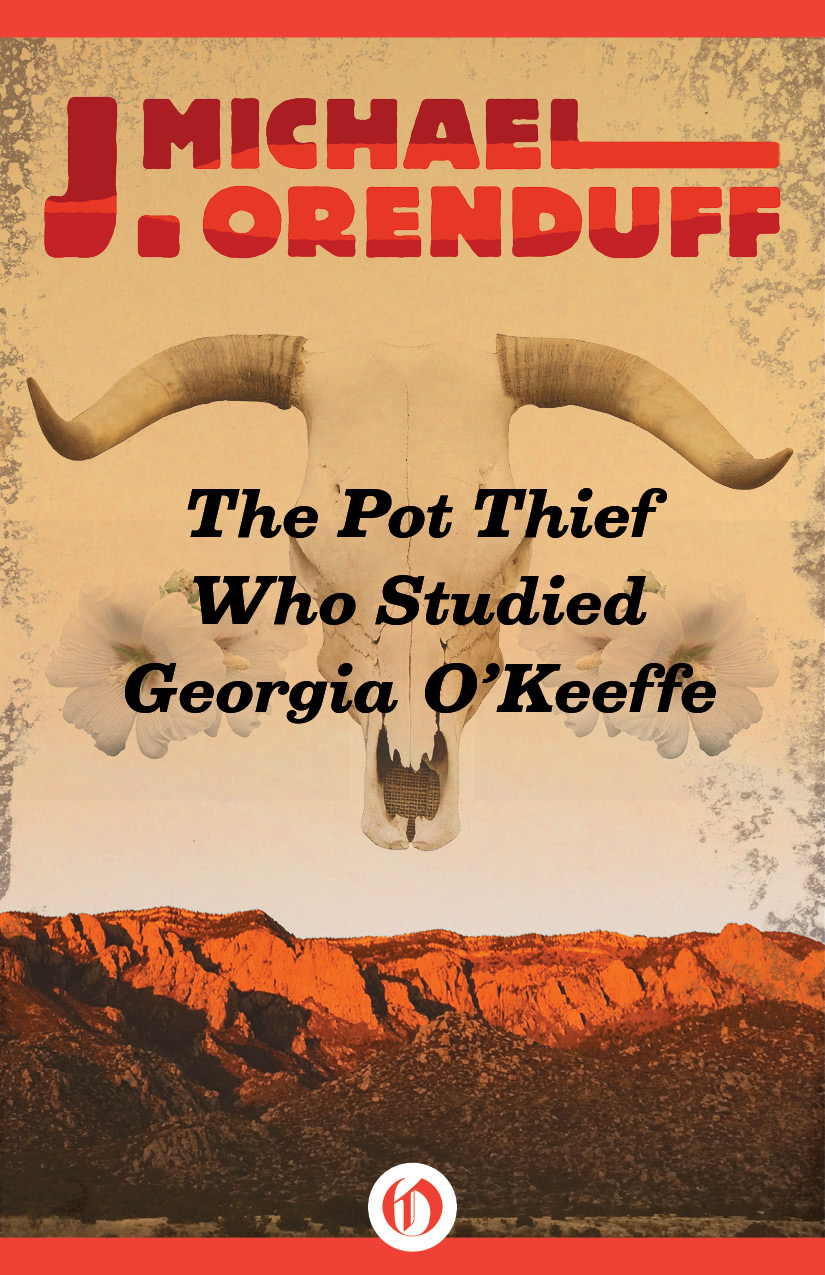
Last week I reviewed the Pot Thief Who Studied Georgia O’Keefe.

https://amberfoxxmysteries.wordpress.com/2016/01/01/a-new-mexico-mystery-review-the-pot-thief-who-studied-georgia-okeefe

I’m delighted to have the author as my guest today.

 Bio: Mike Orenduff grew up in a house so close to the Rio Grande that he could Frisbee a tortilla into Mexico. A former president of New Mexico State University, he took early retirement from higher education to pursue his career as a fiction writer. His many accolades as an author include the Lefty Award for best humorous mystery, the Epic Award for best mystery or suspense e-book, and the New Mexico Book Award for best mystery or suspense fiction.

AF: You’ve been a professor at various colleges. What did you teach? Which class did you most enjoy teaching and why?

JMO: I taught philosophy (primarily logic courses) and mathematics. The mathematics courses were what are now called developmental. They used to be called remedial, but someone decided that’s politically incorrect. That may be, but remedial is a more accurate description. It is no blot on students who are not skilled at math. Good math teachers are rare in the public schools, so students often show up at college unprepared for college level math courses. My courses were a remedy. My favorite teaching experience was the pre-algebra courses I taught at Central Wyoming College. Many of my students were from the Wind River Reservation. The most rewarding thing about teaching is not standing at the blackboard writing the steps of some arcane proof. It is having a student say, “I thought I couldn’t do math. But now I can.”

AF: What’s your favorite place you’ve lived outside of New Mexico? Could you share an anecdote or memory from that place?

JMO: I lived in La Serena, Chile for a summer while my wife was teaching at La Universidad de la Serena. It was an idyllic life. I shopped each day at the market for food and fresh flowers, both of which were waiting when my wife arrived home from work. La Serena is in the northern desert area of Chile, so it was like New Mexico except it’s on the Pacific Ocean. Albuquerque with a beach. And even more Spanish being spoken. Two of my favorite memories from northern Chile are seeing the southern cross in the beautiful clear skies and being stranded in a small fishing village twenty miles north of La Serena after travelling there in a collectivo (a taxi into which six people are crammed to go to a place with no bus service). It was easy to find a collectivo in La Serena, a large city. But Las Casetas was a village and had no collectivos. Hence, no means to return. As we stood by the road wondering what to do, a man in a small Japanese pickup pulled over and asked us if we wanted to go to La Serena. We crowded into a bench seat designed for two people and had a delightful conversation with him on the ride south. I offered to pay him. He declined. I offered to at least pay for his gasoline. He declined again, saying he was going there anyway, so no extra gas was being burned. He told us about his wife whom he obviously adored. When we arrived in La Serena, I finally coaxed him into accepting money by holding out enough pesetas to buy flowers and saying, “This is for flowers for your wife.”

AF: Your books make me want to pay more attention to very old Native pottery. What would be the best places to go for a (legal) pottery tour of New Mexico?

JMO: Of course the shops and museums in Santa Fe are the places most people associate with ancient Native pottery, but my favorite place is Western New Mexico University in Silver City. Their museum has the largest collection of prehistoric Mimbres Mogollon pottery and artifacts in the world, including pottery and artifacts of the Upland Mogollon, Casas Grandes, Salado, and Anasazi. And as an added benefit, you can tour the Gila Cliff Dwelling just north of town and see artifacts in situ and where the people lived who made them.

AF: You share my love of T or C. I noticed that every place you mention there is real. What about the places in Albuquerque? I found myself guessing that every location except Hubie’s shop might also be a real place, but I seldom dine out in Albuquerque so I’m not sure. Are they? What’s behind your decision to use actual places rather than fictitious versions of them?

JMO: You guessed it. Every place is real. The only fictional ones are Hubie’s shop and Dos Hermanas. All the other places are real, even Sharice’s condo. Georgia O’Keeffe said that she preferred painting flowers instead of models because flowers, “are cheaper and they don’t move.” I prefer real places because it’s easier to describe them than to make up new ones. And I like to give them free publicity.

 AF: What made you choose the White Sands Missile Range for Hubie’s latest pot thieving adventure?

 JMO: There were several reasons. Perhaps the most interesting one is a real event that happened there is 2001. A man hunting Oryx found a Chupadero black-on-white water jug dating back to around 1300. Where else could that happen? Especially the Oryx part.

AF: Why Georgia O’Keeffe in the title?

 JMO: After starting out with a bunch of dead white males with no connection to New Mexico, I finally tumbled to the realization that I should use people with NM connections such as D. H. Lawrence. Then I decided a woman in the title would be good. And I chose O’Keeffe because she is strongly identified with NM but also because I had a small personal connection with her. In 1985, I was serving as the academic vice president at West Texas State University, known as West Texas State Normal College when Georgia O’Keeffe taught there from 1916 to 1918. We were celebrating the 75th anniversary of the school’s founding and looking for something to make the event special. I decided we should ask O’Keefe to grant us the right to make prints of a painting she had done while teaching there and allow us to sell those prints to fund scholarships. I gave the task of approaching Ms. O’Keeffe to my wife, whose charm and grace were best suited to the task. And it helped that she is also an artist and an art historian. O’Keeffe granted her request. So Georgia O’Keeffe helped me raise scholarship funding and also inspired me to write the latest book in the series.

 AF: Who are your favorite mystery writers? What is it that makes them stand out?

JMO: In no particular order and with apologies to the many others whom I like but didn’t pop to mind: Simon Brett, Michael Bond, John Mortimer, Mary Jane Maffini, Aaron Elkins, Carl Hiaasen, Leann Sweeney, Lawrence Block (but only his Bernie Rhodenbarr series), and Tim Hallinan (especially his Junior Bender series). What makes them stand out is clever humor.

AF: Did you know you were going to write a series when you wrote the first Pot Thief book? Which book in the series was the most challenging for you to write and why?

JMO: I knew it was to be series, but I didn’t know the titles would all start with The Pot Thief Who Studied…. In fact, the working title of the second one was The Pot Thief Who Gazed at the Stars. What was I thinking?

The first was the most challenging because I had to create everything from scratch. The rest somewhat less so, but I try to have the characters grow and develop as people do in real life.

AF: Any idea what the pot thief will study next?

 JMO: Edward Abbey. Like Hubie (and me), he was a graduate of the University of New Mexico.

AF: One of my favorite writers—and a good match with Hubie. I look forward to it.